DC motor | Working-2 | Single loop | DC Machines | Lec-05
TL;DR
This content explains the operation and equations related to DC motors, including back EMF and power relations.
Transcript
hello everyone in the last session we discussed about the single loop dc motor you know that a dc motor it will take electric power and it will give the mechanical power we should discuss about the operation and the operation is like this and we will continue the continuing the this topic with some equations so in that finally generally the armatur... Read More
Key Insights
- 🦾 DC motors effectively convert electrical energy into mechanical energy through electromagnetic interactions.
- 🖐️ The operation involves generating back EMF, which plays a critical role in stabilizing motor performance and efficiency.
- 🤩 Key equations support understanding the relationships between input voltage, back EMF, and armature current in determining power dynamics.
- ✊ Electromagnetic torque is a vital concept that correlates mechanical power with the rotational speed of the motor.
- 🔙 The commutator is essential for ensuring continuous torque generation by converting AC from the armature into usable DC.
- 🦻 Back EMF resistance against supply voltage aids in controlling current and preventing damage to motor components.
- ✊ The relationship between torque and power illustrates how performance can be manipulated through electrical input and mechanical output.
Install to Summarize YouTube Videos and Get Transcripts
Explore YouTube Video Summarizer or Get YouTube Transcript Extractor
Questions & Answers
Q: What is the primary function of a DC motor?
A DC motor primarily converts electrical energy into mechanical energy. It takes in electric power and outputs mechanical power through rotation driven by the interaction between the magnetic field and the current in the armature conductors.
Q: How does back EMF affect the operation of a DC motor?
Back EMF, or back electromotive force, is generated in a DC motor as the rotor rotates. It opposes the supply voltage, limiting the armature current and regulating the motor's speed. This self-generated voltage is crucial for maintaining stable operations and preventing motor overheating.
Q: What equations are used to describe the input and output power of a DC motor?
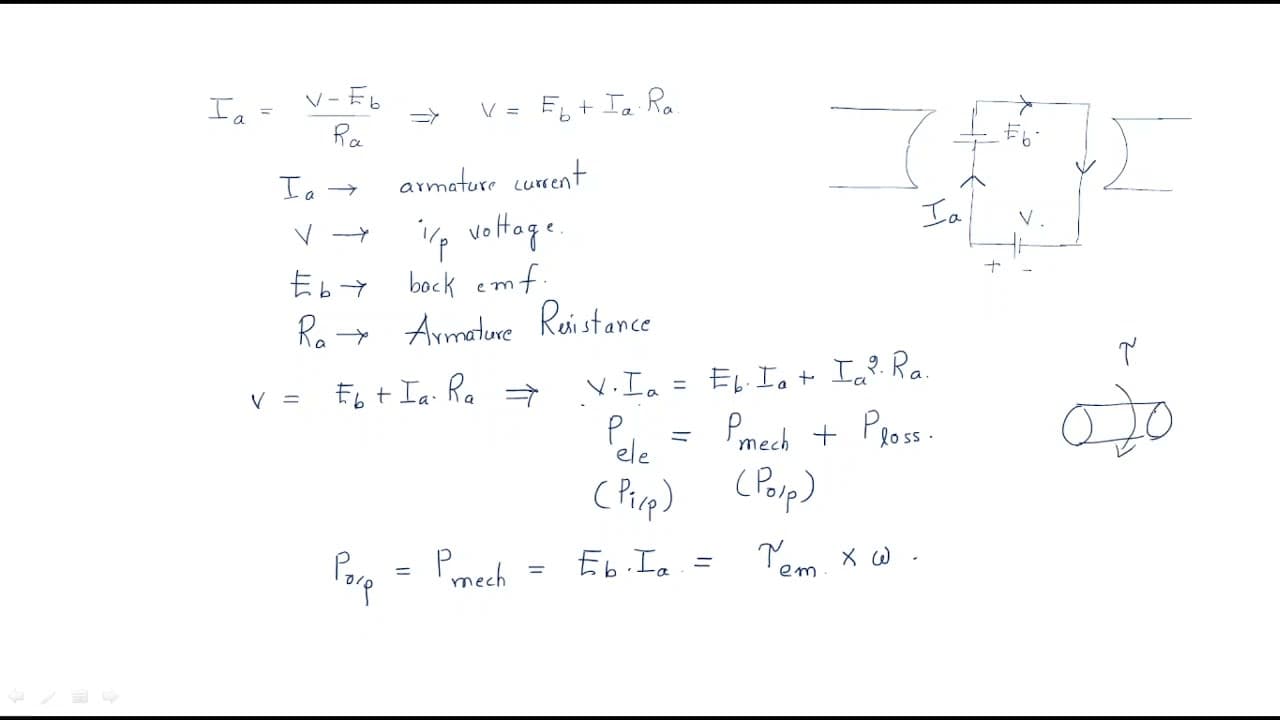
The main equation governing power relates the supply voltage (V) to back EMF (Eb) and armature current (Ia) as V = Eb + Ia * Ra, where Ra is armature resistance. From this, input power is derived as V * Ia, and output mechanical power can be expressed as Eb * Ia, indicating efficiency losses through heat.
Q: How is electromagnetic torque related to a DC motor's operation?
Electromagnetic torque in a DC motor is produced when current flows through the armature within a magnetic field. This torque is directly proportional to mechanical power and the motor's speed, described by the equation Torque = Mechanical Power / Speed, showcasing the dynamic relationship between motor components.
Q: What role does the commutator play in a DC motor?
The commutator in a DC motor rectifies the alternating current generated in the armature windings into direct current. It ensures that the torque produced always remains in the same direction, allowing for continuous motion and operation of the DC motor.
Q: Can you explain the difference between angular and rotational velocity in the context of a DC motor?
In the context of a DC motor, angular velocity refers to the speed of rotation measured in radians per second (ω), while rotational velocity is typically referred to in revolutions per minute (n). Understanding these velocities is crucial for calculating motor dynamics and performance characteristics.
Summary & Key Takeaways
-
The discussion begins with the basics of DC motors, focusing on their ability to convert electrical power into mechanical power while mentioning the significance of back EMF during operation.
-
Key equations governing DC motor operation are presented, detailing the relationship between supply voltage, back EMF, and armature current to understand input and output power.
-
The importance of electromagnetic torque and its relation to speed are highlighted, alongside the understanding that back EMF can be represented as an alternating current with a specific frequency.
Read in Other Languages (beta)
Share This Summary 📚
Summarize YouTube Videos and Get Video Transcripts with 1-Click
Try YouTube Summary with ChatGPT & Claude or YouTube Transcript Generator