Lecture 7: Origami is Hard
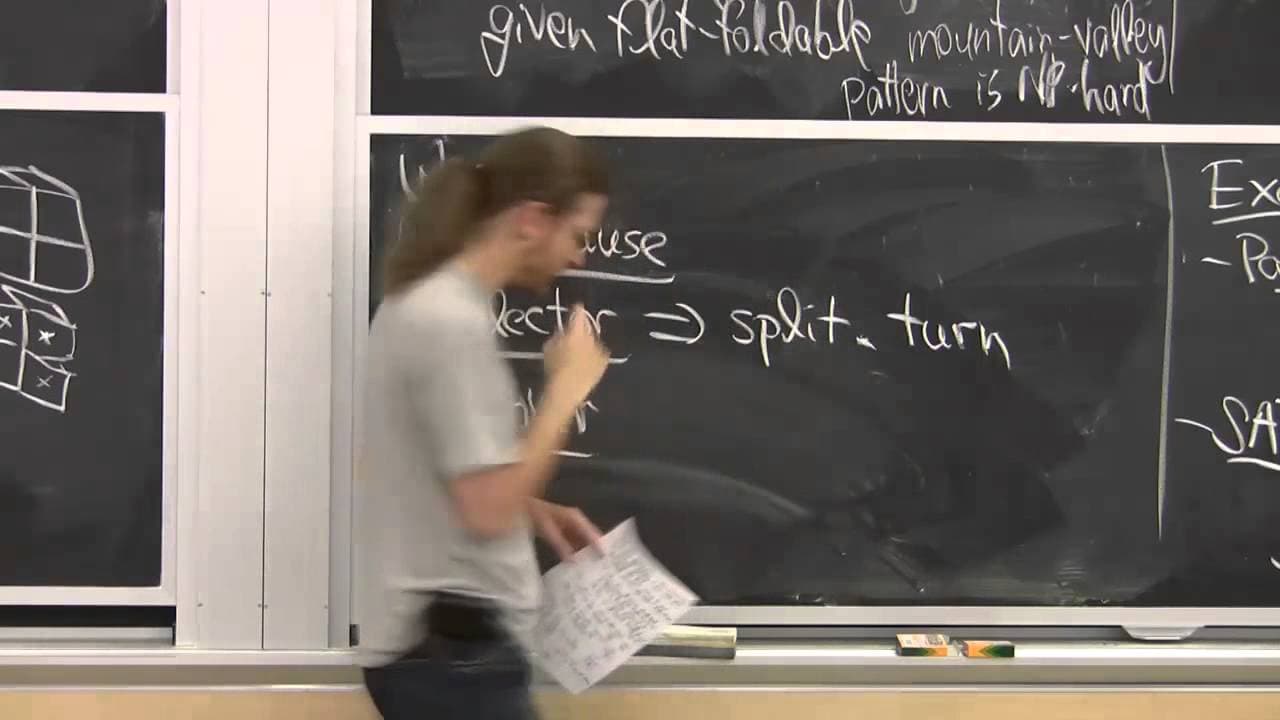
TL;DR
Origami design explores universal hinge patterns and NP-hard problems.
Transcript
PROFESSOR: Continue today. We're still in the spirit of origami. And we're going to do some origami design and foldability again. There are two main topics here on the design side we're going to talk about-- universal hinge patterns, which are the things that make underlying this robot, which I showed in lecture one. You may recall. So it's called ... Read More
Key Insights
- Universal hinge patterns are designed to allow a single pattern to fold into various shapes, like polycubes, by using a subset of creases.
- Origami problems can be computationally intractable, with several being NP-hard, meaning no efficient algorithm exists to solve them.
- The concept of NP-hardness in origami indicates that certain folding problems cannot be efficiently solved, similar to well-known computational problems.
- Simple folds in origami, while appearing easy, can be NP-hard when additional complexity, such as 45-degree creases, is introduced.
- Flat foldability in origami, determining if a crease pattern can fold flat, is a complex problem and is also NP-hard.
- The NP-hardness of disk packing in origami indicates that finding the optimal way to pack disks into a square is computationally challenging.
- Gadgets in origami proofs, such as wires, reflectors, and crossovers, help illustrate the complexity and constraints of folding patterns.
- The reduction technique in NP-hard proofs shows that if a known hard problem can be transformed into an origami problem, the origami problem is also hard.
Install to Summarize YouTube Videos and Get Transcripts
Explore YouTube Video Summarizer or Get YouTube Transcript Extractor
Questions & Answers
Q: What are universal hinge patterns in origami?
Universal hinge patterns in origami refer to a design approach where a single pattern can fold into various shapes by using a subset of its creases. This concept allows for the creation of multiple structures, like polycubes, from one pattern, enhancing the versatility and efficiency of origami designs.
Q: Why are some origami problems considered NP-hard?
Some origami problems are considered NP-hard because they are computationally intractable, meaning there is no efficient algorithm to solve them. This classification implies that solving these problems, such as determining flat foldability or optimal disk packing, is as difficult as solving well-known hard computational problems.
Q: How does the concept of NP-hardness apply to simple folds in origami?
The concept of NP-hardness applies to simple folds in origami by demonstrating that even seemingly straightforward folding tasks can be computationally complex. When additional elements, like 45-degree creases, are introduced, the problem of determining foldability by simple folds becomes NP-hard, indicating significant computational challenges.
Q: What is the significance of gadgets in origami NP-hard proofs?
Gadgets in origami NP-hard proofs are crucial for illustrating the complexity and constraints of folding patterns. They represent components like wires, reflectors, and crossovers, which help demonstrate how origami problems can be transformed into known hard problems, thereby proving their computational difficulty.
Q: Can you explain the reduction technique used in origami NP-hard proofs?
The reduction technique in origami NP-hard proofs involves transforming a known hard problem into an origami problem. If this transformation shows that the origami problem can simulate the complexity of the known problem, it proves that the origami problem is also NP-hard, highlighting its computational intractability.
Q: What challenges exist in determining flat foldability in origami?
Determining flat foldability in origami is challenging because it involves complex computational problems. Even when a mountain-valley assignment is given, finding the correct layer ordering to achieve a flat fold is NP-hard, indicating that no efficient algorithm can solve this problem for all cases.
Q: How does disk packing relate to origami design?
Disk packing relates to origami design in the context of creating uniaxial bases, where the problem involves optimally packing disks of various sizes into a square. This problem is NP-hard, meaning it's computationally challenging to find the best packing arrangement, reflecting the complexity of certain origami design tasks.
Q: What insights does the lecture provide about the complexity of origami?
The lecture provides insights into the complexity of origami by exploring universal hinge patterns and NP-hard problems. It highlights the challenges in designing foldable patterns and solving computationally difficult tasks, such as flat foldability and disk packing, emphasizing the intricate relationship between origami and computational theory.
Summary & Key Takeaways
-
The lecture discusses the complexity of origami design, focusing on universal hinge patterns and their ability to fold into various shapes. It explores the idea of creating a single pattern capable of forming multiple structures, like polycubes, by selectively using creases.
-
Origami problems can be NP-hard, meaning they are computationally intractable and lack efficient solving algorithms. The lecture explains how simple folds, though seemingly easy, become NP-hard with added complexity, such as 45-degree creases.
-
Flat foldability and disk packing in origami are highlighted as NP-hard problems, demonstrating the computational challenges involved in determining if a crease pattern can fold flat or how disks can be optimally packed into a square.
Read in Other Languages (beta)
Share This Summary 📚
Summarize YouTube Videos and Get Video Transcripts with 1-Click
Try YouTube Summary with ChatGPT & Claude or YouTube Transcript Generator
Explore More Summaries from MIT OpenCourseWare 📚



Summarize YouTube Videos and Get Video Transcripts with 1-Click
Try YouTube Summary with ChatGPT & Claude or YouTube Transcript Generator