13: Spectral Analysis Part 3 - Intro to Neural Computation
TL;DR
This content covers spectral analysis techniques, including spectrograms and Fourier transforms, as well as various types of filters for signal processing.
Transcript
[AUDIO PLAYBACK] - Good morning, class. [END PLAYBACK] MICHALE FEE: Hey, let's go ahead and get started. So we're going to finish spectral analysis today. So we are going to learn how to make a graphical representation like this of the spectral and temporal structure of time series, or in this case, a speech signal recorded on a microphone. Well, a... Read More
Key Insights
- 💁 Spectral analysis techniques, such as spectrograms and Fourier transforms, provide valuable information about the frequency and temporal properties of signals.
- 🪟 Choosing appropriate tapers or window functions is crucial for accurate spectral estimation.
- 📡 Filters can be used to remove unwanted noise or isolate specific frequency components in a signal.
Install to Summarize YouTube Videos and Get Transcripts
Explore YouTube Video Summarizer or Get YouTube Transcript Extractor
Questions & Answers
Q: What is a spectrogram and how is it different from a spectrum?
A spectrogram is a graphical representation of the spectral and temporal structure of a signal, showing how the power in the signal varies over time and frequency. It is different from a spectrum, which shows the power or amplitude of the signal at different frequencies at a specific point in time.
Q: What is the time-bandwidth product and why is it important?
The time-bandwidth product is a characteristic of a signal that describes the trade-off between time and frequency resolution. It determines the width of the window used for spectral estimation and affects the accuracy of the spectrum. A smaller time-bandwidth product provides better frequency resolution, while a larger time-bandwidth product provides better temporal resolution.
Q: How can filtering be used to remove unwanted noise from a signal?
Filtering can be used to remove unwanted noise from a signal by applying specific filters, such as high-pass, low-pass, or band-pass filters. These filters suppress or allow certain frequency components in the signal, effectively removing unwanted noise or isolating desired frequencies.
Q: How can the Nyquist Shannon theorem be applied to signal processing?
The Nyquist Shannon theorem states that in order to perfectly reconstruct a signal, the sampling rate should be at least twice the highest frequency present in the signal. This is relevant in signal processing as it determines the minimum sampling rate required to accurately capture a signal's frequency content.
Summary & Key Takeaways
-
The content explains how to construct spectrograms, which show the spectral and temporal structure of time series data, such as speech signals.
-
It discusses the Fourier transform and power spectrum computation for signal analysis.
-
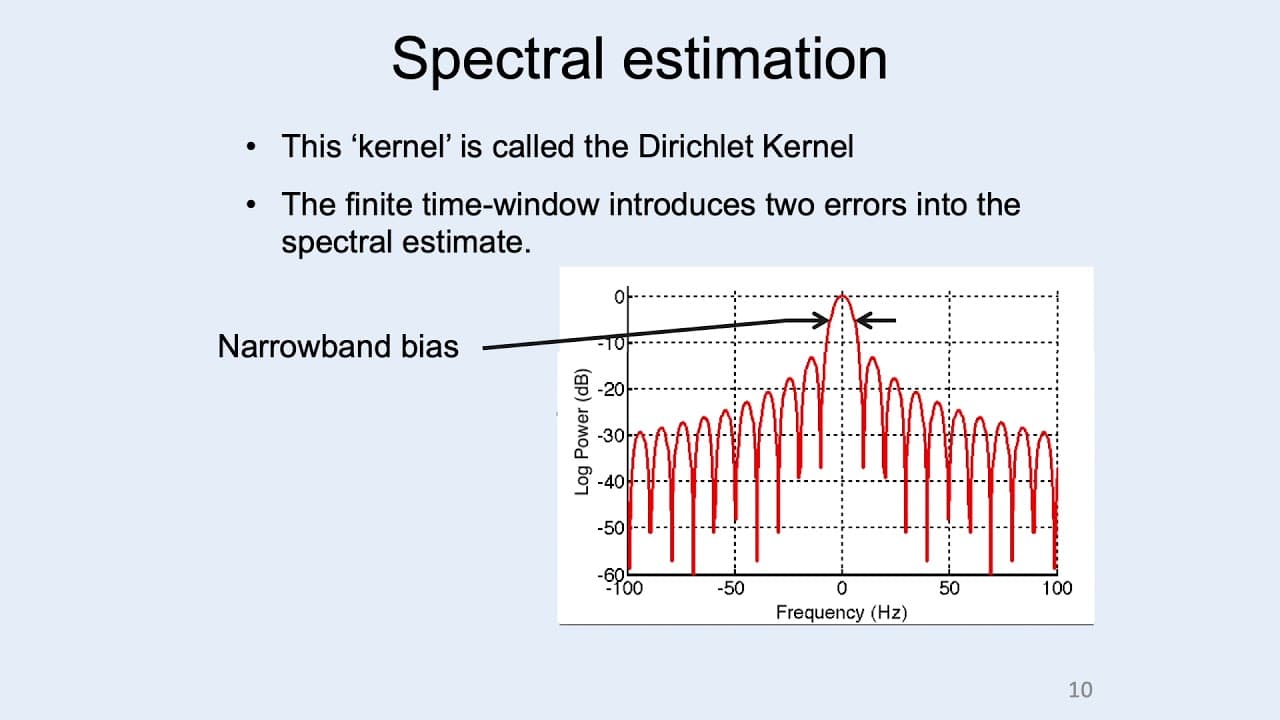
The content introduces different types of tapers and their effects on spectral estimation, highlighting the importance of choosing appropriate tapers for different types of signals.
Read in Other Languages (beta)
Share This Summary 📚
Summarize YouTube Videos and Get Video Transcripts with 1-Click
Try YouTube Summary with ChatGPT & Claude or YouTube Transcript Generator
Explore More Summaries from MIT OpenCourseWare 📚



Summarize YouTube Videos and Get Video Transcripts with 1-Click
Try YouTube Summary with ChatGPT & Claude or YouTube Transcript Generator