10.2 The Large Electron-Positron Collider
TL;DR
The content discusses the speed of particles in accelerators, focusing on the Large Electron Positron Collider at CERN and a small accelerator.
Transcript
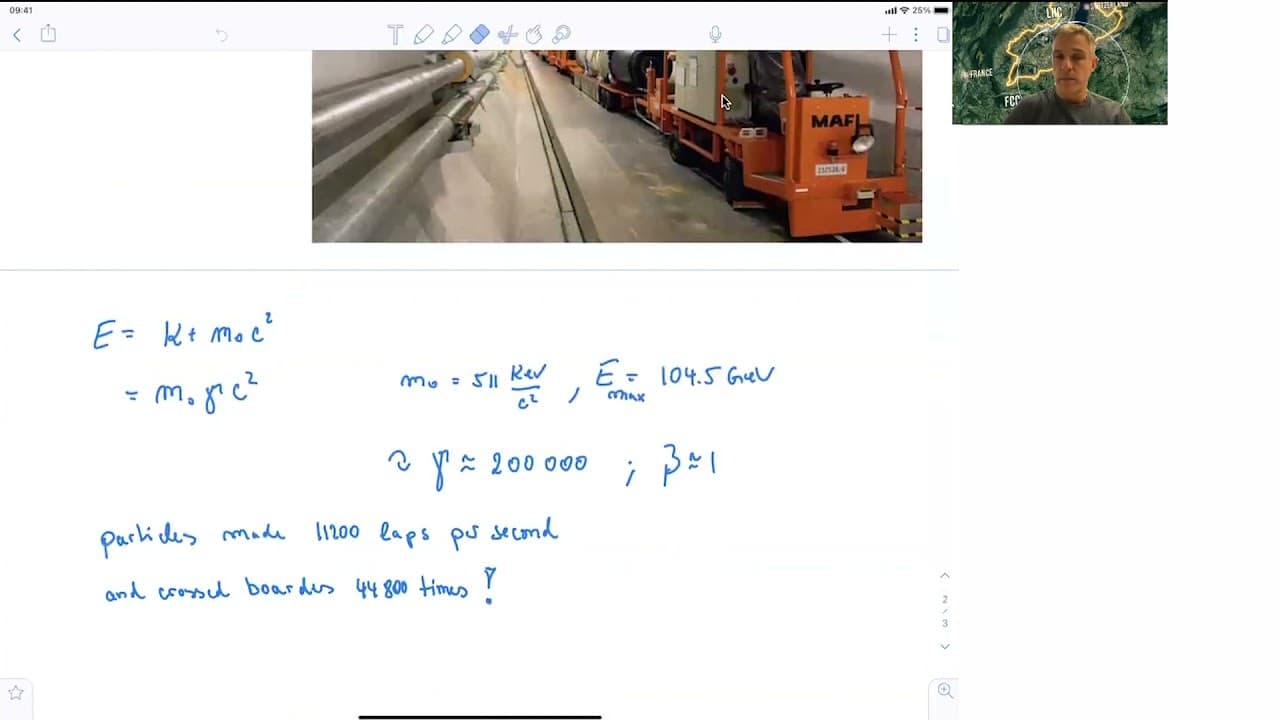
welcome back to 820 special relativity in this section we want to talk about particles in accelerators and we use the large electron position collider at cern as an example lab the large electron position collider was a collider which was operated in the late 1980s up to the year 2000 at center of mass energies from 91 gev to up to 209 gev this ene... Read More
Key Insights
- 💝 The Large Electron Positron Collider at CERN operated from the late 1980s to 2000, exploring various bosons and searching for the Higgs boson.
- 😣 The speed of particles in a collider can be determined by using the relativistic total energy equation, considering both kinetic energy and rest mass.
- 🐎 A smaller accelerator can also accelerate electrons to speeds close to the speed of light using an electrostatic potential.
- 👖 CERN's collider spans two countries, requiring border crossings for electrons and positrons.
Install to Summarize YouTube Videos and Get Transcripts
Explore YouTube Video Summarizer or Get YouTube Transcript Extractor
Questions & Answers
Q: What was the main purpose of the Large Electron Positron Collider at CERN?
The main purpose was to probe the Z-boson, produce pairs of W-boson, and search for the Higgs boson. Unfortunately, the energy wasn't sufficient to find the Higgs boson.
Q: How can we determine the speed of particles in the collider?
The speed can be determined by using the relativistic total energy equation, which incorporates the kinetic energy and rest mass of the particle. By knowing the center of mass energy, we can calculate the gamma factor and find the speed.
Q: What is a fun fact about the collider at CERN?
The collider at CERN spans two countries, Switzerland and France, with each particle lab making about 11,200 laps per second. This means there are approximately 44,800 border crossings for an electron-positron.
Q: What can a proposed larger collider at CERN study?
The proposed larger collider aims to study the Higgs boson with precision and explore top pair production. It would operate at energies up to 350 GeV.
Summary & Key Takeaways
-
The Large Electron Positron Collider at CERN, operating from the late 1980s to 2000, probed the Z-boson, produced pairs of W-boson, and searched for the Higgs boson.
-
By knowing the center of mass energy, one can determine the speed of particles in the collider using the relativistic total energy equation.
-
Another smaller accelerator also accelerates electrons to near the speed of light using an electrostatic potential.
Read in Other Languages (beta)
Share This Summary 📚
Summarize YouTube Videos and Get Video Transcripts with 1-Click
Try YouTube Summary with ChatGPT & Claude or YouTube Transcript Generator
Explore More Summaries from MIT OpenCourseWare 📚


Summarize YouTube Videos and Get Video Transcripts with 1-Click
Try YouTube Summary with ChatGPT & Claude or YouTube Transcript Generator