The best A – A ≠ 0 paradox

TL;DR
The alternating harmonic series appears to have a sum of 0, but it actually converges to the natural logarithm of 2, creating a paradox.
Transcript
Welcome to another Mathologer video. See that infinite series up there? 1 - 1/2 + 1/3 - 1/4, and so on. So the terms are the reciprocals of 1, 2, 3, and so on and the signs plus and minus take turns. Look familiar? Well, that’s the famous alternating harmonic series which quite a few of you will have encountered before, for example, in so... Read More
Key Insights
- 🍉 The alternating harmonic series exhibits a paradox where the sum of all terms appears to be 0, but the infinite series actually converges to the natural logarithm of 2.
- 👻 Visualizing the series with rectangles allows for a better understanding of how the imbalance between positive and negative terms evolves.
- 🍉 By changing the distribution of positive and negative terms, different sums can be achieved.
- 🍹 The infinite series can be rearranged to obtain any desired sum except for cases where the series does not converge or has a fixed value when rearranged.
Install to Summarize YouTube Videos and Get Transcripts
Explore YouTube Video Summarizer or Get YouTube Transcript Extractor
Questions & Answers
Q: How does the paradox of the alternating harmonic series arise?
The paradox arises from the combination of positive and negative terms that cancel each other out, leading to an expected sum of 0. However, the series actually converges to the natural logarithm of 2.
Q: Why do finite sums of the series get closer to the natural logarithm of 2?
The finite sums gradually approach the natural logarithm of 2 because of an imbalance between positive and negative terms. Although every positive term is eventually cancelled by a negative term, the imbalance causes the sum to converge to the natural logarithm of 2.
Q: Can the distribution of positive and negative terms in the series be changed?
Yes, it is possible to change the distribution of positive and negative terms. By altering the pattern, such as having three positive terms followed by one negative term, different sums can be obtained.
Q: Can the series be arranged to have a sum exactly equal to pi?
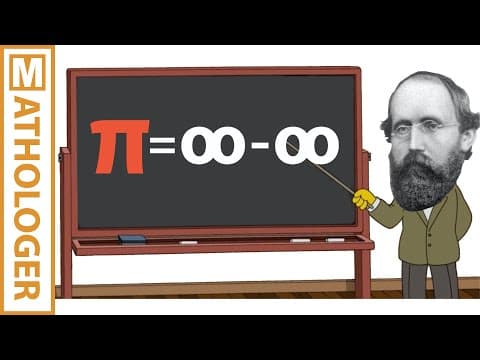
No, the alternating harmonic series cannot be arranged to have a sum exactly equal to pi. However, by using a similar technique, it is possible to obtain a sum that is arbitrarily close to pi.
Summary & Key Takeaways
-
The alternating harmonic series consists of positive and negative terms that cancel each other out, leading to a sum of 0.
-
However, when examining finite sums of the series, they gradually approach the natural logarithm of 2, which challenges the initial assumption.
-
A visual representation using rectangles illustrates how the imbalance between positive and negative terms evolves and converges to the natural logarithm of 2.
Read in Other Languages (beta)
Share This Summary 📚
Summarize YouTube Videos and Get Video Transcripts with 1-Click
Try YouTube Summary with ChatGPT & Claude or YouTube Transcript Generator
Explore More Summaries from Mathologer 📚



Summarize YouTube Videos and Get Video Transcripts with 1-Click
Try YouTube Summary with ChatGPT & Claude or YouTube Transcript Generator