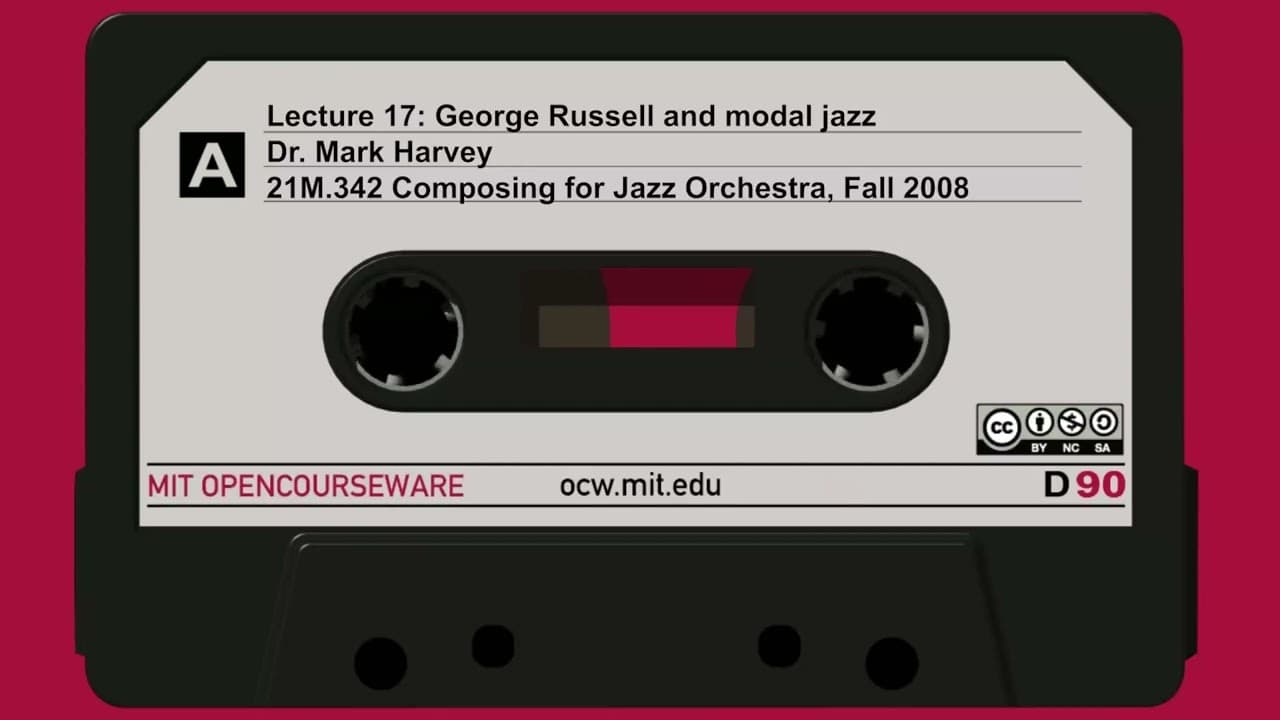
Lecture 17: George Russell and modal jazz (audio only)
TL;DR
This content discusses the concept of modal music and extended form in jazz, focusing on works by George Russell and Mark Harvey.
Transcript
The following content is provided under a Creative Commons license. Your support will help MIT OpenCourseWare continue to offer high-quality educational resources for free. To make a donation or to view additional materials from hundreds of MIT courses, visit [email protected]. MARK HARVEY: I'll begin by just saying a little bit about m... Read More
Key Insights
- 🤪 Extended form in jazz goes beyond short structures and allows for more complex and lengthy compositions.
- 💁 Duke Ellington was one of the first jazz musicians to experiment with extended form, utilizing the limitations of early recording technology.
- 🎼 Modal music in jazz draws on African and African-American music traditions, emphasizing tonal centers and centric melodies.
- 🎼 George Russell's Lydian Chromatic Concept of Tonal Organization expanded the understanding of tonality and modality in jazz music.
- 👻 Commissioned works became more common in jazz, allowing composers to focus on their craft and explore new musical ideas.
Install to Summarize YouTube Videos and Get Transcripts
Explore YouTube Video Summarizer or Get YouTube Transcript Extractor
Questions & Answers
Q: What is extended form in jazz?
Extended form is a term used in jazz to describe larger structures in compositions, going beyond the typical short forms found in the genre, such as the 12-bar blues or 32-bar songs.
Q: How did Duke Ellington contribute to extended form in jazz?
Duke Ellington introduced extended form in jazz with his piece "Creole Rhapsody" in 1931. He cleverly utilized the limitations of recording technology to create a six-minute piece that required flipping the record to hear the complete composition.
Q: What is modal music, and how does it connect to African and African-American music?
Modal music is a type of music that emphasizes specific tonal centers and centric melodies. It has deep roots in African and African-American music traditions, using scales and modes that express the sound of major chords.
Q: How does George Russell's Lydian Chromatic Concept of Tonal Organization influence jazz music?
George Russell's theory, the Lydian Chromatic Concept of Tonal Organization, focuses on the use of parent scales and modes, emphasizing the Lydian scale as the primary mode for expressing the sound of major chords. This concept expanded the possibilities of tonality and modality in jazz music.
Summary & Key Takeaways
-
The content explores the concept of extended form in jazz, which refers to larger structures used in jazz compositions.
-
Modal music and its connection to African and African-American music are discussed, emphasizing the use of tonal centers and centric melodies.
-
Various compositions by George Russell, including "All About Rosie" and "African Game," are analyzed as examples of extended form and modal music.
Read in Other Languages (beta)
Share This Summary 📚
Summarize YouTube Videos and Get Video Transcripts with 1-Click
Try YouTube Summary with ChatGPT & Claude or YouTube Transcript Generator
Explore More Summaries from MIT OpenCourseWare 📚


Summarize YouTube Videos and Get Video Transcripts with 1-Click
Try YouTube Summary with ChatGPT & Claude or YouTube Transcript Generator