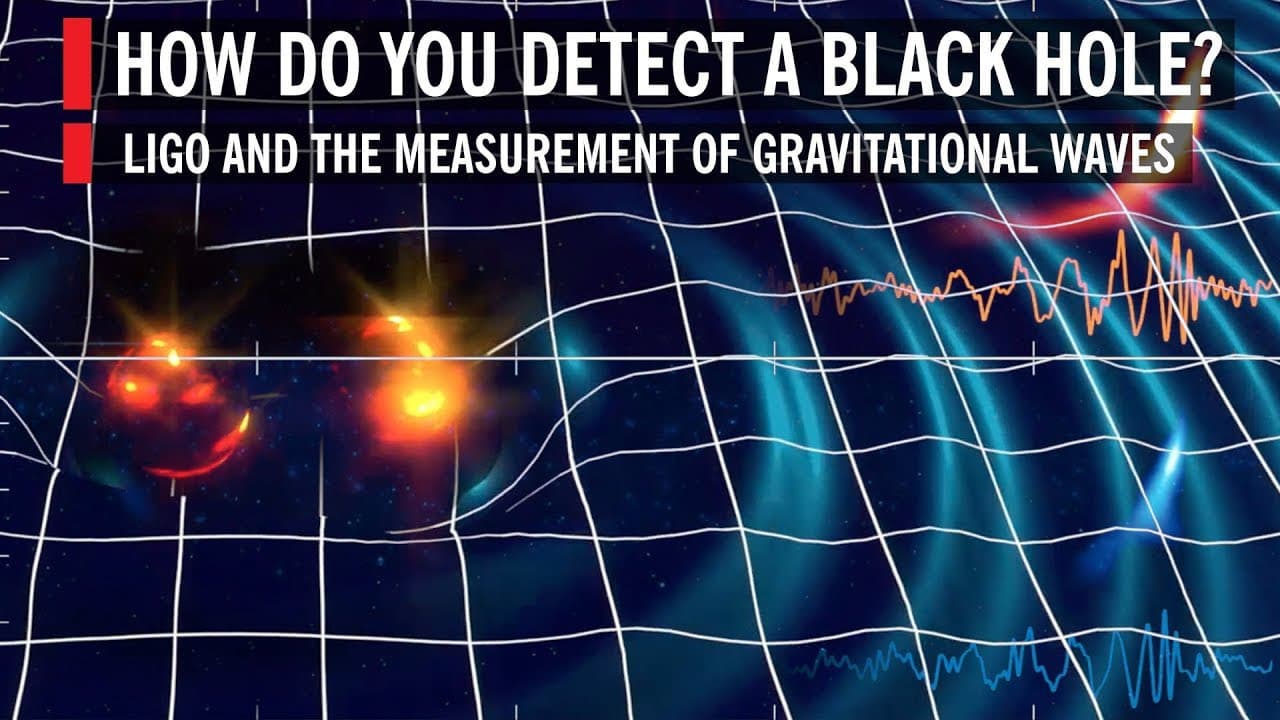
How Do You Detect a Black Hole? LIGO and the Measurement of Gravitational Waves
TL;DR
Gravitational waves, ripples in space-time, were predicted by Einstein's theory of general relativity. They have been detected using laser interferometers, providing insights into cosmic events such as black hole and neutron star collisions.
Transcript
In 1916, this is the year after Einstein wrote his paper on the general theory of relativity, Einstein continued to think about the theoretical ideas and he wrote a paper which we have here, where he was thinking about the possibility that if space and time can warp and curve, then it might be the case that space and time can also ripple, right? Th... Read More
Key Insights
- 👋 Gravitational waves were first proposed by Einstein in 1916 and detected in 2015, confirming their existence.
- 😒 LIGO is a facility that uses laser interferometry to detect and measure gravitational waves.
- ✴️ Gravitational waves have been observed from collisions between black holes and neutron stars, providing insights into astrophysical phenomena.
- 👋 Gravitational waves can be converted into sound waves, resembling a chirping sound.
- 👋 The detection of gravitational waves offers the opportunity to test and refine Einstein's theory of general relativity.
- 👋 The collision of two neutron stars not only produced gravitational waves but also electromagnetic waves, confirming the formation of heavy elements.
- 👋 The study of gravitational waves pushes the frontiers of both physics and astrophysics.
Install to Summarize YouTube Videos and Get Transcripts
Explore YouTube Video Summarizer or Get YouTube Transcript Extractor
Questions & Answers
Q: How did Einstein first propose the existence of gravitational waves?
Einstein wrote a paper in 1916 suggesting that if space and time can warp and curve, they might also ripple or vibrate, known as gravitational waves.
Q: How were gravitational waves detected by LIGO?
LIGO uses laser beams that travel through vacuum tubes to detect changes in the length of the arms caused by the squeezing and stretching of space-time due to passing gravitational waves.
Q: Can gravitational waves be heard?
Gravitational waves are not sound waves, but their frequencies can be converted into sound waves. The resulting sound, known as a chirp, mimics a bird's chirping.
Q: Besides black hole collisions, have other cosmic events been observed using gravitational waves?
Yes, the collision of two neutron stars has also been observed through gravitational waves. This event also produced electromagnetic waves, providing evidence for the formation of heavy elements like gold.
Summary & Key Takeaways
-
Gravitational waves were first hypothesized by Einstein in 1916, and their existence was confirmed in 2015.
-
The Laser Interferometer Gravitational-Wave Observatory (LIGO) is a facility that uses laser beams to detect and measure gravitational waves.
-
LIGO has detected multiple events, including collisions between black holes and neutron stars, providing insights into the behavior of these celestial objects.
Read in Other Languages (beta)
Share This Summary 📚
Summarize YouTube Videos and Get Video Transcripts with 1-Click
Try YouTube Summary with ChatGPT & Claude or YouTube Transcript Generator
Explore More Summaries from World Science Festival 📚



Summarize YouTube Videos and Get Video Transcripts with 1-Click
Try YouTube Summary with ChatGPT & Claude or YouTube Transcript Generator