L09.6 Mixed Random Variables
TL;DR
Mixed random variables can have both discrete and continuous components, and they are described by a cumulative distribution function (CDF).
Transcript
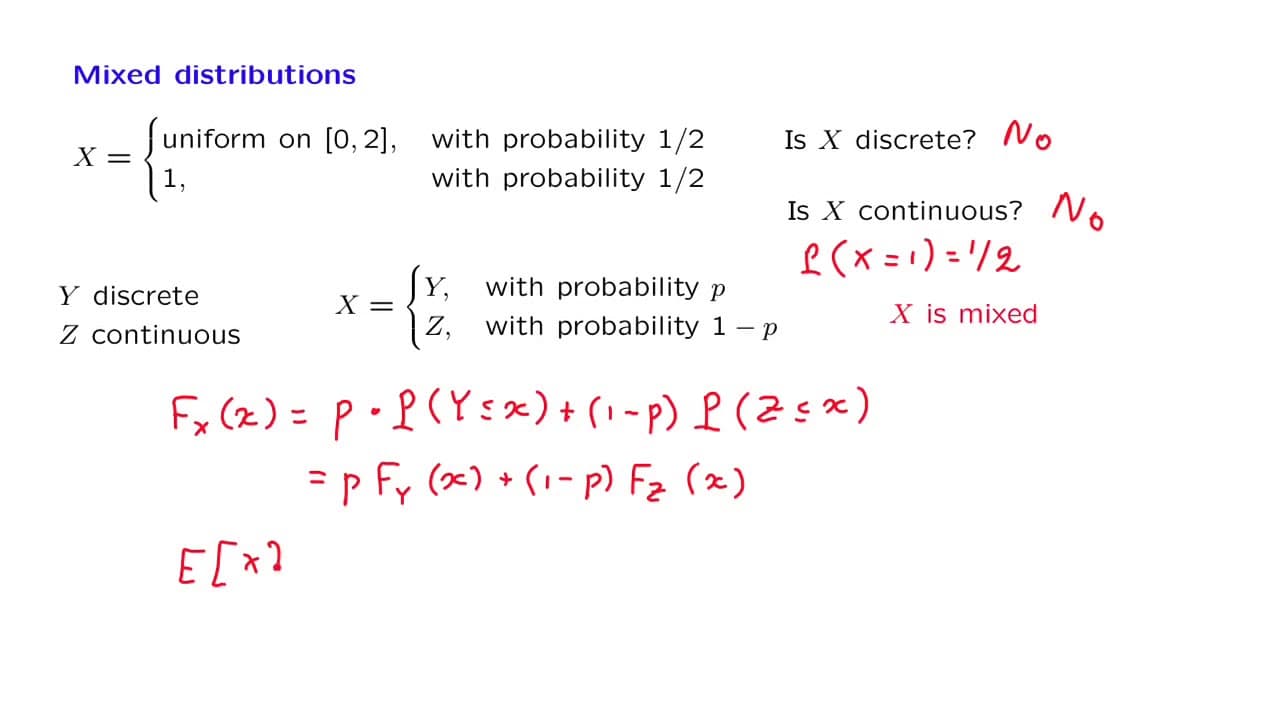
We now look at an example similar to the previous one, in which we have again two scenarios, but in which we have both discrete and continuous random variables involved. You have $1 and the opportunity to play in the lottery. With probability 1/2, you do nothing and you're left with the dollar that you started with. With probability 1/2, you decide... Read More
Key Insights
- ❓ Mixed random variables have both discrete and continuous components.
- 🥡 A random variable is not necessarily discrete just because it takes on integer values.
- ❓ Discrete random variables have a PMF, continuous random variables have a PDF, and mixed random variables have a CDF.
- ❓ The CDF of a mixed random variable can be obtained using the Total Probability Theorem by combining the CDFs of the associated discrete and continuous random variables.
- 🥡 The expected value of a mixed random variable is calculated by taking a weighted sum of the expected values of the associated discrete and continuous random variables.
- ❓ The CDF of a mixed random variable can have both continuous and discontinuous segments.
- ❓ Mixed random variables are commonly used in various probability and statistics problems.
Install to Summarize YouTube Videos and Get Transcripts
Explore YouTube Video Summarizer or Get YouTube Transcript Extractor
Questions & Answers
Q: What is the difference between a discrete and continuous random variable?
A discrete random variable can only take on a countable set of values, while a continuous random variable can take on any value within a certain range. Discrete variables have a probability mass function (PMF), while continuous variables have a probability density function (PDF).
Q: Why is the random variable X in the example considered a mixed random variable?
X is considered a mixed random variable because it is partly discrete and partly continuous. It has a certain probability of being the same as a discrete random variable and a different probability of being the same as a continuous random variable.
Q: How is a mixed random variable described?
Mixed random variables are described using a cumulative distribution function (CDF). The CDF calculates the probability that the random variable is less than or equal to a certain value. It is a weighted sum of the CDFs of the associated discrete and continuous random variables.
Q: How is the expected value of a mixed random variable calculated?
The expected value of a mixed random variable is calculated using the Total Expectation Theorem. It is the weighted sum of the expected values of the associated discrete and continuous random variables, where the weights are the probabilities of each scenario.
Summary & Key Takeaways
-
The example given involves a scenario where there are both discrete and continuous random variables. Players have the opportunity to either do nothing and keep their money or play the lottery and win a random amount between zero and two dollars.
-
The random variable, X, is not discrete because it takes values on a continuous range, and it is not continuous because it has a non-zero probability of taking a specific value.
-
Mixed random variables, like X, cannot be described by a probability mass function (PMF) or a probability density function (PDF), but instead by a cumulative distribution function (CDF).
Read in Other Languages (beta)
Share This Summary 📚
Summarize YouTube Videos and Get Video Transcripts with 1-Click
Try YouTube Summary with ChatGPT & Claude or YouTube Transcript Generator
Explore More Summaries from MIT OpenCourseWare 📚


Summarize YouTube Videos and Get Video Transcripts with 1-Click
Try YouTube Summary with ChatGPT & Claude or YouTube Transcript Generator