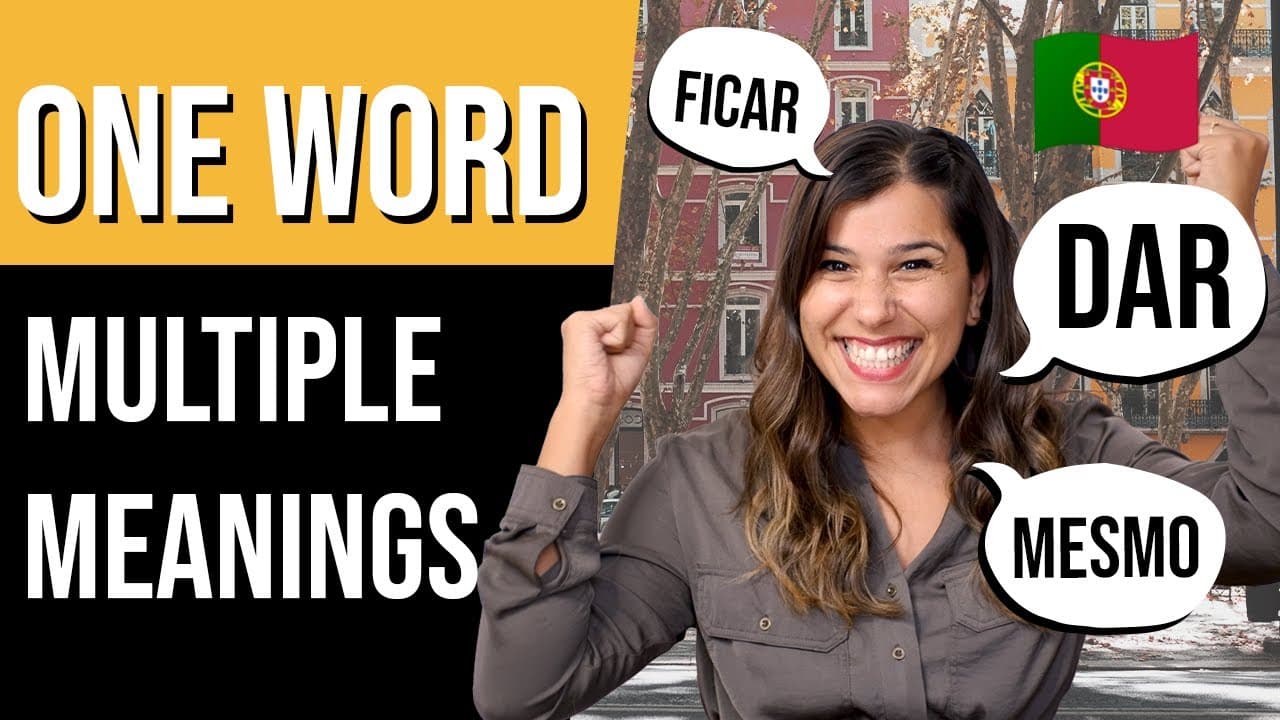
European Portuguese | 5 Common Words with MULTIPLE Meanings!
TL;DR
Learn five Portuguese words with multiple meanings for fluent conversation.
Transcript
is there anything more frustrating than feeling like you've mastered some vocabulary only to find that one word can have multiple meanings if you've just started learning Portuguese you may not know it but how you use certain words can change drastically depending on context confused you won't be after watching today's video I'm going to cover five... Read More
Key Insights
- The verb 'Dar' in Portuguese not only means 'to give' but also indicates functionality, like when a machine doesn't work.
- Pronunciation of Portuguese words ending in 'R' is crucial and often mispronounced by English speakers.
- 'Mesmo' can amplify meaning in Portuguese, making expressions more emphatic and native-like.
- The verb 'Ficar' has multiple meanings, including 'to become', 'to stay', and 'to suit', depending on the context.
- 'Jeito' is a versatile word in Portuguese, used to express talent, suitability, and even attractiveness.
- The verb 'Andar' is commonly associated with movement but can also mean engaging in an activity.
- Understanding the context is key to using Portuguese words with multiple meanings correctly.
- Improving pronunciation and vocabulary through guided lessons can significantly enhance Portuguese language skills.
Install to Summarize YouTube Videos and Get Transcripts
Explore YouTube Video Summarizer or Get YouTube Transcript Extractor
Questions & Answers
Q: What is the primary focus of the video?
The primary focus of the video is to teach learners about five common Portuguese words that have multiple meanings. It aims to help learners understand and use these words correctly in different contexts to improve their fluency and sound more like native speakers.
Q: Why is pronunciation emphasized in the video?
Pronunciation is emphasized because it is a common area where English speakers struggle when learning Portuguese, particularly with words ending in 'R'. Correct pronunciation is crucial for effective communication and to avoid misunderstandings, making it an important focus for learners aiming to speak Portuguese fluently.
Q: How does the video help learners sound more native?
The video helps learners sound more native by providing insights into the multiple meanings of common words and offering pronunciation tips. By understanding context-dependent usage and mastering pronunciation, learners can use these words more naturally in conversation, enhancing their overall fluency and confidence.
Q: What are some additional resources mentioned in the video?
Additional resources mentioned in the video include a free pronunciation guide, a 30-day practical Portuguese challenge, and links to related videos on pronunciation and conversation tips. These resources are designed to help learners improve their Portuguese skills through structured practice and guidance.
Q: What is the significance of the verb 'Dar' in Portuguese?
The verb 'Dar' is significant because it not only means 'to give' but also indicates functionality, such as when something works or doesn't work. Understanding its multiple meanings allows learners to use it correctly in various situations, enhancing their conversational abilities and understanding of Portuguese.
Q: How can 'Mesmo' be used to sound more native?
'Mesmo' can be used to amplify meaning in Portuguese, making expressions more emphatic. For example, it can be used to indicate exactness or emphasis, such as saying 'right here' or 'really liked it'. Using 'Mesmo' in this way helps learners sound more native and natural in conversation.
Q: What are the different meanings of 'Ficar'?
The verb 'Ficar' has several meanings, including 'to become', 'to stay', 'to be situated', 'to keep', and 'to suit'. Each meaning is context-dependent, and understanding these variations allows learners to use 'Ficar' appropriately in different scenarios, enhancing their fluency and comprehension.
Q: What role does context play in using Portuguese words with multiple meanings?
Context plays a crucial role in using Portuguese words with multiple meanings because it determines which meaning is appropriate in a given situation. Understanding the context helps learners choose the correct meaning, ensuring effective communication and avoiding misunderstandings when speaking Portuguese.
Summary & Key Takeaways
-
This video explores five common Portuguese words with multiple meanings, helping learners navigate context-dependent usage. The words include 'Dar', 'Mesmo', 'Ficar', 'Jeito', and 'Andar', each with unique applications that can enhance conversational fluency.
-
Pronunciation tips are provided, especially for words ending in 'R', a common challenge for English speakers. The content encourages viewers to sound more native by mastering these nuances in European Portuguese.
-
The video is a resource for beginners and advanced learners alike, offering free lessons, pronunciation guides, and practical phrases to improve everyday Portuguese conversation skills.
Read in Other Languages (beta)
Share This Summary 📚
Summarize YouTube Videos and Get Video Transcripts with 1-Click
Try YouTube Summary with ChatGPT & Claude or YouTube Transcript Generator
Explore More Summaries from Talk the Streets 📚
![Practice Portuguese with Mixologist Fábio Guerreiro! [English & Portuguese Subtitles] thumbnail](/_next/image?url=https%3A%2F%2Fi.ytimg.com%2Fvi%2F1-T2PNWuiWY%2Fhqdefault.jpg&w=750&q=75)



Summarize YouTube Videos and Get Video Transcripts with 1-Click
Try YouTube Summary with ChatGPT & Claude or YouTube Transcript Generator