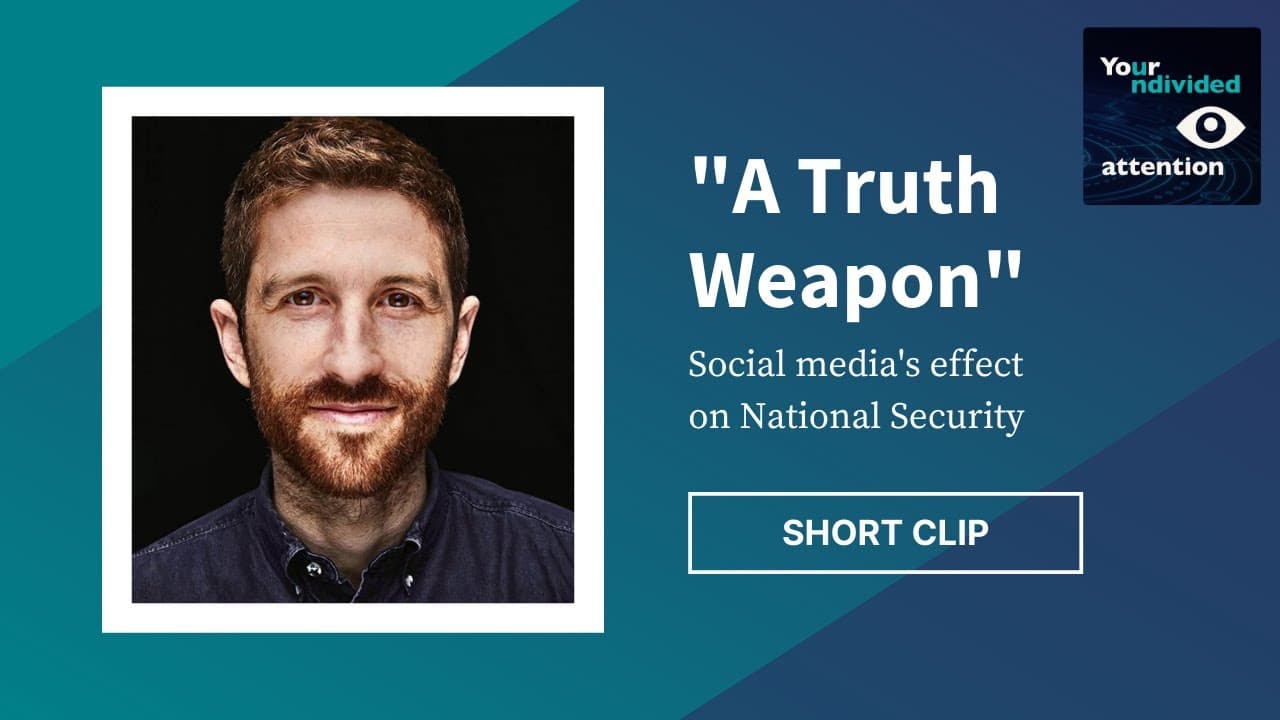
"A Truth Weapon" — How 'The Social Dilemma' Is Really 'The National Security Dilemma'
TL;DR
The rise of social media presents new challenges to national security through misinformation and cognitive warfare.
Transcript
i think we don't fully appreciate the way in which the social dilemma is actually a national security dilemma and we'll look back at this period as a time when we invented a new kind of weapon who needs missile systems or bioweapons or nuclear weapons when i have a truth weapon if i can take down your society's understanding of reality if i can lea... Read More
Key Insights
- 🎖️ Social media has become a formidable tool for destabilization, often overshadowing conventional military threats.
- 👶 The cost-effectiveness of digital misinformation campaigns poses new challenges, making national security less about physical weapons and more about cognitive control.
- 🖐️ Citizens must recognize the role they play in the digital landscape, as everyone is a potential participant in the information warfare.
- 🆘 Developing defenses against 'truth decay' can help reinforce societal cohesion and trust in democratic institutions.
- 🌍 Understanding the motives behind foreign narratives can enhance national resilience against misinformation.
- 💁 The shift in warfare dynamics requires comprehensive strategies that take into account the psychological and cultural aspects of information dissemination.
- 🔒 The adaptation of national security frameworks to include informational security is imperative for addressing contemporary threats.
Install to Summarize YouTube Videos and Get Transcripts
Explore YouTube Video Summarizer or Get YouTube Transcript Extractor
Questions & Answers
Q: How has social media changed the landscape of national security?
Social media has created a new paradigm for national security by enabling the rapid dissemination of misinformation, potentially destabilizing societies. Unlike traditional military assets, social media allows adversaries to exploit societal divisions and manipulate public perception cheaply and efficiently, thus redefining what constitutes a threat to national stability.
Q: What is the concept of 'truth decay' mentioned in the discussion?
'Truth decay' refers to the diminishing trust in objective facts within society, often fueled by misinformation campaigns. This phenomenon can undermine civic discourse and democratic processes, making it easier for malign actors to exploit societal vulnerabilities and destabilize governments, thereby posing a significant threat to national security.
Q: Why are digital borders considered more crucial than physical borders nowadays?
Digital borders encapsulate the online domains where misinformation can spread rapidly, affecting public perception and societal cohesion. Given that many aspects of daily life, including education, communication, and voting occur online, protecting these digital realms has become essential for maintaining national security in a world increasingly reliant on information technology.
Q: What lessons can the U.S. learn from countries like Estonia and Taiwan regarding information security?
Countries like Estonia and Taiwan actively recognize and defend against foreign information operations due to their geographic vulnerabilities. The U.S. could adopt similar strategies by fostering a proactive public awareness and understanding of narratives that foreign adversaries wish to propagate, building resilience against misinformation campaigns.
Q: How can a new national defense strategy address these informational threats?
A new national defense strategy should prioritize informational security, developing capabilities to safeguard against misinformation and manipulation. This could involve increasing public education on media literacy, investing in technological defenses against cyber threats, and fostering a culture of transparency that builds public trust in information sources.
Q: What role do adversaries like Russia play in manipulating public sentiment through misinformation?
Adversaries like Russia actively utilize social media and bot networks to propagate divisive narratives or amplify specific movements that align with their geopolitical goals. For instance, by promoting anti-fracking sentiments, they aim to weaken the U.S. energy independence and increase reliance on foreign oil, directly impacting national security dynamics.
Summary & Key Takeaways
-
The speaker argues that social media has transformed national security into an informational and cognitive challenge, undermining societal understanding of reality and trust.
-
Conventional military power, such as nuclear weapons, is rendered less significant in the face of digital misinformation capabilities wielded by adversaries like China and Russia.
-
The need for a shift in national defense strategies is emphasized, focusing on protecting 'informational security' and developing cultural mechanisms to defend against psychological manipulation.
Read in Other Languages (beta)
Share This Summary 📚
Summarize YouTube Videos and Get Video Transcripts with 1-Click
Try YouTube Summary with ChatGPT & Claude or YouTube Transcript Generator
Explore More Summaries from Center for Humane Technology 📚


Summarize YouTube Videos and Get Video Transcripts with 1-Click
Try YouTube Summary with ChatGPT & Claude or YouTube Transcript Generator