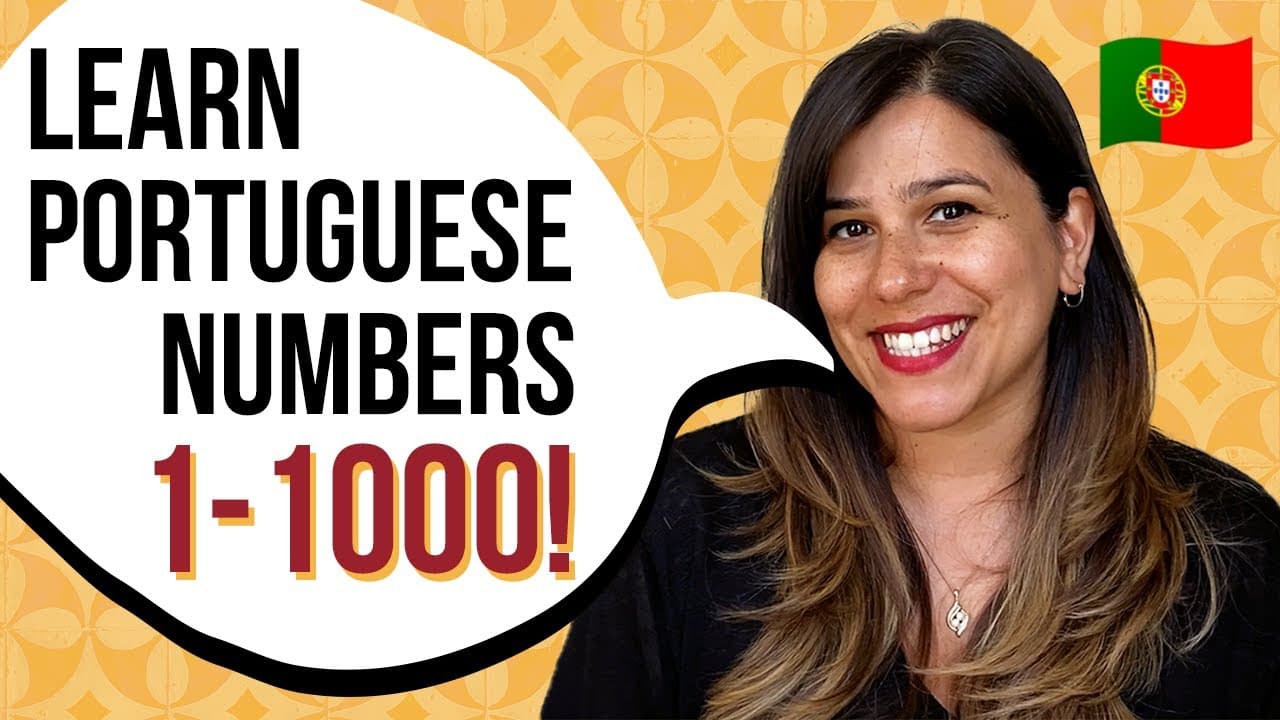
Learn Portuguese Numbers 1-1000: The Ultimate Guide for Beginners!
TL;DR
Learn to pronounce and use Portuguese numbers correctly.
Transcript
you can't get far in Portugal without knowing your numbers from giving out your phone number to your date of birth to that very important very Portuguese thing the contribuinte or your fiscal number which will be asked for a lot here so that's what we're going to tackle in today's video and by the end you will be able to tackle all of these que... Read More
Key Insights
- Understanding Portuguese numbers is essential for everyday activities in Portugal, including sharing phone numbers and dates.
- Pronunciation of numbers in Portuguese involves specific nasal sounds and closed syllables, requiring practice for accuracy.
- Numbers one and two in Portuguese vary by gender, adapting to the gender of the noun they describe.
- Grouping phone numbers into sets of three digits can simplify pronunciation and memorization.
- The pronunciation of 's' in Portuguese changes depending on its position in a word or sentence, affecting how numbers are spoken.
- Higher numbers, such as those for prices and years, require understanding of Portuguese counting rules and gender variations.
- Flashcards and online resources can aid in memorizing and practicing Portuguese numbers effectively.
- Learning Portuguese numbers enhances communication skills and cultural understanding, making interactions in Portugal smoother.
Install to Summarize YouTube Videos and Get Transcripts
Explore YouTube Video Summarizer or Get YouTube Transcript Extractor
Questions & Answers
Q: Why is learning Portuguese numbers important?
Learning Portuguese numbers is crucial for navigating daily life in Portugal. Numbers are essential for sharing personal information like phone numbers and dates of birth. They are also necessary for understanding prices and dates, making them vital for effective communication and integration into Portuguese culture.
Q: How do gender variations affect Portuguese numbers?
In Portuguese, numbers one and two change based on the gender of the noun they describe. For masculine nouns, 'um' and 'dois' are used, while 'uma' and 'duas' are used for feminine nouns. This gender adaptation is important for correct grammar and communication in Portuguese.
Q: What are some pronunciation challenges with Portuguese numbers?
Pronunciation challenges include mastering nasal sounds and the closed 'e' sound. For instance, the number 'um' involves a nasal sound without pronouncing the 'm'. Additionally, the 's' at the end of numbers like 'dois' changes to a 'z' sound when followed by a vowel, requiring careful articulation.
Q: How can flashcards help in learning Portuguese numbers?
Flashcards are a valuable tool for memorizing Portuguese numbers. They provide a visual and interactive way to practice, reinforcing memory through repetition. Flashcards can include gender variations and pronunciation tips, offering a comprehensive approach to mastering numbers and enhancing language skills.
Q: What resources are available for learning Portuguese pronunciation?
Numerous resources are available, including free online lessons and pronunciation guides. These resources offer detailed explanations of pronunciation rules, such as nasal sounds and syllable emphasis. They also provide practice exercises and tips for avoiding common mistakes, essential for improving pronunciation skills.
Q: How are higher numbers like prices and years handled in Portuguese?
Higher numbers in Portuguese, such as those for prices and years, require understanding counting rules and gender variations. Numbers above 100 involve using 'cento' instead of 'cem', and gender affects hundreds. Years are pronounced as full numbers, not split into tens and units like in English.
Q: What is the significance of grouping phone numbers in Portuguese?
Grouping phone numbers into sets of three digits simplifies pronunciation and memorization. This method aligns with common practices in Portugal, making it easier to communicate phone numbers accurately. It reduces errors and enhances clarity, important for effective communication in Portuguese.
Q: Why is it important to understand the pronunciation of 's' in Portuguese numbers?
Understanding the pronunciation of 's' is crucial because it changes depending on its position. At the end of a word, it becomes a 'sh' sound, but between vowels, it changes to a 'z' sound. This affects how numbers are spoken and ensures accurate communication in Portuguese.
Summary & Key Takeaways
-
This video focuses on teaching European Portuguese numbers, emphasizing pronunciation and practical usage. It covers numbers from one to a thousand, including gender variations and pronunciation rules. Resources like flashcards and online lessons are offered to aid learning and practice.
-
Pronunciation is a key focus, with tips on nasal sounds and syllable emphasis. The video explains how to handle gender differences in numbers, crucial for accurate communication. It also provides strategies for memorizing numbers, such as grouping phone digits.
-
The content aims to improve viewers' Portuguese language skills, offering tools like flashcards and free online lessons. It highlights the importance of numbers in everyday interactions in Portugal, from phone numbers to prices, enhancing cultural integration.
Read in Other Languages (beta)
Share This Summary 📚
Summarize YouTube Videos and Get Video Transcripts with 1-Click
Try YouTube Summary with ChatGPT & Claude or YouTube Transcript Generator
Explore More Summaries from Talk the Streets 📚


![Learn European Portuguese Outside of Portugal! [NEW apps & TOP tips!] thumbnail](/_next/image?url=https%3A%2F%2Fi.ytimg.com%2Fvi%2F0K81C-5Z1I0%2Fhqdefault.jpg&w=750&q=75)


Summarize YouTube Videos and Get Video Transcripts with 1-Click
Try YouTube Summary with ChatGPT & Claude or YouTube Transcript Generator