European Portuguese - Understand FAST Portuguese with These Tips!
TL;DR
Learn to understand fast-spoken Portuguese with practical tips.
Transcript
Have you noticed that the Portuguese speak really fast? This is a common problem in language learning, you learn to speak one way in your classes and then when you go to listen to people in real life or try and speak to people in real life, it doesn't always help you that much. So in today's lesson I'm going to go through seven common words and phr... Read More
Key Insights
- Understanding fast-spoken Portuguese often involves recognizing words that are shortened or have sounds omitted in casual conversation.
- The word 'peraí' is a contraction of 'espera aí,' commonly used to mean 'wait' or 'slow down.'
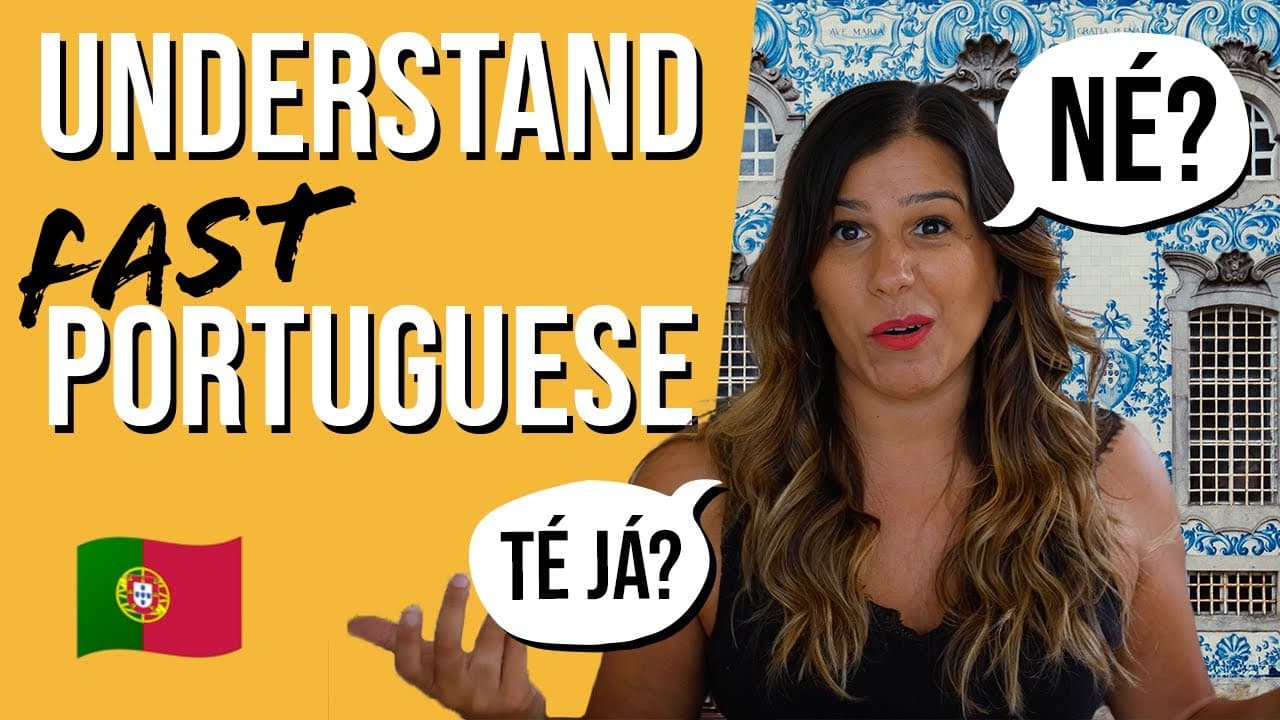
- The phrase 'né' is a colloquial shortening of 'não é,' often used to mean 'right?' or 'isn't it?'
- 'Té já' is a quick way of saying 'até já,' which means 'see you very soon,' as opposed to 'até logo' for a more indefinite 'see you later.'
- The phrase 'tá bem' is derived from 'está bem,' meaning 'it's fine' or 'okay,' with the initial 'es' often dropped in fast speech.
- The word 'pra' is a shortened form of 'para,' commonly used in everyday speech and sometimes reflected in written subtitles.
- 'Bora' is a colloquial abbreviation of 'vamos embora,' meaning 'let's go,' and is used in both Portugal and Brazil.
- Listening and practicing these colloquial contractions can help learners sound more natural and improve comprehension of fast-spoken Portuguese.
Install to Summarize YouTube Videos and Get Transcripts
Explore YouTube Video Summarizer or Get YouTube Transcript Extractor
Questions & Answers
Q: What is the main challenge addressed in the video?
The video addresses the challenge of understanding fast-spoken European Portuguese. It highlights that learners often struggle with the speed and colloquial nature of the language in real-life situations, as opposed to the more formal and slower-paced language taught in classes.
Q: How does the video suggest overcoming the difficulty of fast-spoken Portuguese?
The video suggests overcoming this difficulty by learning common contractions and sound omissions that occur in everyday speech. By familiarizing oneself with these colloquial forms, learners can better understand and communicate in fast-spoken Portuguese, making their interactions more natural and fluid.
Q: What are some examples of shortened phrases mentioned in the video?
Examples include 'peraí' for 'espera aí,' 'né' for 'não é,' 'té já' for 'até já,' 'tá bem' for 'está bem,' 'pra' for 'para,' and 'bora' for 'vamos embora.' These contractions are commonly used in casual conversations, helping to streamline speech.
Q: Why is it important to learn these colloquial expressions?
Learning these colloquial expressions is important because they are frequently used in everyday conversations. Understanding and using them can significantly improve comprehension and communication skills, making learners sound more like native speakers and enhancing their ability to engage in real-life interactions.
Q: What additional resources does the video offer to learners?
The video offers additional resources such as an online course focusing on practical, real-life Portuguese, a free pronunciation guide, and live YouTube lessons. These resources aim to provide learners with further opportunities to practice and improve their understanding and speaking skills in European Portuguese.
Q: How does the video encourage active learning?
The video encourages active learning by challenging viewers to listen for these shortened phrases in conversations and use them in their own speech. It also invites viewers to share their experiences and questions in the comments, fostering an interactive learning environment.
Q: What is the significance of the phrase 'bora'?
The phrase 'bora' is significant because it is a widely used colloquial expression meaning 'let's go,' derived from 'vamos embora.' Its usage in both Portugal and Brazil underscores its importance in everyday communication, making it a key phrase for learners to understand and use.
Q: How does the video aim to bridge the gap between classroom learning and real-life interactions?
The video aims to bridge this gap by focusing on the practical aspects of language learning, specifically the colloquial expressions and contractions used in fast-spoken Portuguese. By providing insights into these common speech patterns, the video helps learners transition from formal classroom language to more natural, conversational Portuguese.
Summary & Key Takeaways
-
The video provides insights into understanding fast-spoken European Portuguese by highlighting common contractions and omissions in everyday speech. It emphasizes practical learning to help listeners comprehend and use these expressions naturally.
-
Viewers are introduced to seven specific Portuguese phrases that are frequently shortened in casual conversation. The video aims to bridge the gap between classroom learning and real-life interactions.
-
The content encourages active listening and practice, offering additional resources like an online course and live lessons to further improve understanding and speaking skills in European Portuguese.
Read in Other Languages (beta)
Share This Summary 📚
Summarize YouTube Videos and Get Video Transcripts with 1-Click
Try YouTube Summary with ChatGPT & Claude or YouTube Transcript Generator
Explore More Summaries from Talk the Streets 📚
![Practice Portuguese with Mixologist Fábio Guerreiro! [English & Portuguese Subtitles] thumbnail](/_next/image?url=https%3A%2F%2Fi.ytimg.com%2Fvi%2F1-T2PNWuiWY%2Fhqdefault.jpg&w=750&q=75)
![Learn European Portuguese Outside of Portugal! [NEW apps & TOP tips!] thumbnail](/_next/image?url=https%3A%2F%2Fi.ytimg.com%2Fvi%2F0K81C-5Z1I0%2Fhqdefault.jpg&w=750&q=75)

Summarize YouTube Videos and Get Video Transcripts with 1-Click
Try YouTube Summary with ChatGPT & Claude or YouTube Transcript Generator