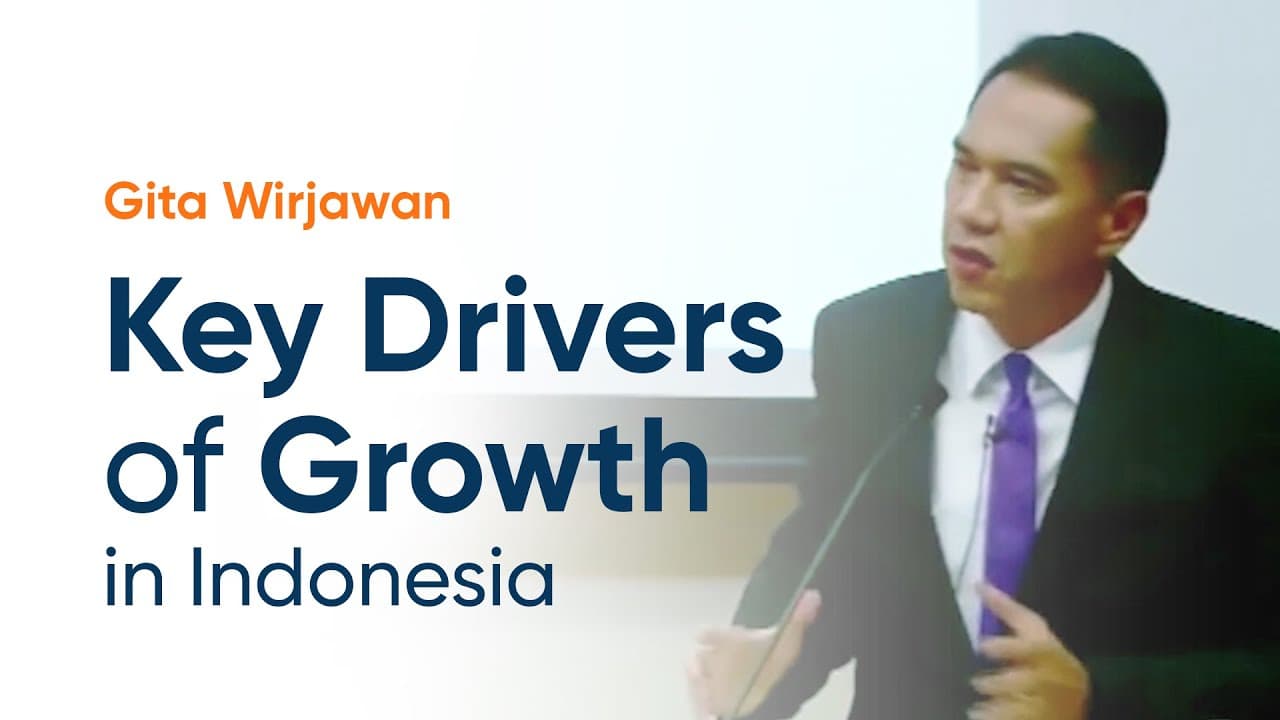
What Is Indonesia's Economic Growth Story and Future?
TL;DR
Indonesia's GDP per capita has risen from $400 to $4,000 in recent decades, with projections reaching $5,000 as it maintains a low debt-to-GDP ratio of 23% and controlled inflation. The country's youthful population presents both opportunities and challenges for economic growth, emphasizing the need for investments in education and infrastructure to enhance its competitiveness.
Transcript
I want to talk to you guys about two things essentially. The first is basically the global economic situation and outlook and the second is about Indonesia, quite obviously. If we take a look at the world today I think it's pretty clear that the freshwater economists predominantly based in Chicago have been very influential in shaping the econ... Read More
Key Insights
- The global economy is influenced by different economic schools, with the US and Europe following liquidity infusion strategies, while others prefer proactive government roles.
- Indonesia's GDP per capita has grown significantly, with projections suggesting further increases under stable economic conditions.
- Indonesia's fiscal health is improving, with a low debt-to-GDP ratio and controlled inflation, despite challenges like low tax collection.
- ASEAN's economic integration efforts, such as RCEP, aim to boost regional trade, but geopolitical tensions and domestic readiness pose challenges.
- Indonesia's youthful demographic presents opportunities and challenges for economic growth, requiring effective policy and infrastructure development.
- Investment in Indonesia is diversifying, with increasing foreign direct investment outside Java, indicating broader economic development.
- The politics of fuel subsidies in Indonesia highlight the tension between economic needs and political interests, affecting fiscal policy.
- Indonesia's future economic growth hinges on improving education and infrastructure, leveraging its fiscal space to enhance competitiveness.
Install to Summarize YouTube Videos and Get Transcripts
Explore YouTube Video Summarizer or Get YouTube Transcript Extractor
Questions & Answers
Q: What are the main challenges facing the global economy?
The global economy faces challenges such as differing economic strategies between liquidity infusion and proactive government roles, slow growth in the US and Europe, and high debt-to-GDP ratios. Additionally, geopolitical tensions and trade integration efforts like RCEP and TPP present complexities for economic resilience.
Q: How has Indonesia's GDP per capita evolved over the years?
Indonesia's GDP per capita has seen significant growth, increasing from $400 during Sukarno's era to $4000 by the end of SBY's term. Projections suggest it could reach $5000 by the end of SBY's tenure, indicating a quintupling within a decade, driven by fiscal stability and economic reforms.
Q: What role does ASEAN play in regional economic integration?
ASEAN plays a crucial role in regional economic integration through initiatives like RCEP, which aims to deepen trade agreements among Asian countries. These efforts are intended to enhance economic resilience and foster investment, though geopolitical tensions and domestic readiness pose challenges.
Q: What are the potential benefits of Indonesia's youthful demographic?
Indonesia's youthful demographic presents significant economic growth potential, offering a large, dynamic workforce and consumer base. However, realizing these benefits requires effective policy, infrastructure development, and investment in education to ensure that the youth are equipped to contribute to and shape the economy.
Q: How is Indonesia managing its fiscal health?
Indonesia is managing its fiscal health by maintaining a low debt-to-GDP ratio of 23% and controlling inflation, which was under 4% in recent years. Despite these achievements, challenges remain, such as low tax collection rates, which limit fiscal capacity for further economic development.
Q: What are the political challenges related to fuel subsidies in Indonesia?
Fuel subsidies in Indonesia present political challenges as they involve balancing economic needs with political interests. Attempts to reform subsidies have faced resistance in parliament, where decisions often reflect party interests over national economic priorities, complicating fiscal policy and economic stability.
Q: How is investment in Indonesia changing?
Investment in Indonesia is diversifying, with increasing foreign direct investment outside Java, indicating broader economic development. In 2012, 46% of total capital formation occurred outside Java, with investments focusing on infrastructure and services, moving up the value chain and reducing reliance on mining.
Q: What is the potential trajectory of Indonesia's economy over the next 20 years?
Indonesia's economy could grow to a GDP of 6 to 7 trillion USD over the next 20 years, assuming a 5% real growth rate and 5% inflation. This trajectory depends on maintaining economic stability and leveraging the country's fiscal space to invest in education and infrastructure, enhancing competitiveness.
Summary & Key Takeaways
-
Indonesia's GDP per capita has increased from $400 to $4000 over recent decades, with projections suggesting further growth to $5000. This growth is supported by a low debt-to-GDP ratio and controlled inflation, though tax collection remains a challenge.
-
ASEAN's regional integration efforts, including RCEP and TPP, are crucial for economic resilience. However, geopolitical tensions and domestic readiness, particularly in Indonesia, affect participation and potential benefits.
-
Indonesia's youthful demographic offers economic growth opportunities, but requires effective policy, infrastructure development, and education investment to harness this potential. Political challenges, such as fuel subsidies, impact fiscal policy and economic stability.
Read in Other Languages (beta)
Share This Summary 📚
Summarize YouTube Videos and Get Video Transcripts with 1-Click
Try YouTube Summary with ChatGPT & Claude or YouTube Transcript Generator
Explore More Summaries from Gita Wirjawan 📚



Summarize YouTube Videos and Get Video Transcripts with 1-Click
Try YouTube Summary with ChatGPT & Claude or YouTube Transcript Generator