How did Ramanujan solve the STRAND puzzle?

TL;DR
This video explores the concept of infinite continued fractions, focusing on Ramanujan's famous strand puzzle and its connection to root 2.
Transcript
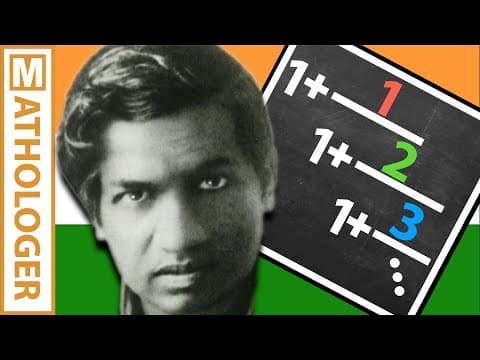
welcome to another mathologer video. many of you will have heard of the indian mathematical genius srinivasa ramanujan. largely self-taught, astonishingly original, died way too young 100 years ago and so on. an incredible story. one of the things ramanujan is famous for are these totally insane infinite continued fraction equations like the one ov... Read More
Key Insights
- ❓ Ramanujan's ability to solve complex infinite continued fractions was a testament to his mathematical genius.
- 🧩 The strand puzzle, solved by Ramanujan using an infinite continued fraction, is connected to the Pell equation.
- 🖐️ The Euclidean algorithm plays a vital role in understanding continued fractions and their relationship to irrational numbers.
- #️⃣ Partial fractions offer rational approximations for irrational numbers, providing insights into their values and properties.
- 🫚 The continued fraction for root 2 exhibits a periodic structure, making it possible to approximate the value accurately using partial fractions.
Install to Summarize YouTube Videos and Get Transcripts
Explore YouTube Video Summarizer or Get YouTube Transcript Extractor
Questions & Answers
Q: What is Ramanujan famous for in mathematics?
Ramanujan is known for his profound insights and contributions to various areas of mathematics, particularly his work with infinite continued fractions.
Q: How did Ramanujan solve the strand puzzle using an infinite continued fraction?
Ramanujan used an infinite continued fraction to derive a solution for the strand puzzle. By understanding the relationship between the puzzle and the Pell equation, he obtained an expression that encompassed all the solutions.
Q: What is the connection between the Euclidean algorithm and continued fractions?
The Euclidean algorithm, a method for finding the greatest common divisor of two numbers, is intimately related to continued fractions. By applying the Euclidean algorithm, one can generate the partial fractions that make up a continued fraction.
Q: How do partial fractions provide rational approximations for irrational numbers?
Partial fractions represent rational numbers that approximate irrational numbers. By evaluating the partial fractions in a continued fraction sequence, one can obtain increasingly accurate approximations of the irrational number.
Summary & Key Takeaways
-
The video introduces Ramanujan and his groundbreaking work in mathematics, including his ability to solve complex infinite continued fractions.
-
It discusses the strand puzzle, which Ramanujan solved using an infinite continued fraction and its connection to the Pell equation.
-
The video explains the concept of the Euclidean algorithm and its relationship to continued fractions.
-
It demonstrates how the infinite continued fraction for root 2 can be generated using the Euclidean algorithm and how partial fractions provide rational approximations for irrational numbers.
-
Expanding on the strand puzzle, the video presents a formula that surpasses Ramanujan's solution, using the relationship between consecutive fractions in the continued fraction sequence.
Read in Other Languages (beta)
Share This Summary 📚
Summarize YouTube Videos and Get Video Transcripts with 1-Click
Try YouTube Summary with ChatGPT & Claude or YouTube Transcript Generator
Explore More Summaries from Mathologer 📚

Summarize YouTube Videos and Get Video Transcripts with 1-Click
Try YouTube Summary with ChatGPT & Claude or YouTube Transcript Generator