What Are the Best Methods for Evaluating Facility Locations?
TL;DR
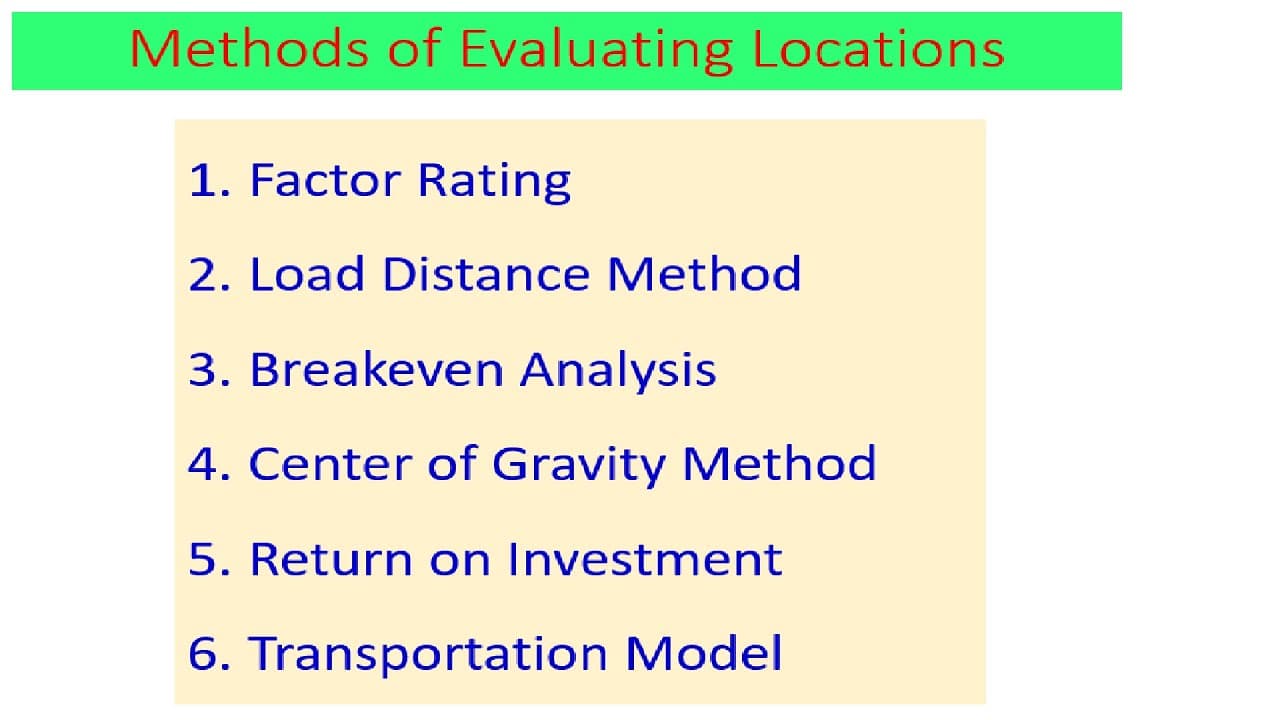
To evaluate facility locations effectively, use methods such as factor rating, load distance, break-even analysis, center of gravity, return on investment, and the transportation model. Each method assesses different aspects, like critical success factors, transportation costs, and financial returns, to identify the most advantageous location for a facility.
Transcript
hello everybody and welcome to this lesson previously we have discussed about facilities location under facilities location we have seen about the importance of facilities location features of facility location when we need to determine facilities location when we need to make a decision about facility location and the other is critical s... Read More
Key Insights
- 🧑🏭 Evaluating location alternatives involves considering factors such as critical success factors, transportation costs, break-even analysis, center of gravity, return on investment, and supply-demand capacities.
- 🧑🏭 The factor rating method assigns weights and scores to each location based on critical success factors to determine the best choice.
- 🍰 The load distance method focuses on selecting the location with the shortest distance to minimize transportation costs.
- 🔈 Break-even analysis compares locations based on their cost-volume analysis and selects the one with the lowest total cost at a specific production volume.
- 🇨🇷 The center of gravity method aims to minimize distribution or transportation costs by considering the location of the market, volume of goods, and shipping costs.
- ↩️ Return on investment compares locations based on their financial return, considering factors such as expenses, initial investment, and total expected sales.
Install to Summarize YouTube Videos and Get Transcripts
Explore YouTube Video Summarizer or Get YouTube Transcript Extractor
Questions & Answers
Q: What is the factor rating method for evaluating location alternatives?
The factor rating method involves identifying critical success factors, assigning weights to these factors based on their relative importance, and scoring each location based on these factors. The location with the highest rating is considered the best choice.
Q: How does the load distance method work?
The load distance method aims to minimize transportation costs by selecting the location closest to the supply, demand, or market. It calculates the distance between locations and chooses the one with the shortest distance.
Q: What is break-even analysis in the context of evaluating location alternatives?
Break-even analysis compares locations based on their cost-volume analysis. By plotting the total cost for each location against the expected production volume, the location with the lowest total cost at a specific production volume is chosen.
Q: How does the center of gravity method evaluate location alternatives?
The center of gravity method aims to minimize distribution or transportation costs. It considers factors such as the location of the market, volume of goods, and shipping costs, and calculates the center of gravity based on these factors.
Q: How is return on investment used to evaluate location alternatives?
Return on investment compares locations based on their financial return. It takes into account factors such as expenses, initial investment, and total expected sales. The location with the highest return on investment is considered the best choice.
Q: What is the transportation model method for evaluating location alternatives?
The transportation model method uses linear programming to minimize the cost of distributing a product from multiple sources to multiple destinations. It considers supply and demand capacities and aims to find the most cost-effective distribution plan.
Summary & Key Takeaways
-
The lesson introduces methods for evaluating location alternatives, which include factor rating, load distance, break-even analysis, center of gravity, return on investment, and transportation model.
-
The factor rating method involves identifying critical success factors, assigning weights to these factors, and scoring each location based on these factors. The location with the highest rating is considered the best.
-
The load distance method focuses on minimizing transportation costs by selecting the location closest to the supply, demand, or market.
-
The break-even analysis method compares locations based on their cost-volume analysis and selects the location with the lowest total cost for a specific production volume.
-
The center of gravity method aims to minimize distribution or transportation costs and considers the location of the market, volume of goods, and shipping costs.
-
The return on investment method compares locations based on their financial return, considering factors such as expenses, initial investment, and total expected sales.
-
The transportation model method uses linear programming to minimize the cost of distributing a product from multiple sources to multiple destinations, taking into account supply and demand capacities.
Read in Other Languages (beta)
Share This Summary 📚
Summarize YouTube Videos and Get Video Transcripts with 1-Click
Try YouTube Summary with ChatGPT & Claude or YouTube Transcript Generator
Explore More Summaries from Solomon Getachew 📚

Summarize YouTube Videos and Get Video Transcripts with 1-Click
Try YouTube Summary with ChatGPT & Claude or YouTube Transcript Generator