Frequency Division Multiplexing (FDM) Explained
TL;DR
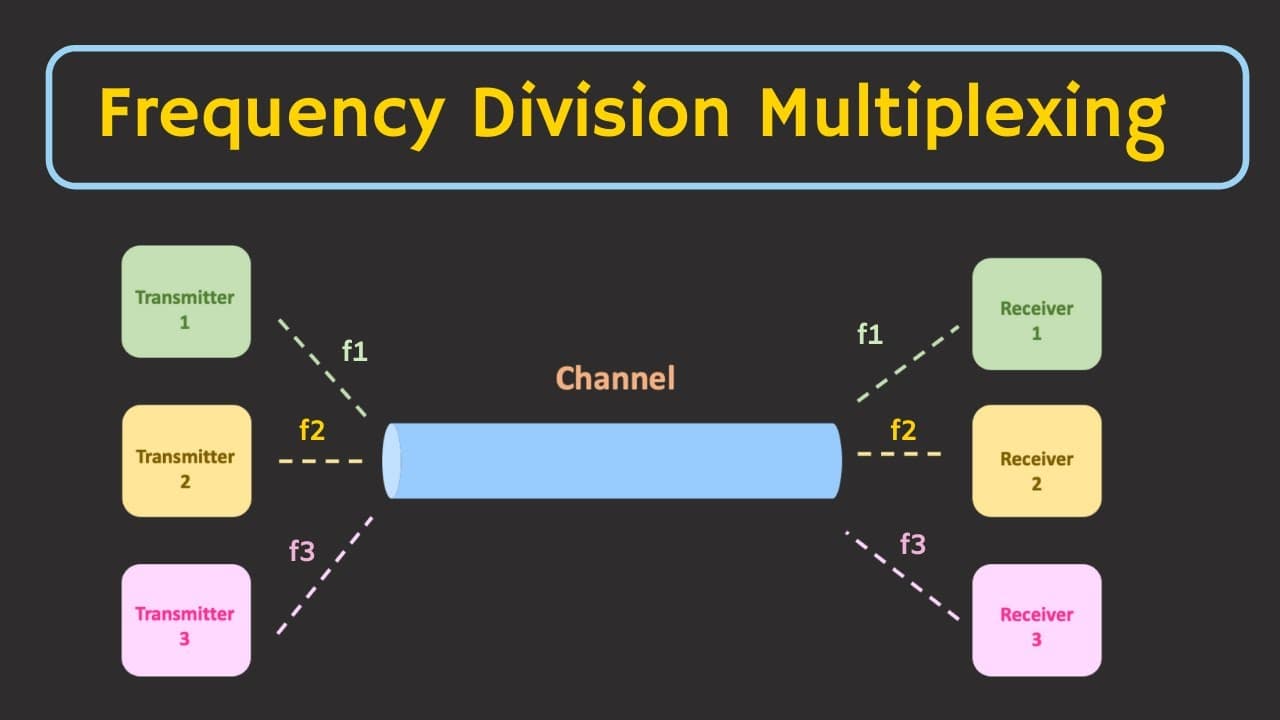
Frequency Division Multiplexing is a technique that allows multiple signals to be transmitted simultaneously through a single channel by modulating message signals at different carrier frequencies.
Transcript
Hey, friends welcome to the YouTube channel ALL ABOUT ELECTRONICS. So in this video, we will learn what is frequency division multiplexing. So first of all, let us understand what is multiplexing, and the importance of the multiplexing in the communication. So in a broad sense, this is the typical communication link, which consists of t... Read More
Key Insights
- 📡 Frequency Division Multiplexing allows multiple signals to be transmitted simultaneously through a single channel by modulating message signals at different carrier frequencies.
- 🤕 Band pass filters at the receiver separate the individual message signals.
- 📻 Frequency Division Multiplexing is used in radio, television, telemetry, telephony, and cellular networks.
- ➗ Different types of multiplexing include frequency division, time division, and wavelength division.
- 📡 In Frequency Division Multiplexing, there should be enough separation between carrier signals to avoid interference.
- 🔂 Conventional AM and DSB-SC modulation require a minimum separation of 2B, while single sideband modulation requires a minimum separation of B.
- 😒 The use of guard bands allows more signals to be accommodated in the given channel bandwidth.
Install to Summarize YouTube Videos and Get Transcripts
Explore YouTube Video Summarizer or Get YouTube Transcript Extractor
Questions & Answers
Q: What is Frequency Division Multiplexing?
Frequency Division Multiplexing is a technique used in communication to transmit multiple signals simultaneously through a single channel by modulating message signals at different carrier frequencies and combining them into a composite signal.
Q: How is Frequency Division Multiplexing different from Time Division Multiplexing and Wavelength Division Multiplexing?
Frequency Division Multiplexing combines message signals at different frequencies, Time Division Multiplexing combines message signals at different time slots, and Wavelength Division Multiplexing combines message signals of different wavelengths.
Q: What is the purpose of the band pass filters in Frequency Division Multiplexing?
The band pass filters in Frequency Division Multiplexing are used to separate the individual message signals at the receiver by tuning each filter to a specific carrier frequency and passing the corresponding message signal.
Q: What are the applications of Frequency Division Multiplexing?
Frequency Division Multiplexing is used in radio and television broadcasting, telemetry systems, telephony systems, and early generation cellular networks.
Key Insights:
- Frequency Division Multiplexing allows multiple signals to be transmitted simultaneously through a single channel by modulating message signals at different carrier frequencies.
- Band pass filters at the receiver separate the individual message signals.
- Frequency Division Multiplexing is used in radio, television, telemetry, telephony, and cellular networks.
- Different types of multiplexing include frequency division, time division, and wavelength division.
- In Frequency Division Multiplexing, there should be enough separation between carrier signals to avoid interference.
- Conventional AM and DSB-SC modulation require a minimum separation of 2B, while single sideband modulation requires a minimum separation of B.
- The use of guard bands allows more signals to be accommodated in the given channel bandwidth.
- Frequency Division Multiplexing is commonly used in telephony systems to multiplex voice signals.
Summary & Key Takeaways
-
Frequency Division Multiplexing is a technique that allows multiple signals to share a channel, increasing channel efficiency.
-
In Frequency Division Multiplexing, message signals are modulated at different carrier frequencies and combined into a single composite signal.
-
At the receiver, the composite signal is demultiplexed, separating the individual message signals.
Read in Other Languages (beta)
Share This Summary 📚
Summarize YouTube Videos and Get Video Transcripts with 1-Click
Try YouTube Summary with ChatGPT & Claude or YouTube Transcript Generator
Explore More Summaries from ALL ABOUT ELECTRONICS 📚
Summarize YouTube Videos and Get Video Transcripts with 1-Click
Try YouTube Summary with ChatGPT & Claude or YouTube Transcript Generator