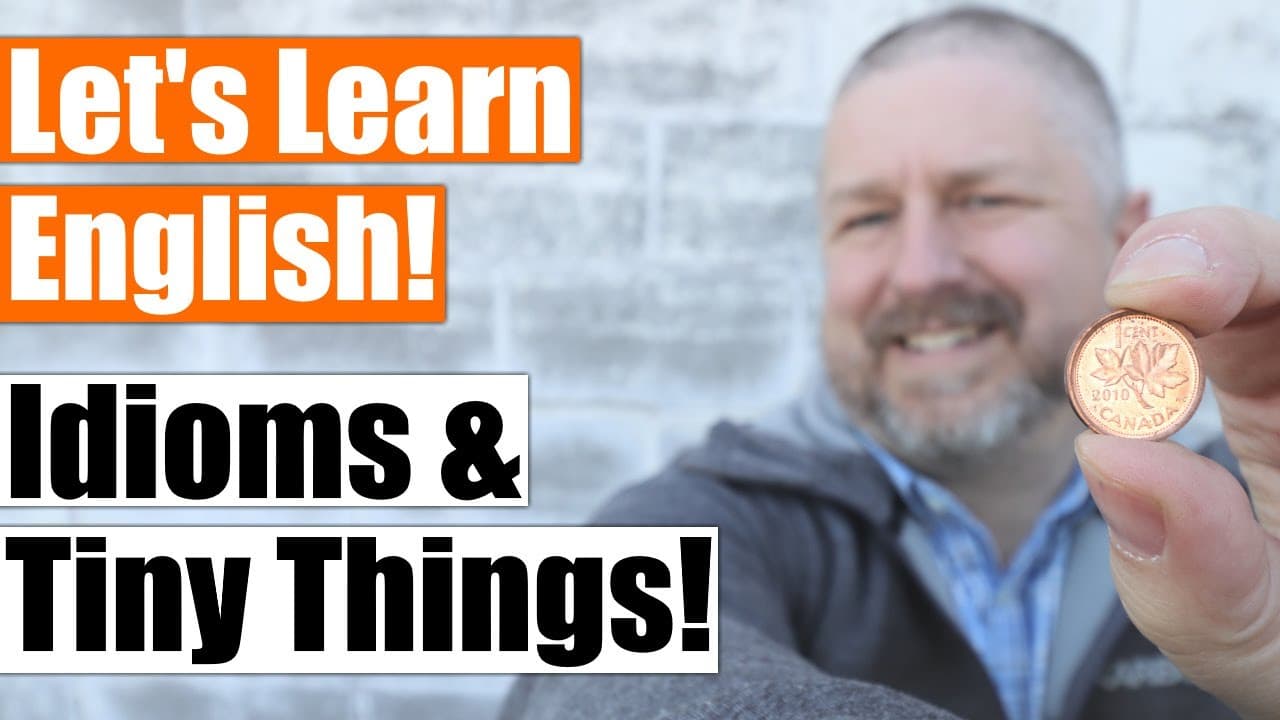
An English Lesson about Idioms and Tiny Things!
TL;DR
Learn English idioms and phrases related to small objects like salt, penny, ring, pin, seed, hair, and cookie.
Transcript
Hi, Bob the Canadian here. Welcome to this English lesson where I'm going to talk about, a few really little things. I'm going to talk about some tiny things. And not only will I tell you what it is, but I'm also going to teach you a few English phrases, or a few English idioms that use the name of that tiny thing. (pop music) Well hey, welcome to ... Read More
Key Insights
- 🛩️ English idioms often incorporate references to small objects or things.
- 🧂 Idioms like "salt of the earth" and "a penny saved is a penny earned" convey valuable life lessons.
- 😋 Phrases such as "to give someone a ring" and "to let your hair down" have nuanced meanings in English.
- 😑 Understanding idiomatic expressions can enhance language fluency and communication skills.
- 🪜 Learning idioms related to everyday objects adds depth to language proficiency and cultural understanding.
- 😴 Idioms involving hair, pins, seeds, and cookies provide insights into English language usage.
- 😑 Exploring idioms about tiny things can help learners expand their vocabulary and express ideas creatively.
Install to Summarize YouTube Videos and Get Transcripts
Explore YouTube Video Summarizer or Get YouTube Transcript Extractor
Questions & Answers
Q: What does "dot your i's and cross your t's" mean in English?
"Dot your i's and cross your t's" means to do a job thoroughly and completely, ensuring that it is done well and with attention to detail.
Q: How can you use the phrase "rubbing salt in someone's wounds" in a sentence?
You can use "rubbing salt in someone's wounds" to describe someone continuously reminding another person of a negative event, making them feel worse about it.
Q: What does the phrase "a penny saved is a penny earned" imply?
The phrase "a penny saved is a penny earned" suggests that saving money is equivalent to earning money because not spending it translates to financial gain.
Q: How is the phrase "to plant a seed in someone's mind" different from its literal meaning?
While planting a seed literally means putting it in the ground, planting a seed in someone's mind means giving them an idea or suggestion.
Summary & Key Takeaways
-
Discusses English phrases related to small objects like the dot on "i", salt, penny, ring, pin, seed, hair, and cookie.
-
Explains idioms such as "dot your i's and cross your t's," "salt of the earth," "penny for your thoughts," and more.
-
Teaches how to use these phrases in everyday conversations and provides context for each.
Read in Other Languages (beta)
Share This Summary 📚
Summarize YouTube Videos and Get Video Transcripts with 1-Click
Try YouTube Summary with ChatGPT & Claude or YouTube Transcript Generator
Explore More Summaries from Learn English with Bob the Canadian 📚





Summarize YouTube Videos and Get Video Transcripts with 1-Click
Try YouTube Summary with ChatGPT & Claude or YouTube Transcript Generator