How to Describe People in Portuguese
TL;DR
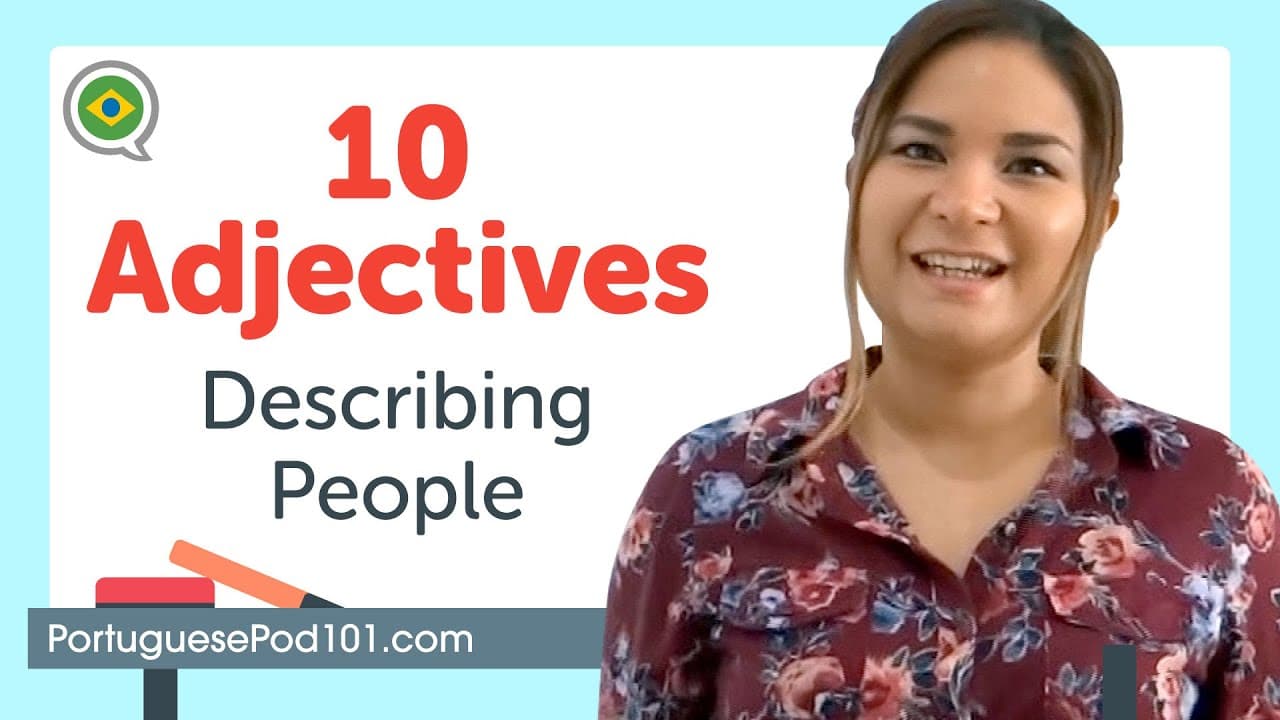
Learn the top 10 adjectives in Portuguese to describe people effectively. This video covers essential descriptors like 'young', 'old', 'short', and 'tall' among others, providing both masculine and feminine forms. It serves as a practical guide for beginners to enhance their vocabulary and improve their Portuguese language skills.
Transcript
Wan to speak real portuguese from your first lesson sign up for your free Lifetime account at portuguesepod101 [Música] docom Hi everyone here is palem from portuges.com Welcome to whiteboard lessons today we are going to talk about top 10 adjectives to describe people Ok so first novo novo and nova nova means Young novo nova next we have velho vel... Read More
Key Insights
- Novo and nova mean 'young' in Portuguese, with 'novo' being masculine and 'nova' being feminine.
- Velho and velha are used to describe someone as 'old', with 'velho' for males and 'velha' for females.
- Baixo and baixa translate to 'short', with 'baixo' for males and 'baixa' for females.
- Alto and alta mean 'tall', with 'alto' being the masculine form and 'alta' the feminine form.
- Magro and magra are used to describe someone as 'thin', with 'magro' for males and 'magra' for females.
- Gordo and gorda mean 'fat', with 'gordo' being masculine and 'gorda' being feminine.
- Feio and feia translate to 'ugly', with 'feio' for males and 'feia' for females.
- Bonito and bonita mean 'pretty', with 'bonito' for males and 'bonita' for females.
Install to Summarize YouTube Videos and Get Transcripts
Explore YouTube Video Summarizer or Get YouTube Transcript Extractor
Questions & Answers
Q: How to say 'young' in Portuguese?
In Portuguese, 'young' is translated as 'novo' for males and 'nova' for females. These adjectives are commonly used to describe someone who is youthful in appearance or age. It's important to use the correct gender form when describing a person in Portuguese.
Q: What is the Portuguese word for 'old'?
The word 'old' in Portuguese is 'velho' for males and 'velha' for females. These adjectives are used to describe someone who is advanced in age. As with many Portuguese adjectives, they change form based on the gender of the person being described.
Q: How do you say 'short' in Portuguese?
The word for 'short' in Portuguese is 'baixo' for males and 'baixa' for females. These adjectives are used to describe someone of short stature. It's essential to use the gender-appropriate form when speaking or writing in Portuguese.
Q: What is the Portuguese adjective for 'tall'?
In Portuguese, 'tall' is expressed as 'alto' for males and 'alta' for females. These adjectives are used to describe someone who is of considerable height. The distinction between masculine and feminine forms is important in Portuguese grammar.
Q: How to describe someone as 'thin' in Portuguese?
To describe someone as 'thin' in Portuguese, you would use 'magro' for males and 'magra' for females. These adjectives are part of the basic vocabulary for describing physical appearance in Portuguese, and gender agreement is crucial.
Q: What is the translation for 'fat' in Portuguese?
The Portuguese word for 'fat' is 'gordo' for males and 'gorda' for females. These adjectives are used to describe someone with a larger body size. As with other adjectives, the form changes based on the gender of the person being described.
Q: How do you say 'ugly' in Portuguese?
The word for 'ugly' in Portuguese is 'feio' for males and 'feia' for females. These adjectives are used to describe someone who is not conventionally attractive. Gender-specific forms are an essential part of Portuguese adjective usage.
Q: What is the Portuguese word for 'pretty'?
In Portuguese, 'pretty' is translated as 'bonito' for males and 'bonita' for females. These adjectives are used to describe someone who is attractive or pleasing in appearance. Using the correct form based on gender is important in Portuguese.
Summary & Key Takeaways
-
The video introduces Portuguese adjectives to describe people, focusing on both masculine and feminine forms. Key adjectives include 'novo/nova' for 'young' and 'velho/velha' for 'old'.
-
Viewers learn how to say 'short' and 'tall' with 'baixo/baixa' and 'alto/alta', respectively. The lesson also covers 'magro/magra' for 'thin' and 'gordo/gorda' for 'fat'.
-
The video concludes with adjectives for attractiveness, teaching 'feio/feia' for 'ugly' and 'bonito/bonita' for 'pretty', providing a comprehensive vocabulary for describing people.
Read in Other Languages (beta)
Share This Summary 📚
Summarize YouTube Videos and Get Video Transcripts with 1-Click
Try YouTube Summary with ChatGPT & Claude or YouTube Transcript Generator
Explore More Summaries from Learn Portuguese with PortuguesePod101.com 📚





Summarize YouTube Videos and Get Video Transcripts with 1-Click
Try YouTube Summary with ChatGPT & Claude or YouTube Transcript Generator