8.2.6 Part 1 Wrap-up
TL;DR
This comprehensive analysis covers the main topics discussed in a course on design tradeoffs in digital systems.
Transcript
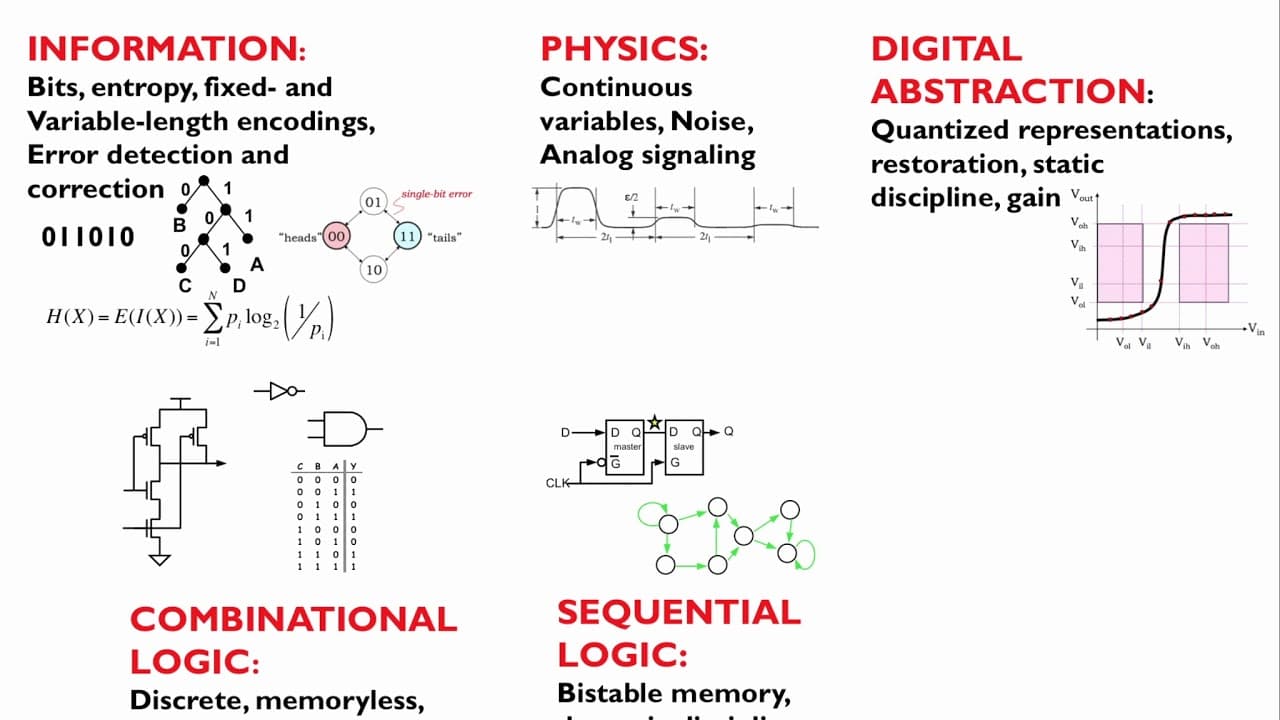
This discussion of design tradeoffs completes Part 1 of the course. We've covered a lot of ground in the last eight lectures. We started by looking at the mathematics underlying information theory and used it to help evaluate various alternative ways of effectively using sequences of bits to encode information content. Then we turned our attention ... Read More
Key Insights
- 💁 Information theory and encodings are fundamental to effectively using sequences of bits for encoding information content.
- 🕵️ Redundancies can be added to encodings to detect and correct errors.
- 🧡 Analog signaling accumulates errors, but digital signaling using specific voltage ranges can mitigate this.
- 🚱 The static discipline requires combinational devices to be non-linear and exhibit gains > 1.
- ⚡ MOSFETs are used as voltage-controlled switches in CMOS combinational logic gates.
- 🌥️ Synthesizing larger combinational circuits enables the implementation of any desired functionality.
- 🤩 Bistable storage elements and finite-state machines are key components of sequential logic.
Install to Summarize YouTube Videos and Get Transcripts
Explore YouTube Video Summarizer or Get YouTube Transcript Extractor
Questions & Answers
Q: What were the main topics covered in the course on design tradeoffs in digital systems?
The course covered information theory, encodings, error detection and correction, analog signaling, combinational logic, storage elements, finite-state machines, latency and throughput, and tradeoffs in power dissipation and performance.
Q: How were MOSFETs used in building CMOS combinational logic gates?
MOSFETs were used as voltage-controlled switches in building CMOS combinational logic gates, which adhered to the criteria of the static discipline and met the requirements for building digital systems.
Q: How were larger combinational circuits synthesized in the course?
Systematic techniques were taught to synthesize larger combinational circuits capable of implementing any functionality expressed in the form of a truth table. These techniques allowed for efficient design and implementation.
Q: How were asynchronous inputs handled in the course?
The course covered techniques to minimize the chance of incorrect operation due to metastability when dealing with asynchronous inputs. These techniques ensured proper handling and synchronization of asynchronous signals.
Summary & Key Takeaways
-
The course covered topics such as information theory, encodings, error detection and correction, analog signaling, combinational logic, storage elements, finite-state machines, latency and throughput, and tradeoffs in power dissipation and performance.
-
Students learned about various techniques and disciplines used in designing digital systems, including the use of MOSFETs, CMOS combinational logic gates, and systematic synthesis of larger circuits.
-
The course also addressed handling asynchronous inputs and achieving maximum throughput while considering power dissipation.
Read in Other Languages (beta)
Share This Summary 📚
Summarize YouTube Videos and Get Video Transcripts with 1-Click
Try YouTube Summary with ChatGPT & Claude or YouTube Transcript Generator
Explore More Summaries from MIT OpenCourseWare 📚



Summarize YouTube Videos and Get Video Transcripts with 1-Click
Try YouTube Summary with ChatGPT & Claude or YouTube Transcript Generator