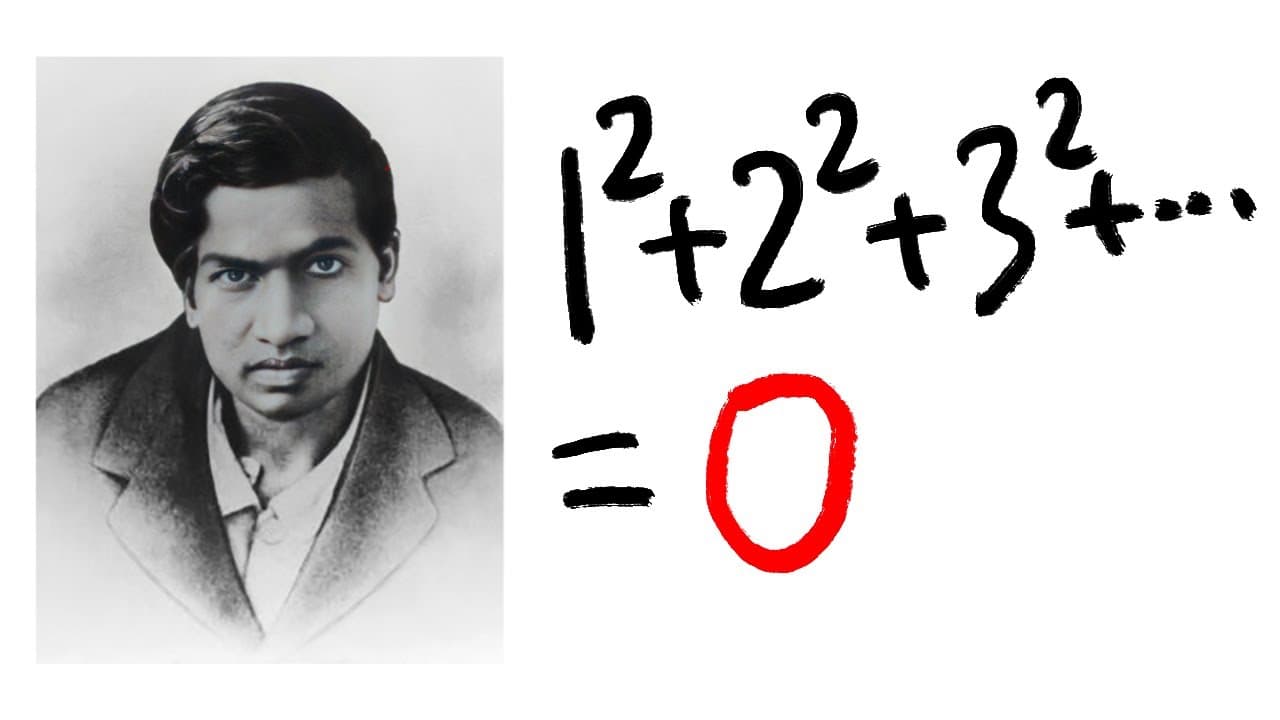
how Ramanujan did 1^2+2^2+3^2+...=0
TL;DR
This content analyzes Ramanujan summation and explores the series 1^2+2^2+3^2+... to understand its properties.
Transcript
Ramanujan summation 1^2+2^2+3^2+... Read More
Key Insights
- ❓ Ramanujan summation is a technique used to assign values to divergent series.
- ❓ The series 1^2+2^2+3^2+... is divergent and assigned a value of -1/12 using Ramanujan summation.
- 🏑 Ramanujan summation is a powerful tool in mathematics, used in diverse fields such as quantum physics and complex analysis.
- ❓ Despite its controversial nature, Ramanujan summation provides meaningful results in certain mathematical contexts.
- 💨 Divergent series pose challenges in traditional mathematical calculations, but Ramanujan summation offers a way to handle them.
- ❓ Ramanujan summation requires an understanding of advanced mathematical concepts and techniques.
- ❓ The value assigned by Ramanujan summation may seem counterintuitive, but it is obtained through rigorous mathematical reasoning.
Install to Summarize YouTube Videos and Get Transcripts
Explore YouTube Video Summarizer or Get YouTube Transcript Extractor
Questions & Answers
Q: How does Ramanujan summation assign a value to a divergent series?
Ramanujan summation uses a mathematical technique to assign a finite value to divergent series. It involves manipulating the series to transform it into a convergent series, allowing for a valid sum.
Q: Why is the value of -1/12 assigned to the series 1^2+2^2+3^2+...?
The value of -1/12 is assigned based on the mathematical properties of the series and the techniques used in Ramanujan summation. It is not the actual sum of the series but a result of the summation technique.
Q: How is the series 1^2+2^2+3^2+... different from a convergent series?
A convergent series converges to a finite value as the number of terms increases, while a divergent series does not. The series 1^2+2^2+3^2+... does not converge to a finite value and requires a summation technique like Ramanujan summation for an assigned value.
Q: What are the applications of Ramanujan summation in mathematics?
Ramanujan summation has applications in various mathematical fields, including quantum field theory, string theory, and complex analysis. It allows mathematicians to manipulate divergent series and assign meaningful values.
Summary & Key Takeaways
-
Ramanujan summation is a technique used to assign a value to divergent series that would otherwise be undefined.
-
The series 1^2+2^2+3^2+... is an example of a divergent series, meaning it does not converge to a finite value.
-
Ramanujan summation assigns a value of -1/12 to the series 1^2+2^2+3^2+..., despite the series diverging.
Read in Other Languages (beta)
Share This Summary 📚
Summarize YouTube Videos and Get Video Transcripts with 1-Click
Try YouTube Summary with ChatGPT & Claude or YouTube Transcript Generator
Explore More Summaries from blackpenredpen 📚
Summarize YouTube Videos and Get Video Transcripts with 1-Click
Try YouTube Summary with ChatGPT & Claude or YouTube Transcript Generator