(Q14) Sample #1, Math 141/146 common final, completing the square
TL;DR
Learn how to solve a quadratic equation by completing the square, using a step-by-step method.
Transcript
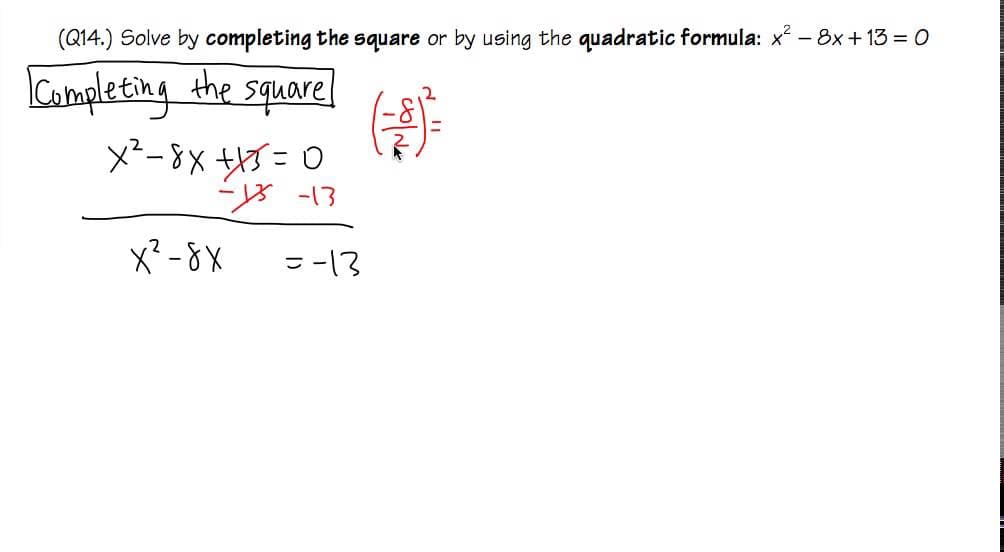
okay for number 14 we are going to solve another quadratic equation x squared minus 8x plus 13 is equal to 0. notice that this equation is not factorable but it's okay because we learned the completing a square and also the quadratic formula in order for us to solve this let me go over the completing square first x squared minus ax plus 13 equals t... Read More
Key Insights
- ❎ Completing the square is a reliable method for solving quadratic equations that are not factorable.
- 🙃 The process involves adding a specific constant to both sides to create a perfect square trinomial.
- 🙃 Taking the square root of both sides helps in finding the solutions.
- 🍉 It is important to remember the ± when taking the square root of the constant term.
- 🙃 Completing the square guarantees that the equation will have the same factors on both sides.
- 💦 The coefficient of the x^2 term must be 1 for completing the square to work effectively.
- ❎ The quadratic formula is an alternative method for solving quadratic equations, but completing the square is more useful when factoring is not possible.
Install to Summarize YouTube Videos and Get Transcripts
Explore YouTube Video Summarizer or Get YouTube Transcript Extractor
Questions & Answers
Q: How do you solve a quadratic equation using completing the square?
To solve a quadratic equation using completing the square, start by making sure the coefficient of the x^2 term is 1. Then, find the number to be added to both sides, which is half the coefficient of the x term squared. Proceed with taking the square root and adding the necessary constants.
Q: Why is completing the square useful for solving quadratic equations?
Completing the square allows us to solve quadratic equations that are not easily factorable. It is a reliable method that guarantees factorability and provides an accurate solution.
Q: Can you explain the steps involved in completing the square?
The steps in completing the square include getting the equation in the form x^2 + bx = c, finding the value to be added to both sides (half the coefficient of x squared), adding that value, simplifying the equation, and finally taking the square root and solving for x.
Q: What happens if the quadratic equation is already factorable?
If the quadratic equation is already factorable, completing the square may not be necessary. You can use the factoring method to find the solutions directly.
Summary & Key Takeaways
-
To solve x^2 - 8x + 13 = 0, which is not factorable, we can use the completing the square method.
-
By adding 16 on both sides, the equation becomes (x - 4)^2 = 3.
-
Taking the square root on both sides, we get x - 4 = ±√3, and after adding 4, the solution is x = 4 ± √3.
Read in Other Languages (beta)
Share This Summary 📚
Summarize YouTube Videos and Get Video Transcripts with 1-Click
Try YouTube Summary with ChatGPT & Claude or YouTube Transcript Generator
Explore More Summaries from blackpenredpen 📚

Summarize YouTube Videos and Get Video Transcripts with 1-Click
Try YouTube Summary with ChatGPT & Claude or YouTube Transcript Generator