5.2 Participant Observation and Structured Observation
TL;DR
Observation is a valuable method for collecting primary data, allowing researchers to understand what people do and the meanings they attach to their actions.
Transcript
welcome to the second video of the fifth module in the course where we are learning how to write a proper research thesis now in the previous video we have started to discuss data collection this wall module is dedicated to a data collection so we have discussed secondary data that we can use for our research now in these upcoming videos we need to... Read More
Key Insights
- 👨🔬 Observation is a valuable method for collecting primary data, particularly when the research aim is focused on understanding human actions and behaviors.
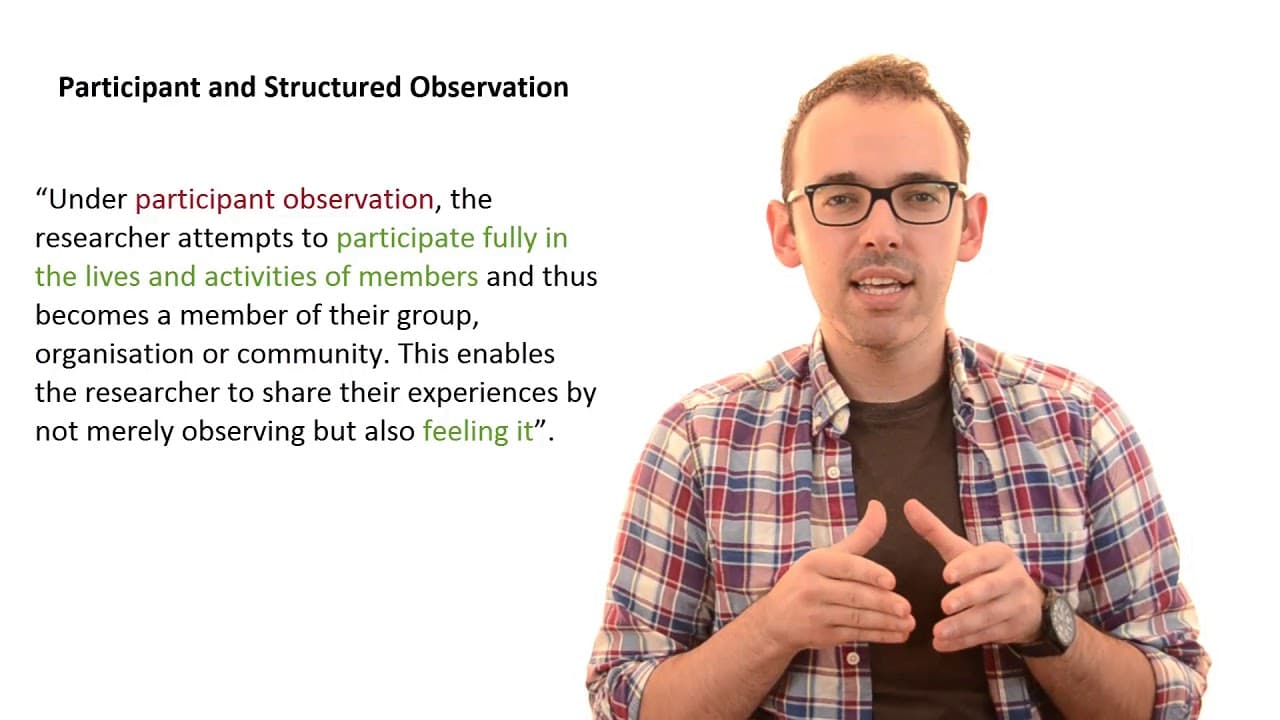
- 👻 Participant observation allows researchers to become part of the group being studied, uncovering subjective patterns, feelings, and meanings attached to actions.
- ❓ Structured observation is more objective and focuses on quantifying the frequency of actions, often used in situations where concealing the researcher's identity is necessary.
- ❓ Complete participant observation involves the researcher actively participating in the phenomenon being studied, while complete observer observation involves purely observing without becoming involved.
- 🤑 Observation can provide rich and detailed data, particularly when studying behaviors and actions that may not be accurately captured through other methods.
- 🥡 Ethical considerations must be taken into account when using observation as a data collection method, particularly in cases where complete participation or concealed identity is necessary.
- 👯 Participant observation can be particularly useful when studying sensitive or hidden behaviors, as people may be more likely to reveal their actions when they are unaware of being observed.
Install to Summarize YouTube Videos and Get Transcripts
Explore YouTube Video Summarizer or Get YouTube Transcript Extractor
Questions & Answers
Q: When is observation a suitable data collection method?
Observation is ideal when the research aim is focused on understanding human actions and behaviors, allowing for a direct observation of what they do.
Q: What is the difference between participant observation and structured observation?
Participant observation involves the researcher becoming a part of the group being studied, while structured observation is more objective and focuses on measuring the frequency of actions.
Q: What are the advantages of participant observation?
Participant observation allows researchers to uncover nuances of meaning that people attach to events or actions, as well as subjective feelings and opinions, providing rich and detailed data.
Q: In what situations would a complete observer be used?
Complete observation is commonly used in situations where it is important to conceal the researcher's identity, such as observing consumer behavior in supermarkets.
Key Insights:
- Observation is a valuable method for collecting primary data, particularly when the research aim is focused on understanding human actions and behaviors.
- Participant observation allows researchers to become part of the group being studied, uncovering subjective patterns, feelings, and meanings attached to actions.
- Structured observation is more objective and focuses on quantifying the frequency of actions, often used in situations where concealing the researcher's identity is necessary.
- Complete participant observation involves the researcher actively participating in the phenomenon being studied, while complete observer observation involves purely observing without becoming involved.
- Observation can provide rich and detailed data, particularly when studying behaviors and actions that may not be accurately captured through other methods.
- Ethical considerations must be taken into account when using observation as a data collection method, particularly in cases where complete participation or concealed identity is necessary.
- Participant observation can be particularly useful when studying sensitive or hidden behaviors, as people may be more likely to reveal their actions when they are unaware of being observed.
- Observation is often used in organizational research to study employee behavior, consumer behavior, and workplace dynamics.
Summary & Key Takeaways
-
This video discusses two types of observations: participant observation, which focuses on understanding the meanings people attach to their actions, and structured observation, which is more quantitative and measures the frequency of actions.
-
Participant observation involves the researcher becoming part of the group or community being studied, allowing them to feel and experience what others do and uncover subjective patterns and feelings.
-
Structured observation is more objective and involves the researcher observing action without becoming actively involved, often used in situations where a concealed identity is necessary.
Read in Other Languages (beta)
Share This Summary 📚
Summarize YouTube Videos and Get Video Transcripts with 1-Click
Try YouTube Summary with ChatGPT & Claude or YouTube Transcript Generator