Tutorial 5.2: Tomer Ullman - Church Programming Language Part 2
TL;DR
Probabilistic programming allows for planning, inference, and understanding implicatures by using generative models and sampling techniques.
Transcript
The following content is provided under a Creative Commons license. Your support will help MIT OpenCourseWare continue to offer high quality educational resources for free. To make a donation or view additional materials from hundreds of MIT courses, visit MIT OpenCourseWare at ocw.mit.edu. TOMER ULLMAN: So so far, we've talked about just examples ... Read More
Key Insights
- 👻 Probabilistic programming allows for planning and inference by conditioning generative models on observed data or goals.
- ❓ Sampling and rejection methods can be used to explore different hypotheses and estimate posterior distributions.
Install to Summarize YouTube Videos and Get Transcripts
Explore YouTube Video Summarizer or Get YouTube Transcript Extractor
Questions & Answers
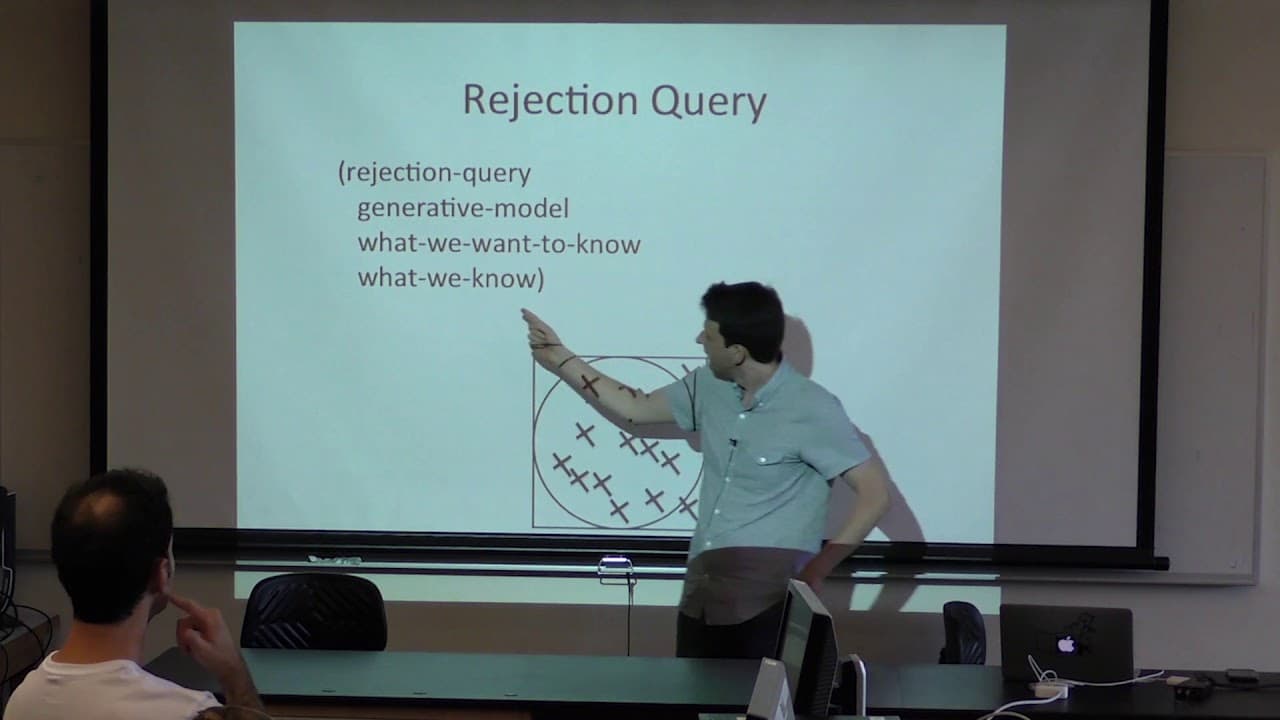
Q: How does rejection query work?
Rejection query involves sampling from a simple distribution and checking if it satisfies the desired condition. If it does, the sample is accepted; otherwise, it is rejected and a new sample is drawn.
Q: What is Metropolis Hastings and how does it relate to probabilistic programming?
Metropolis Hastings is an algorithm used for Markov Chain Monte Carlo (MCMC) sampling, which is a common technique in probabilistic programming. MCMC methods are used to sample from complex posterior distributions when direct sampling is not possible.
Q: What is implicature and how can it be modeled using probabilistic programming?
Implicature is a pragmatic inference that a listener makes based on what a speaker says. It can be modeled using probabilistic programming by defining a generative model of the speaker and listener and reasoning about their goals, beliefs, and actions.
Summary & Key Takeaways
-
Probabilistic programming involves writing generative models that describe how we think the world works.
-
Inference and planning can be done by conditioning the generative model on observed data or goals, and sampling from the posterior distribution.
-
Implicature can also be modeled using probabilistic programming, where the speaker and listener reason about each other's intentions and beliefs.
Read in Other Languages (beta)
Share This Summary 📚
Summarize YouTube Videos and Get Video Transcripts with 1-Click
Try YouTube Summary with ChatGPT & Claude or YouTube Transcript Generator
Explore More Summaries from MIT OpenCourseWare 📚



Summarize YouTube Videos and Get Video Transcripts with 1-Click
Try YouTube Summary with ChatGPT & Claude or YouTube Transcript Generator