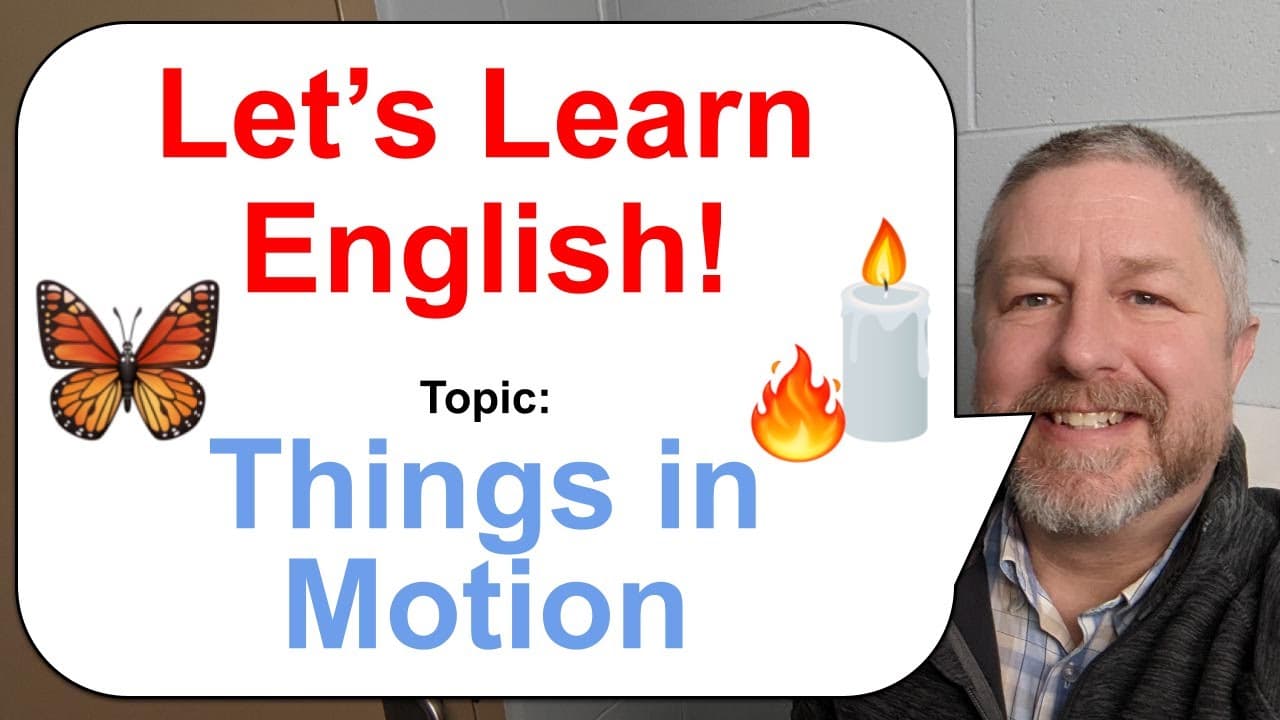
Let's Learn English! Topic: Things in Motion 🕯️🦋🔥
TL;DR
Learn various motion verbs in English with examples and explanations.
Transcript
foreign I hope you're ready to learn a lot about things in motion you'll see what the lesson is about in a moment sorry I seem to have a box under my desk let me move that for a sec there we go I don't want to be kicking it we'll start in about 26 seconds once I make sure everything is working properly sounds like the sound is working so we'll star... Read More
Key Insights
- ❓ Learning about motion vocabulary enriches your English language skills and enables better communication.
- ❓ Understanding how different verbs describe actions in motion enhances your descriptive abilities.
- 🍉 Practicing motion-related terms through real-world examples provides a clear understanding of their usage.
- ❓ Connecting with educational content that incorporates visuals and explanations fosters a more engaging learning experience.
- 🧡 Exploring a range of action verbs related to movement deepens your comprehension of the English language.
- 🦻 Engaging in interactive lessons focused on motion-related vocabulary aids in vocabulary retention and application.
- 🆘 Incorporating various verbs for motion in daily practice helps in expanding your language proficiency.
Install to Summarize YouTube Videos and Get Transcripts
Explore YouTube Video Summarizer or Get YouTube Transcript Extractor
Questions & Answers
Q: What does it mean to absorb something?
Absorption occurs when one substance takes in or soaks up another substance, like a sponge absorbing liquid. It is a common occurrence when cleaning up spills.
Q: How is the word "emit" usually used?
"Emit" is often used to describe the release or discharge of something, such as a factory emitting pollution into the atmosphere. It signifies something coming out or being given off.
Q: Can you differentiate between "flap" and "flutter" in terms of motion?
While both involve repetitive movements, "flap" typically signifies a more forceful swinging motion, like a flag flapping in the wind. On the other hand, "flutter" suggests a lighter, quicker back-and-forth movement, akin to butterfly wings fluttering.
Q: Provide an example of something that can float.
Objects like boats, balls, or even human beings can float on water, meaning they stay on the surface without sinking. The buoyancy of an object determines its ability to float.
Summary & Key Takeaways
-
Explore action words like ripple, sliding, spinning, hovering, and more in a dynamic English lesson.
-
Understand the meanings and usage of verbs such as absorb, emit, and flutter through real-life examples.
-
Enhance your vocabulary with motion-related terms like vibrate, sway, and topple in an engaging presentation.
Read in Other Languages (beta)
Share This Summary 📚
Summarize YouTube Videos and Get Video Transcripts with 1-Click
Try YouTube Summary with ChatGPT & Claude or YouTube Transcript Generator
Explore More Summaries from Learn English with Bob the Canadian 📚


Summarize YouTube Videos and Get Video Transcripts with 1-Click
Try YouTube Summary with ChatGPT & Claude or YouTube Transcript Generator