What Is a Resource Allocation Graph and Its Role in Deadlock?
TL;DR
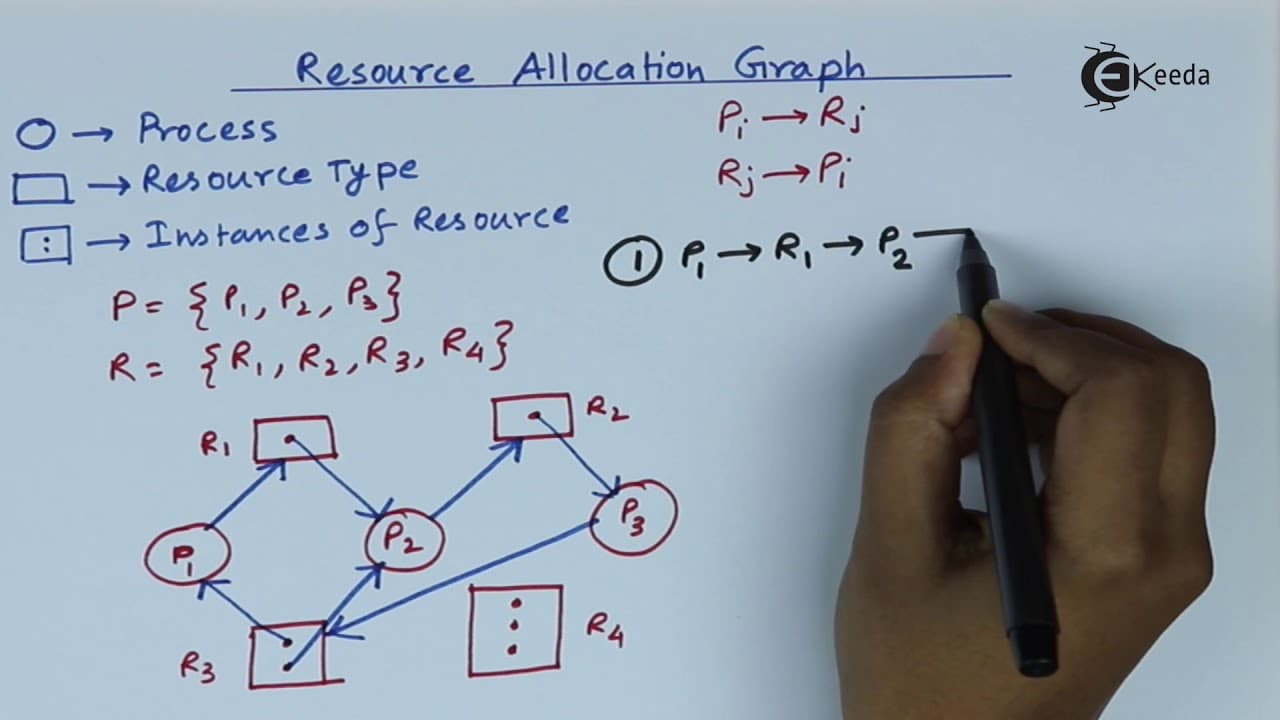
A resource allocation graph visually represents the allocation and request of resources among processes. Deadlock can occur when this graph contains cycles; if every resource type has only one instance allocated, the presence of a cycle indicates a deadlock situation. Managing resource allocation to avoid cycles is crucial for preventing deadlocks.
Transcript
click the bell icon to get latest videos from equator hello friends today we are going to discuss about a deadlock characterization method which is in terms of a graph and known as a resource allocation graph we will see that how the cycles present in that graph matters to be in deadlock and no cycles represent no deadlock and what are the implemen... Read More
Key Insights
- 📈 Deadlock can be characterized using resource allocation graphs.
- 🦔 Request and assignment edges represent resource requests and allocations in the graph.
- 🏍️ If a resource allocation graph contains a cycle, deadlock may occur.
- 🏍️ Deadlock can be prevented by avoiding cycles or breaking cycles through resource reallocation.
- 🇰🇼 Deadlock occurs when a process requests a resource that is already allocated to another process, and that process is waiting for additional resources.
- 🏍️ Resource allocation graphs with cycles indicate potential deadlock situations.
- ❓ Deadlock can be avoided by managing resource allocations effectively.
Install to Summarize YouTube Videos and Get Transcripts
Explore YouTube Video Summarizer or Get YouTube Transcript Extractor
Questions & Answers
Q: What is a resource allocation graph?
A resource allocation graph consists of processes and resources, where requests and assignments of resources are represented by edges.
Q: How can deadlock be detected in a resource allocation graph?
If the graph contains a cycle, it indicates a potential deadlock situation.
Q: What does a request edge represent in the graph?
A request edge represents a process requesting a resource type and waiting for its allocation.
Q: What does an assignment edge represent in the graph?
An assignment edge represents an instance of a resource type being allocated to a process, allowing it to access the resource.
Q: How can deadlock be prevented in a resource allocation graph?
Deadlock can be prevented by ensuring that the graph does not contain any cycles, or by breaking cycles through resource reallocation.
Summary & Key Takeaways
-
Deadlocks can be characterized using resource allocation graphs, which consist of processes and resources.
-
Request and assignment edges represent the requests and allocations of resources in the graph.
-
If a resource allocation graph contains a cycle, deadlock may occur.
Read in Other Languages (beta)
Share This Summary 📚
Summarize YouTube Videos and Get Video Transcripts with 1-Click
Try YouTube Summary with ChatGPT & Claude or YouTube Transcript Generator
Explore More Summaries from Ekeeda 📚



Summarize YouTube Videos and Get Video Transcripts with 1-Click
Try YouTube Summary with ChatGPT & Claude or YouTube Transcript Generator