L20.2 The one-dimensional analogy for phase shifts
TL;DR
The content discusses the partial wave expansion and scattering in quantum mechanics, emphasizing the approximate and independent nature of each term in the expansion.
Transcript
PROFESSOR: I'm going to write this e to the ikz somewhat differently so that you appreciate more what it is. So e to the ikz, I'll write it as square root of 4 pi over k. You say, where does that k come from? We'll see in a second. Sum over l, square root of 2l plus 1, i to the l, yl0, 1 over 2i. Basically what I'm going to do is I'm expanding this... Read More
Key Insights
- 👋 The partial wave expansion involves expanding the function e to the ikz, allowing for the description of waves occurring at a large distance.
- 🍉 Each term in the expansion, corresponding to different values of l, is an approximate solution of the Schrödinger equation.
- ❓ The approximate solutions can be made exact by replacing the exponentials with Bessel functions.
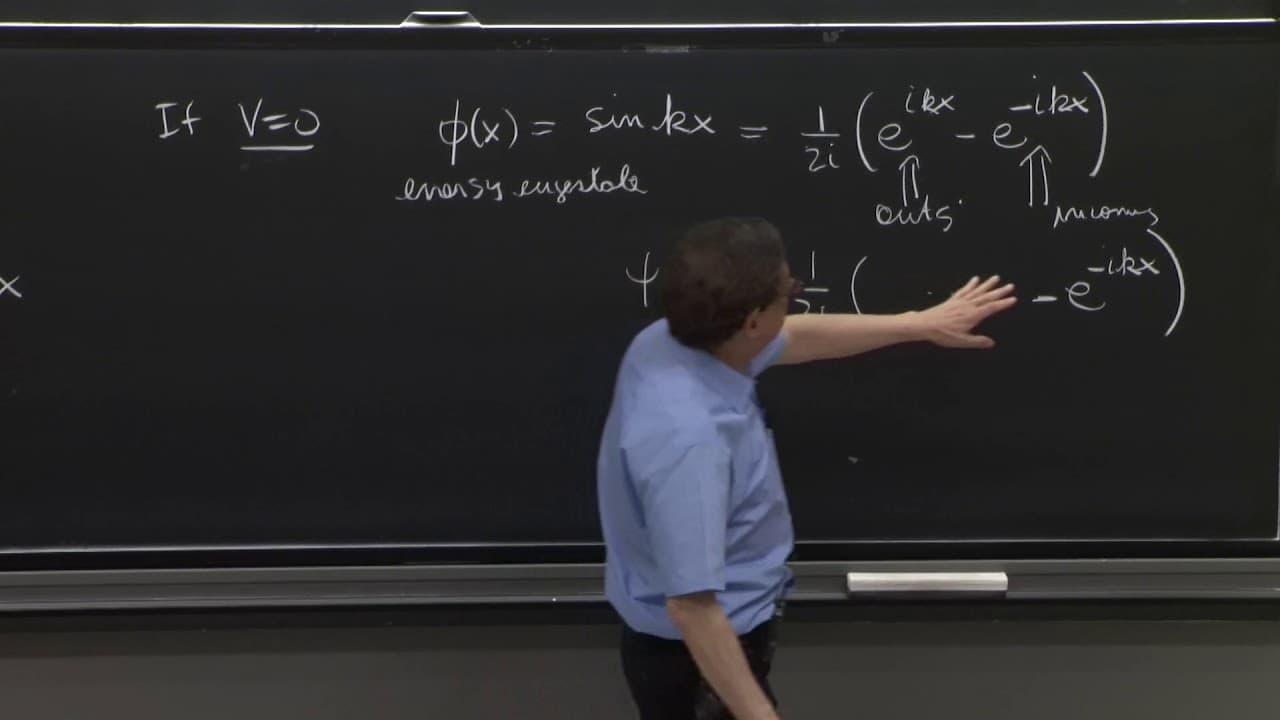
- 👋 In the one-dimensional case of scattering, an incoming wave is combined with an outgoing wave to solve the scattering problem, resulting in a phase shift and a scattered wave.
Install to Summarize YouTube Videos and Get Transcripts
Explore YouTube Video Summarizer or Get YouTube Transcript Extractor
Questions & Answers
Q: What is the motivation behind expanding the function e to the ikz for large x?
Expanding the function allows for the description of waves that are occurring at a large distance (r) from the origin, and it helps in understanding the behavior of these waves.
Q: How does the partial wave expansion relate to the Schrödinger equation?
Each term in the expansion, corresponding to different values of l, is an approximate solution of the Schrödinger equation. The sum of these approximate solutions creates an overall approximate solution.
Q: Can the approximate solutions be made exact?
Yes, the approximate solutions can be made exact by replacing the exponentials with Bessel functions. However, each term in the expansion can still be considered a good approximate solution independently.
Q: Does the Schrödinger equation mix ingoing and outgoing waves?
No, the Schrödinger equation treats ingoing and outgoing waves separately. Each wave can be an approximate solution on its own, and the equation remains valid for each wave.
Summary & Key Takeaways
-
The content explains the expansion of the function e to the ikz for large x and the role of the k term in the expansion.
-
It discusses the concept of ingoing and outgoing waves and how they relate to the approximate solutions of the Schrödinger equation.
-
The content then moves to the one-dimensional case of scattering, where a hard wall potential is introduced and the solutions with and without the potential are compared.
Read in Other Languages (beta)
Share This Summary 📚
Summarize YouTube Videos and Get Video Transcripts with 1-Click
Try YouTube Summary with ChatGPT & Claude or YouTube Transcript Generator
Explore More Summaries from MIT OpenCourseWare 📚



Summarize YouTube Videos and Get Video Transcripts with 1-Click
Try YouTube Summary with ChatGPT & Claude or YouTube Transcript Generator