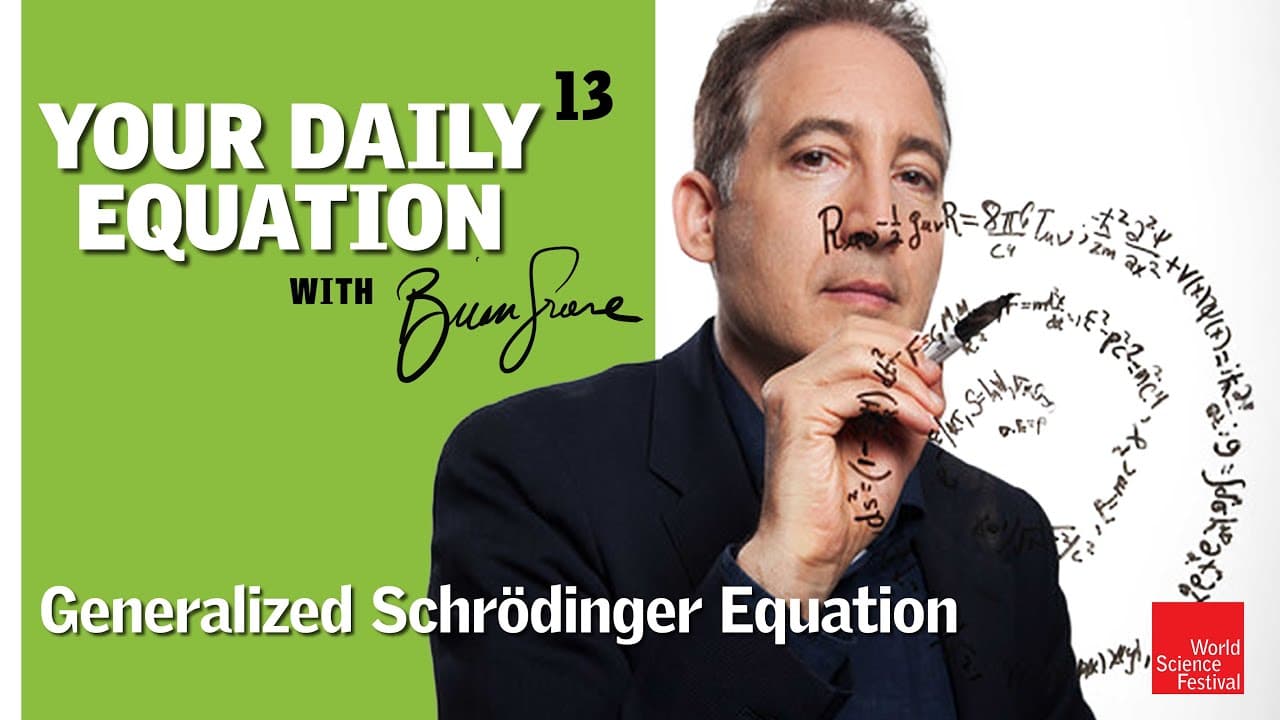
Your Daily Equation #13: Generalized Schrödinger Equation
TL;DR
Schrodinger's equation is a fundamental equation in quantum mechanics involving imaginary numbers, superposition, and high-dimensional probability waves.
Transcript
hi everyone welcome to this next episode of your daily equation and today i think it's going to be a quick episode sometimes i think it's going to be quick and then you know i keep on going forever but this one all i want to do is say a few remarks about schrodinger's equation and then after those insights which i hope that you'll find interesting ... Read More
Key Insights
- #️⃣ Schrodinger's equation contains imaginary numbers, but their significance is related to the probability interpretation rather than literal measurement.
- 🤩 The linearity of the equation allows for the superposition of solutions, which is a key principle in quantum mechanics.
- 👾 Generalizing the equation to multiple particles and dimensions results in a wave function that exists in high-dimensional spaces.
Install to Summarize YouTube Videos and Get Transcripts
Explore YouTube Video Summarizer or Get YouTube Transcript Extractor
Questions & Answers
Q: Why does Schrodinger's equation involve imaginary numbers?
The presence of the imaginary number "i" in the equation is necessary for the math to work out correctly and represents the probabilistic nature of quantum mechanics. However, in the physical interpretation, the imaginary component is eliminated when considering probabilities.
Q: What is the significance of the equation being linear?
Linearity allows for the superposition of solutions, meaning that any linear combination of valid solutions is also a valid solution. This property underlies the principle of superposition in quantum mechanics, which allows particles to exist in multiple states simultaneously.
Q: How does the generalization of Schrodinger's equation to multiple particles and dimensions work?
When dealing with multiple particles in three-dimensional space, the equation for each particle is combined, resulting in a wave function that depends on each particle's spatial coordinates. This demonstrates that the wave function exists in a high-dimensional space, which is a consequence of the math involved.
Q: Is the wave function considered to be a physical entity or merely a description of the world?
This is a debated topic in quantum mechanics. Some consider the wave function to be a real object that exists in a high-dimensional space, while others view it as a mathematical description of the quantum system. The interpretation ultimately depends on one's philosophical stance.
Summary & Key Takeaways
-
Schrodinger's equation involves imaginary numbers and is used to describe the behavior of quantum particles.
-
The equation is linear, allowing for the superposition of solutions.
-
The generalization of the equation to multiple particles and dimensions involves higher-dimensional probability waves.
Read in Other Languages (beta)
Share This Summary 📚
Summarize YouTube Videos and Get Video Transcripts with 1-Click
Try YouTube Summary with ChatGPT & Claude or YouTube Transcript Generator
Explore More Summaries from World Science Festival 📚



Summarize YouTube Videos and Get Video Transcripts with 1-Click
Try YouTube Summary with ChatGPT & Claude or YouTube Transcript Generator