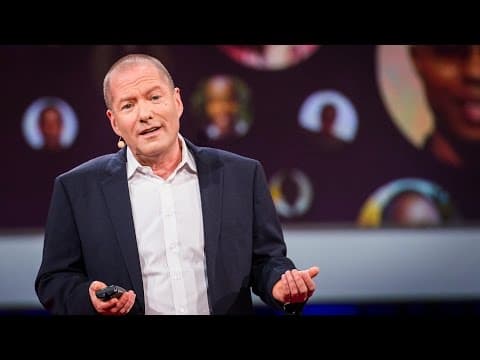
Rodney Brooks: How robots will invade our lives

TL;DR
Robots are becoming increasingly common in our lives, with their presence expected to grow exponentially in the future, but concerns about their rights and potential takeover are unfounded.
Transcript
What I want to tell you about today is how I see robots invading our lives at multiple levels, over multiple timescales. And when I look out in the future, I can't imagine a world, 500 years from now, where we don't have robots everywhere. Assuming -- despite all the dire predictions from many people about our future -- assuming we're still around,... Read More
Key Insights
- 🤖 Robots will become increasingly common and integrated into our lives at various levels over the next few decades, similar to the way personal computers became ubiquitous in the 1970s and 1980s.
- 🏠 Home-cleaning robots and lawn-mowing robots are already available on the market, indicating the growing presence of robots in domestic settings.
- 🌐 Robots are also being used in military applications, such as surveillance and search-and-rescue missions. Their use has increased since September 11th, 2001.
- 🔍 Visual attention systems are crucial for robots to interact and communicate with humans effectively.
- 😊 Robots can demonstrate basic social skills and understanding, such as sharing attention, recognizing emotional cues, and engaging in turn-taking during conversations.
- 🎥 Robotics technology is continuously advancing, with researchers working on developing more human-like and emotionally responsive robots.
- ⚙️ Computation is vital, but the mechanics of robots still matter. The intelligence of a robot is not solely dependent on its computational capabilities.
- 🤔 While there are concerns about robots potentially taking over or requiring rights, the likelihood of accidental or deliberate creation of robots that pose a threat is low and unlikely to happen.
Install to Summarize YouTube Videos and Get Transcripts
Explore YouTube Video Summarizer or Get YouTube Transcript Extractor
Questions & Answers
Q: What is the speaker's view on the potential for robots to have rights?
The speaker believes that the idea of robots having rights is hard for us to accept, as it challenges our sense of specialness and uniqueness as humans. However, over the next 50 years, he thinks we will come to accept that robots can have emotions and be living creatures.
Q: What is the speaker's opinion on the possibility of robots taking over?
The speaker dismisses the notion that robots will accidentally or deliberately take over from humans. He believes that we will not allow robots to become too powerful or pose a threat to us, as we will not build robots that make us uncomfortable.
Q: What are some examples of robots already present in our lives?
Examples include lawn-mowing robots, home-cleaning robots, and military surveillance robots. The speaker also mentions robot toys like Furbies and the Sony Aibo, as well as robots with hacking kits and platforms for programming.
Q: What capabilities are important for robots to interact socially?
The speaker emphasizes the importance of visual attention systems in robots, which allow them to focus on and interact with what they are seeing. He also mentions the ability to estimate gaze direction, shared attention, and recognizing socially communicated reinforcement as important aspects of robot-human interaction.
Summary & Key Takeaways
-
The speaker believes that robots will be present everywhere in the future and that their presence is already becoming more common, similar to the rise of personal computers in the late 1970s and early 1980s.
-
Examples of robots already in our lives include robots for cleaning and mowing lawns, as well as military surveillance robots.
-
The speaker highlights the importance of visual attention systems and the ability of robots to interact socially, demonstrating examples of robots with these capabilities.
Read in Other Languages (beta)
Share This Summary 📚
Summarize YouTube Videos and Get Video Transcripts with 1-Click
Try YouTube Summary with ChatGPT & Claude or YouTube Transcript Generator
Explore More Summaries from TED 📚

Summarize YouTube Videos and Get Video Transcripts with 1-Click
Try YouTube Summary with ChatGPT & Claude or YouTube Transcript Generator