What Are the 5 Most Confusing Portuguese Phrases?
TL;DR
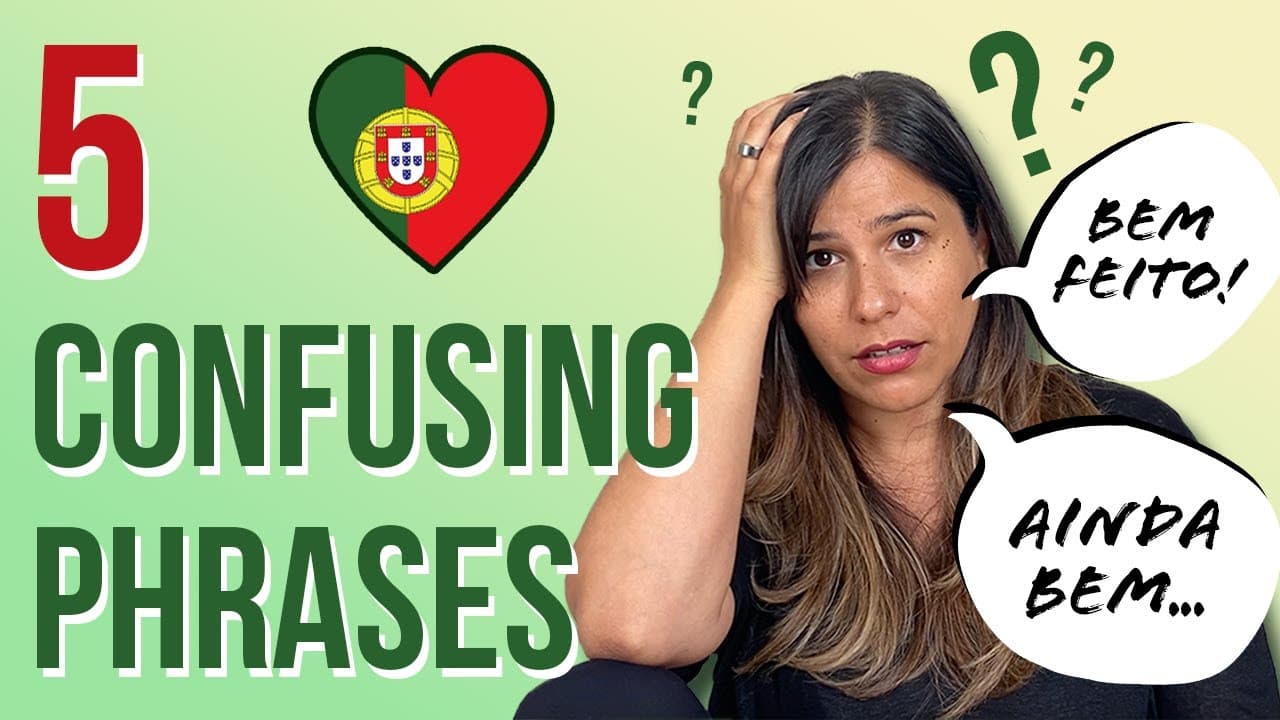
The five confusing Portuguese phrases are 'Bem feito' (serves you right), 'Ainda bem' (it's a good job), 'Será que' (is it possible that), 'sempre' (word position changes meaning), and 'É capaz de' (maybe). Mastering these phrases will enhance your conversational skills and help you sound more advanced in Portuguese.
Transcript
are you starting to understand individual words but get lost when they are put together in sentences this might not be your fault just like in English there are some set phrases in Portuguese that are used all the time but no one ever teaches them in a classroom so if you got a few minutes stick around and learn some useful but kind of confusing sh... Read More
Key Insights
- Understanding Portuguese involves more than vocabulary; set phrases are essential for sounding natural and advanced.
- The phrase 'Bem feito' translates to 'serves you right' rather than 'well done,' illustrating the nuances in language learning.
- 'Ainda bem' means 'it's a good job,' showing how literal translations can be misleading.
- The phrase 'Será que' introduces doubt, translating to 'is it possible that,' which is crucial in forming questions.
- The position of 'sempre' in a sentence can change its meaning, highlighting the importance of word order in Portuguese.
- 'É capaz de' is used to express possibility, translating loosely to 'maybe' or 'might,' which is vital for expressing uncertainty.
- Learning these set phrases can significantly improve conversational skills and help learners connect better with native speakers.
- The video offers resources like a free lesson and pronunciation guide to help beginners start their Portuguese learning journey.
Install to Summarize YouTube Videos and Get Transcripts
Explore YouTube Video Summarizer or Get YouTube Transcript Extractor
Questions & Answers
Q: Why is learning set phrases important in Portuguese?
Learning set phrases is crucial because they are commonly used in everyday conversations and can significantly enhance your ability to communicate naturally. These phrases often carry meanings that are not immediately obvious from their literal translations, so understanding them can help you sound more fluent and connect better with native speakers.
Q: What does 'Bem feito' actually mean in Portuguese?
'Bem feito' is a phrase that can be misleading if translated literally as 'well done.' In reality, it means 'serves you right.' This example illustrates how set phrases in Portuguese can differ significantly from their literal translations, making it important for learners to understand their actual usage.
Q: How does the placement of 'sempre' change its meaning?
In Portuguese, the word 'sempre' means 'always' when used in its usual position. However, when 'sempre' is placed before a verb, it changes the meaning to question whether someone is still going to do something. This highlights the importance of word order in understanding and conveying the correct meaning in Portuguese.
Q: What resources does the video offer for learning Portuguese?
The video offers several resources to aid in learning Portuguese, including a free beginner's lesson and a pronunciation guide. These resources are designed to help learners master pronunciation, understand basic grammar, and gain confidence in real-life conversations. They provide a structured way to start or improve Portuguese language skills.
Q: How does 'Será que' function in a sentence?
'Será que' is a phrase used to introduce doubt or question the possibility of something. It translates to 'is it possible that' in English. This phrase is essential for forming questions that express uncertainty or doubt, making it a valuable tool for learners to navigate conversations in Portuguese.
Q: What is the significance of 'É capaz de' in Portuguese?
The phrase 'É capaz de' is used to express possibility, translating loosely to 'maybe' or 'might.' It is significant because it allows speakers to express uncertainty or potentiality in situations, which is a common aspect of everyday conversations. Understanding this phrase helps learners articulate nuanced thoughts more effectively.
Q: Why might literal translations be misleading in Portuguese?
Literal translations can be misleading because many Portuguese phrases have meanings that differ from their direct English counterparts. These phrases often carry cultural or contextual nuances that are not captured by a word-for-word translation. Understanding the intended meaning behind these phrases is crucial for effective communication.
Q: How can learning these phrases improve conversational skills?
Learning these phrases can improve conversational skills by enabling learners to understand and use expressions that are common in everyday Portuguese. This knowledge helps learners sound more natural and fluent, making it easier to connect with native speakers and navigate real-life situations with confidence.
Summary & Key Takeaways
-
The video explains five confusing Portuguese phrases that are not typically taught in classrooms but are frequently used in everyday conversations. Understanding these can help learners sound more natural and advanced.
-
Liz Sharma, the instructor, shares insights from her own experience as an English speaker living in Portugal, providing practical examples to clarify the meaning and usage of these phrases.
-
Additional resources such as a free beginner's lesson and pronunciation guide are offered to help learners improve their Portuguese skills, with emphasis on pronunciation and real-life conversation starters.
Read in Other Languages (beta)
Share This Summary 📚
Summarize YouTube Videos and Get Video Transcripts with 1-Click
Try YouTube Summary with ChatGPT & Claude or YouTube Transcript Generator
Explore More Summaries from Talk the Streets 📚




![Practice Portuguese with Mixologist Fábio Guerreiro! [English & Portuguese Subtitles] thumbnail](/_next/image?url=https%3A%2F%2Fi.ytimg.com%2Fvi%2F1-T2PNWuiWY%2Fhqdefault.jpg&w=750&q=75)
Summarize YouTube Videos and Get Video Transcripts with 1-Click
Try YouTube Summary with ChatGPT & Claude or YouTube Transcript Generator