How to Find the Area of a Triangle in 5 Different Ways
TL;DR
To find the area of a triangle, you can use five methods: visualizing it as a rectangle, employing determinants to calculate with coordinates, applying the Shoeless theorem, or utilizing Pick's theorem for polygons with lattice points. Each method offers a unique approach, allowing for varied applications depending on the situation.
Transcript
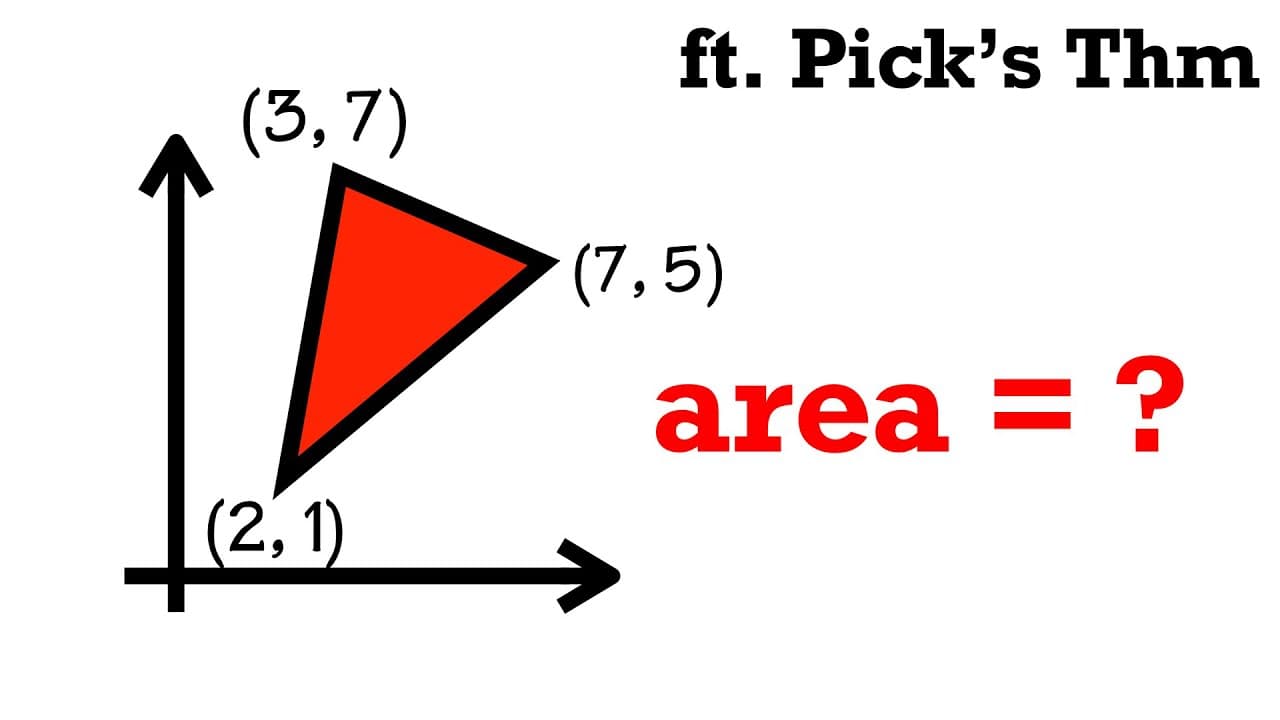
62 - this is okay I have a question for you guys how would you find the area of this triangle notice that this right here is now right triangle so I don't think you should use the traditional formula one-half base times height because that way hmm it's not easy to find the distance from here to here right and also it's not so easy to find out how l... Read More
Key Insights
- 🤔 Thinking outside the box and visualizing a triangle as a rectangle can make it easier to calculate the area.
- 🔺 Determinants can be used to find the area of a triangle by calculating the determinant of the vectors between the points.
- 🔺 The Shoeless theorem provides another method for finding the area of a triangle using matrices and determinants.
Install to Summarize YouTube Videos and Get Transcripts
Explore YouTube Video Summarizer or Get YouTube Transcript Extractor
Questions & Answers
Q: What is the first method of finding the area of a triangle mentioned in the video?
The first method involves thinking outside the box and visualizing the triangle as a rectangle. The area of the rectangle is calculated by multiplying the base and height.
Q: How does the second method use determinants to find the area of a triangle?
In the second method, a point is chosen, and the X and Y components of the vectors between the points are calculated. The determinant of these vectors is then multiplied by 1/2 to find the area of the triangle.
Q: What is the Shoeless theorem, and how is it used to find the area of a triangle?
The Shoeless theorem involves using a 3x3 matrix to calculate the area of a triangle. The determinant of the matrix, divided by 2, gives the area of the triangle.
Q: How does Pick's theorem work for finding the area of a triangle with lattice points?
Pick's theorem states that the area of a polygon with lattice points can be calculated using the formula Area = I + B/2 - 1, where I represents the number of lattice points inside the polygon and B represents the number of lattice points on the boundary.
Summary & Key Takeaways
-
The video demonstrates the first method of finding the area of a triangle by thinking outside the box and visualizing it as a rectangle.
-
The second method involves using determinants and picking a point to calculate the area. The video provides step-by-step instructions for this approach.
-
The third way, called the Shoeless theorem, involves using a matrix and computing the determinant. The video explains this method and shows the calculations.
-
Finally, the video introduces Pick's theorem, which provides a formula to find the area of a polygon with lattice points. It is demonstrated using the example of a triangle.
Read in Other Languages (beta)
Share This Summary 📚
Summarize YouTube Videos and Get Video Transcripts with 1-Click
Try YouTube Summary with ChatGPT & Claude or YouTube Transcript Generator
Explore More Summaries from blackpenredpen 📚





Summarize YouTube Videos and Get Video Transcripts with 1-Click
Try YouTube Summary with ChatGPT & Claude or YouTube Transcript Generator