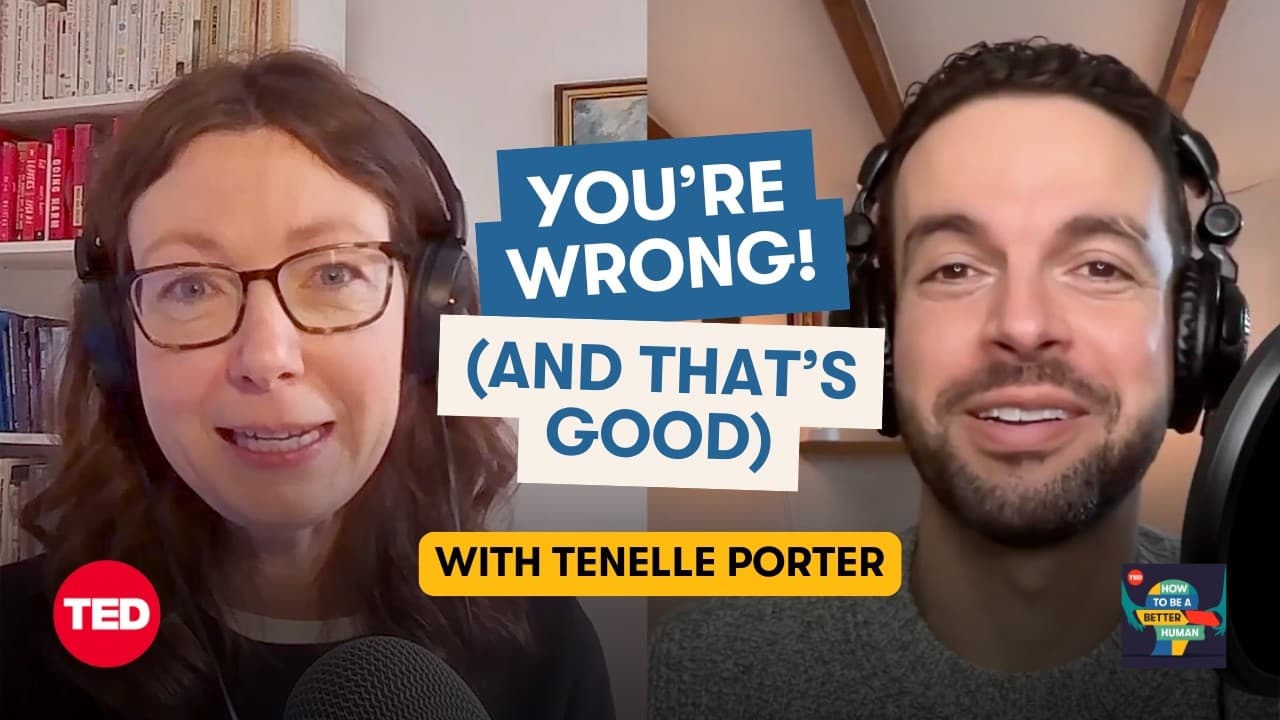
When Is It OK to Be Wrong? (w/ Tenelle Porter) | How to Be a Better Human | TED
TL;DR
Intellectual humility can enhance learning and improve relationships.
Transcript
You're watching How to be a better human. I'm your host, Chris Duffy, and today on the show, we're talking about humility. Anyone who knows me knows that humility is not my strong suit. I have a big head, both literally, regularsized baseball cap. As you can see, it does not fit. It's also true metaphorically. I'm a comedian. I think strangers shou... Read More
Key Insights
- Intellectual humility involves recognizing that our knowledge is limited and being open to the possibility that we might be wrong.
- Dr. Tenelle Porter highlights the importance of intellectual humility in various contexts, including personal growth, education, and societal interactions.
- Intellectual humility can be scientifically studied through experiments that measure openness to differing perspectives and adaptability in beliefs.
- Teenagers who exhibit intellectual humility tend to perform better academically, as they are more receptive to feedback and persistent in their learning.
- Intellectual humility is not about lacking confidence; rather, it requires a certain level of confidence to admit one's limitations and learn from them.
- The cultural pressure to maintain rigid beliefs can hinder intellectual humility, but fostering environments that encourage openness can promote it.
- Modeling intellectual humility, especially in educational settings, can encourage others to express uncertainty and engage in honest dialogue.
- Intellectual humility can help bridge divides in society by making it easier to have constructive conversations with those who hold differing views.
Install to Summarize YouTube Videos and Get Transcripts
Explore YouTube Video Summarizer or Get YouTube Transcript Extractor
Questions & Answers
Q: What is intellectual humility?
Intellectual humility is the recognition of the limitations of one's knowledge and the openness to the possibility of being wrong. It involves an awareness that our understanding is partial and that we might need to revise our beliefs based on new information or perspectives.
Q: How does intellectual humility benefit teenagers?
Teenagers who exhibit intellectual humility tend to perform better academically. They are more open to feedback, persistent in their learning efforts, and able to adapt their understanding based on new information. This openness and adaptability contribute to their overall academic success and personal growth.
Q: Can confidence and intellectual humility coexist?
Yes, confidence and intellectual humility can coexist. Intellectual humility does not mean lacking confidence; rather, it requires confidence to acknowledge one's limitations and be open to learning from others. A confident person is more likely to admit what they don't know and seek to improve their understanding.
Q: How can intellectual humility be cultivated in educational settings?
Intellectual humility can be cultivated in educational settings by modeling it as an educator. Teachers can set the tone by admitting their own knowledge gaps, encouraging students to express uncertainty, and fostering an environment where questioning and open dialogue are valued. This approach helps students feel comfortable being intellectually humble.
Q: What role does intellectual humility play in societal interactions?
Intellectual humility plays a crucial role in societal interactions by facilitating constructive dialogue and reducing polarization. When individuals are open to considering different perspectives and acknowledging their own limitations, it becomes easier to engage in meaningful conversations and find common ground with those who hold differing views.
Q: Are there cultural challenges to embracing intellectual humility?
Yes, cultural challenges to embracing intellectual humility include societal pressures to maintain rigid beliefs and appear certain. In many contexts, admitting uncertainty can be perceived as a weakness. Overcoming these challenges requires fostering environments that value openness and flexibility in thinking.
Q: How does intellectual humility impact personal growth?
Intellectual humility positively impacts personal growth by encouraging individuals to remain open to new information and perspectives. This openness allows for continuous learning and adaptation, leading to a deeper understanding of oneself and the world. It also fosters resilience by enabling individuals to learn from mistakes and setbacks.
Q: What are practical ways to practice intellectual humility?
Practical ways to practice intellectual humility include reflecting on one's knowledge limitations, seeking feedback, engaging with differing perspectives, and being open to revising beliefs. Additionally, modeling humility in interactions and valuing open dialogue can encourage others to adopt similar attitudes, creating a culture of intellectual humility.
Summary & Key Takeaways
-
This podcast episode explores intellectual humility, defined as the understanding that one's knowledge is limited and being open to being wrong. Dr. Tenelle Porter discusses how intellectual humility can enhance learning and improve relationships, emphasizing its relevance in today's polarized society.
-
The conversation delves into scientific methods for studying intellectual humility, such as experiments with high school students. Findings suggest that intellectually humble teenagers perform better academically and are more adaptable, highlighting the benefits of fostering this trait from a young age.
-
Dr. Porter and host Chris Duffy discuss the balance between confidence and humility, the cultural challenges to embracing intellectual humility, and practical ways to cultivate it, such as modeling it in educational settings and encouraging open, honest dialogue.
Read in Other Languages (beta)
Share This Summary 📚
Summarize YouTube Videos and Get Video Transcripts with 1-Click
Try YouTube Summary with ChatGPT & Claude or YouTube Transcript Generator
Explore More Summaries from TED 📚






Summarize YouTube Videos and Get Video Transcripts with 1-Click
Try YouTube Summary with ChatGPT & Claude or YouTube Transcript Generator