L03.7 Independence of a Collection of Events
TL;DR
The concept of independence in probability refers to a situation where the results of previous events do not affect beliefs about the likelihood of future events.
Transcript
Suppose I have a fair coin which I toss multiple times. I want to model a situation where the results of previous flips do not affect my beliefs about the likelihood of heads in the next flip. And I would like to describe this situation by saying that the coin tosses are independent. You may say, we already defined the notion of independent events.... Read More
Key Insights
- ⏮️ Independence of events in probability refers to the concept of previous event results not influencing future event likelihood.
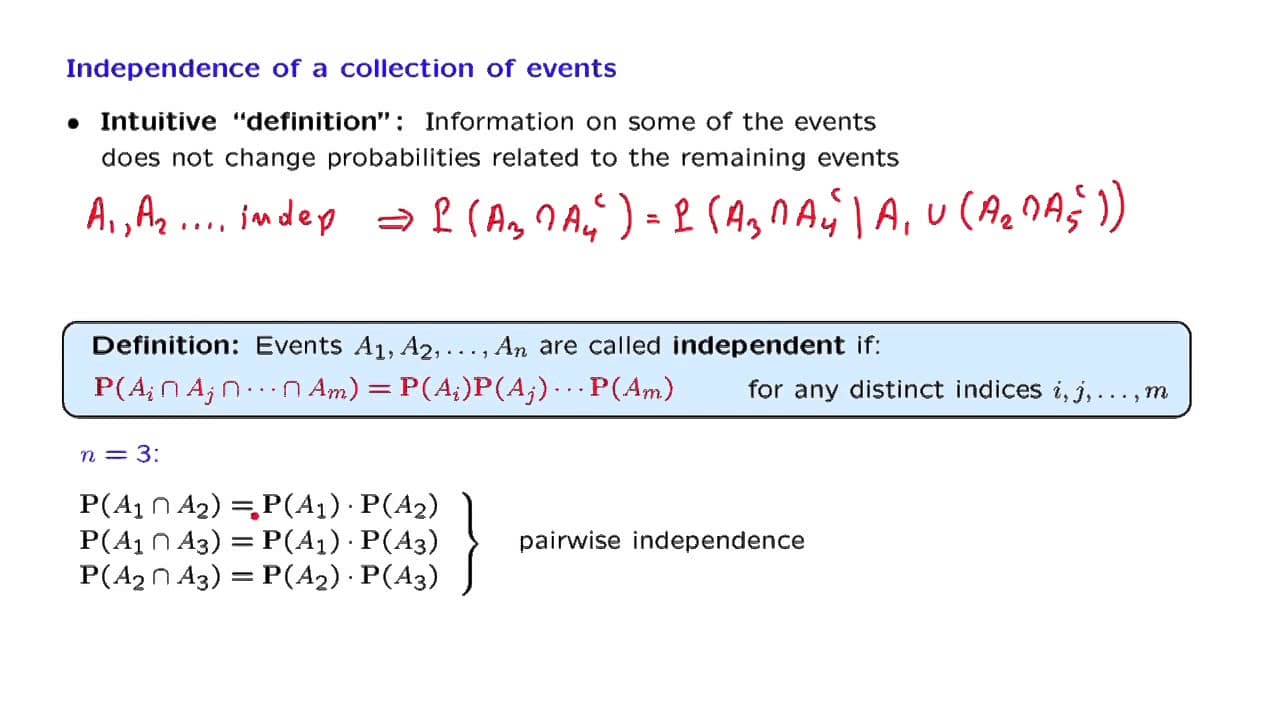
- ❓ A collection of events is independent if knowledge about some events does not affect beliefs or probability models for other events.
- ❓ Pairwise independence refers to any two events within a collection being independent, while full independence considers intersections of multiple events.
- ✖️ The probability of intersections of events in a collection can be calculated by multiplying individual probabilities for full independence.
- 🖐️ Conditional probabilities play a role in determining independence, with the condition that they are equal to unconditional probabilities.
- ❓ The definition of independence in probability satisfies various relations and formulas for calculating probabilities.
Install to Summarize YouTube Videos and Get Transcripts
Explore YouTube Video Summarizer or Get YouTube Transcript Extractor
Questions & Answers
Q: What does it mean for a collection of events to be independent in probability?
If a collection of events is independent, it means that knowledge about some events does not affect beliefs or probability models for other events in the collection. The probabilities of individual events remain the same.
Q: How is independence of events related to pairwise independence?
Pairwise independence refers to the situation where any two events within a collection are independent. While pairwise independence is a condition for independence, full independence also considers the probabilities of multiple event intersections.
Q: How is full independence defined in probability?
Full independence requires that the probabilities of intersections of multiple events can be calculated by multiplying individual probabilities. This condition holds for all possible choices of events within the collection.
Q: What is the significance of conditional probabilities in the concept of independence?
Conditional probabilities play a role in determining independence. If two events are independent, the conditional probability of one event given another event is the same as the unconditional probability of that event.
Summary & Key Takeaways
-
Independence of events in probability refers to the idea that knowledge about some events does not change beliefs or probability models for other events.
-
A collection of events is considered independent if probabilities can be calculated by multiplying individual probabilities.
-
Pairwise independence is when any two events are independent, while full independence considers the probability of multiple event intersections.
Read in Other Languages (beta)
Share This Summary 📚
Summarize YouTube Videos and Get Video Transcripts with 1-Click
Try YouTube Summary with ChatGPT & Claude or YouTube Transcript Generator
Explore More Summaries from MIT OpenCourseWare 📚



Summarize YouTube Videos and Get Video Transcripts with 1-Click
Try YouTube Summary with ChatGPT & Claude or YouTube Transcript Generator