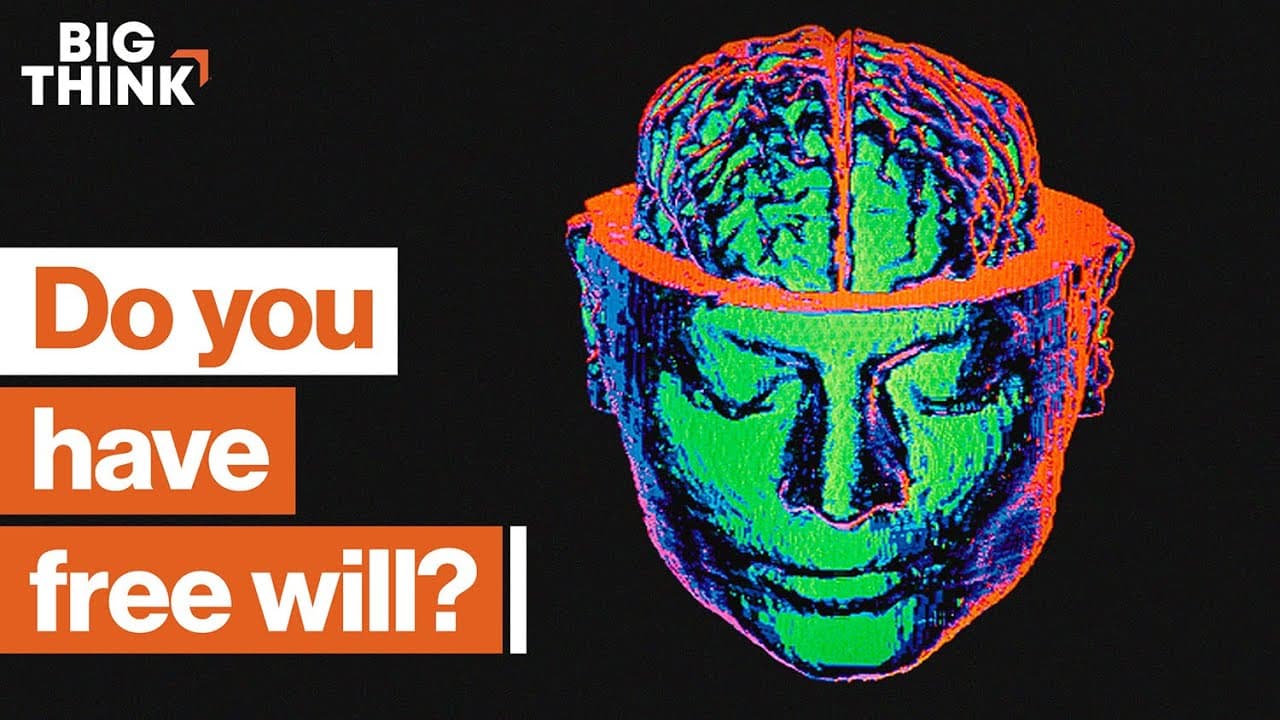
Is free will an illusion? | Uri Maoz | Big Think
TL;DR
The subconscious heavily influences our lives, challenging the idea of free will.
Transcript
URI MAOZ: We all kind of go around with this feeling that we are the authors of our lives and we are in control, that I could've done otherwise. To what extent is the conscious we are we in control? NARRATOR: The subconscious is a force that looms large below the surface of our conscious minds, and it's controlling our lives much more th... Read More
Key Insights
- 🥶 The subconscious wields significant influence over conscious decisions, challenging the notion of free will.
- 🤨 Libet's experiment raises doubts about the true extent of conscious control in important life choices.
- 🧠 Understanding the brain's interplay between conscious and unconscious processes is crucial in navigating decisions and actions.
- 🧠 Prediction of actions through real-time brain monitoring highlights the limits of conscious decision-making capabilities.
- 🦻 Strategies like Ulysses' approach to resisting subconscious impulses can aid in regaining control over choices.
- 🥶 The concept of free will remains complex, with definitions and interpretations varying across individuals.
- 🥺 Acknowledging limitations in control can lead to more forgiving attitudes towards decisions and actions.
Install to Summarize YouTube Videos and Get Transcripts
Explore YouTube Video Summarizer or Get YouTube Transcript Extractor
Questions & Answers
Q: How does the subconscious impact our sense of free will?
The subconscious often controls our actions without our awareness, challenging the idea of free will as a conscious choice. Understanding this interplay can help us navigate the limits of our control.
Q: What was Benjamin Libet's experiment, and what did it reveal?
Libet's experiment showed that the brain activity preceding a conscious decision suggests unconscious processes guide actions. This challenges the notion that important decisions are fully under conscious control.
Q: How did Uri Maoz's research study free will in real-time brain signals?
Maoz's study involved monitoring epilepsy patients' brains during decision-making tasks, showing that brain signals predict actions with a high accuracy rate. This suggests limited conscious control over certain choices.
Q: How can we regain control from the subconscious?
Drawing parallels to Ulysses' strategy against the sirens, consciously preparing strategies to resist subconscious impulses can help in making deliberate choices.
Summary & Key Takeaways
-
Uri Maoz explores the interplay between conscious and unconscious in determining free will.
-
Benjamin Libet's controversial experiment suggests unconscious decisions guide important life choices.
-
Taking control back from the subconscious parallels Ulysses' struggle with the sirens in Greek mythology.
Read in Other Languages (beta)
Share This Summary 📚
Summarize YouTube Videos and Get Video Transcripts with 1-Click
Try YouTube Summary with ChatGPT & Claude or YouTube Transcript Generator
Explore More Summaries from Big Think 📚

Summarize YouTube Videos and Get Video Transcripts with 1-Click
Try YouTube Summary with ChatGPT & Claude or YouTube Transcript Generator