6.3.3 Predictive Diagnosis - Video 2: The Data
TL;DR
Health insurance claims data can provide valuable insights into a patient's health history and risk factors for heart attacks.
Transcript
Claims data offers an expansive view of the patients health history. Specifically, claims data include information on demographics, medical history, and medications. They offer insights regarding a patient's risk. And as I will demonstrate, may reveal indicative signals and patterns. We'll use health insurance claims filed for about 7,000 members f... Read More
Key Insights
- 😷 Claims data includes information on demographics, medical history, and medications, providing a comprehensive view of a patient's health.
- 🥰 Analyzing claims data for specific attributes can identify individuals at high risk of heart attacks.
- 🥰 The data is organized chronologically, allowing for the examination of diagnostic history leading up to a heart attack event.
- 🇨🇷 Medical care costs can vary significantly, with approximately 70% of the overall cost generated by only 11% of the population.
- 🇨🇷 Dividing the data into cost buckets helps mitigate the impact of high-cost outliers.
- 😘 The majority of patients have low medical expenses.
- 🥰 Claims data can be a valuable tool for predicting and preventing heart attacks.
Install to Summarize YouTube Videos and Get Transcripts
Explore YouTube Video Summarizer or Get YouTube Transcript Extractor
Questions & Answers
Q: What information is included in claims data?
Claims data includes demographics, medical history, and medication records, providing a comprehensive view of a patient's health.
Q: How can claims data help identify individuals at high risk of heart attacks?
By analyzing claims data for patients with specific attributes, such as coronary artery disease and hypertension diagnoses, researchers can identify individuals at high risk of heart attacks.
Q: How is the diagnostic history represented in the data?
The diagnostic history is split into three periods - zero to three months before the event, three to six months before the event, and six to nine months before the event - allowing for the observation of a patient's diagnosis profile over time.
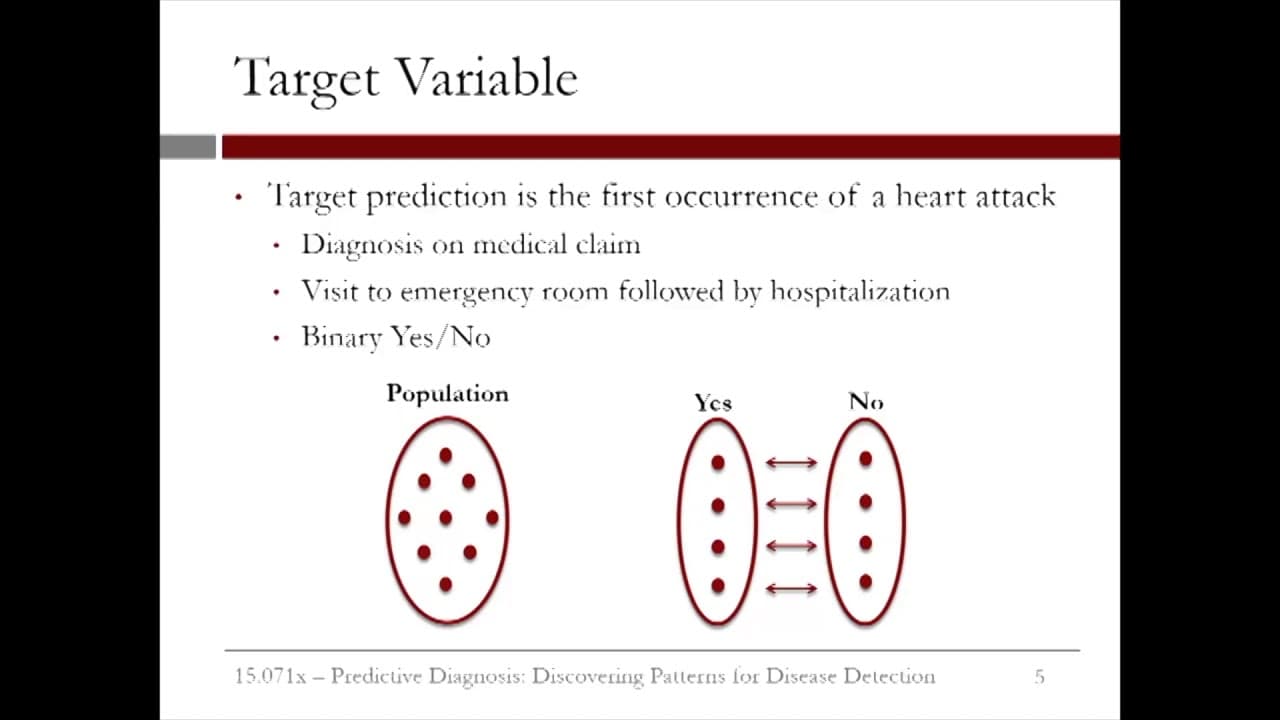
Q: What is the target variable in predicting heart attacks?
The target variable is the occurrence of a heart attack, defined by a combination of claims, including a heart attack diagnosis, emergency room visit, and subsequent hospitalization.
Summary & Key Takeaways
-
Claims data includes information on demographics, medical history, and medications, providing a comprehensive view of a patient's health.
-
By analyzing claims data for patients with specific attributes, such as coronary artery disease and hypertension diagnoses, researchers can identify individuals at high risk of heart attacks.
-
The data is organized into 21 periods, each 90 days in length, allowing for the examination of diagnostic history leading up to a heart attack event.
Read in Other Languages (beta)
Share This Summary 📚
Summarize YouTube Videos and Get Video Transcripts with 1-Click
Try YouTube Summary with ChatGPT & Claude or YouTube Transcript Generator
Explore More Summaries from MIT OpenCourseWare 📚



Summarize YouTube Videos and Get Video Transcripts with 1-Click
Try YouTube Summary with ChatGPT & Claude or YouTube Transcript Generator