Is China Really Stealing Jobs & Wealth from the United States?
TL;DR
Explores if China is truly harming U.S. jobs and wealth.
Transcript
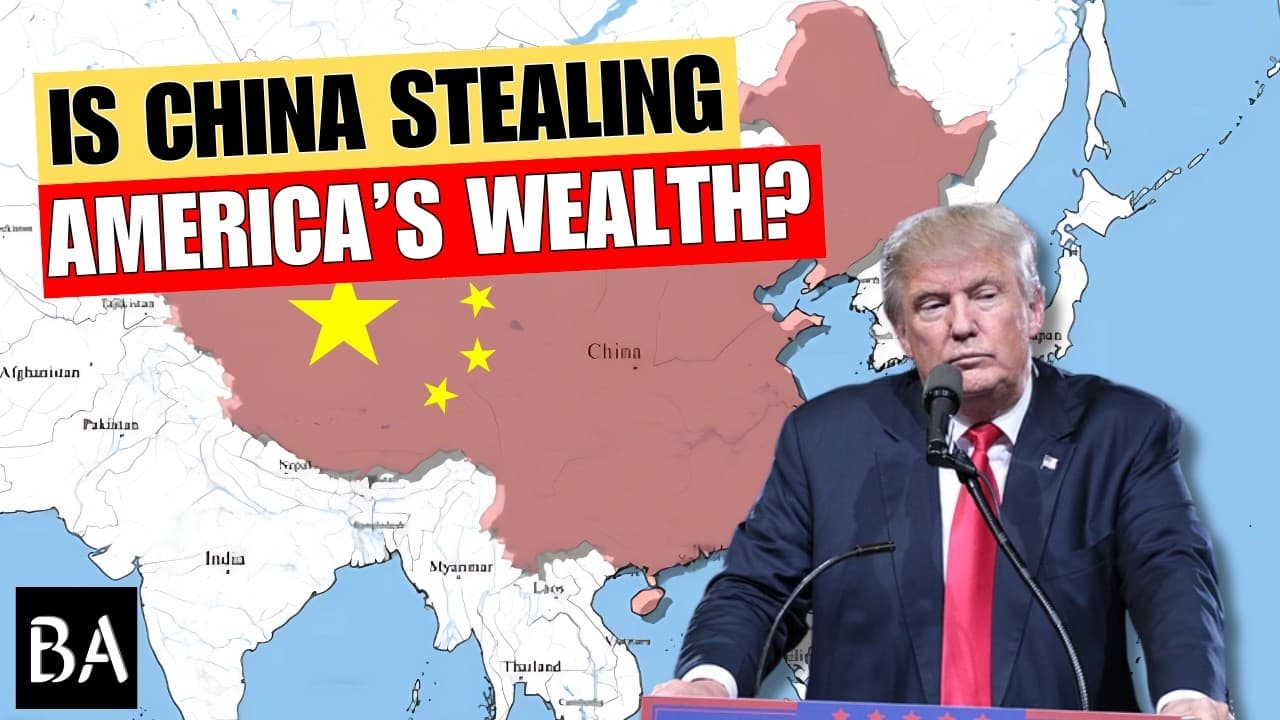
When Donald Trump was elected into office as the president of the United States, one of his biggest foreign policy focuses was China. From the beginning of his administration, Trump adopted a confrontational stance toward Beijing, framing China not just as a competitor but as a strategic threat to American economic dominance and national ... Read More
Key Insights
- Donald Trump's presidency focused heavily on China, accusing it of unfair trade practices and intellectual property theft, which he claimed harmed American jobs and wealth.
- China's entry into the World Trade Organization in 2001 marked a significant shift in U.S.-China trade relations, leading to a substantial trade deficit favoring China.
- The U.S. experienced a noticeable decline in manufacturing jobs post-2001, correlating with China's increased imports, causing economic anxiety and political shifts.
- Economists have documented a 'China Shock,' where competition from Chinese imports led to significant job losses and wage reductions in U.S. manufacturing sectors.
- While manufacturing jobs declined, the U.S. saw growth in service, technology, healthcare, and finance sectors, offsetting some manufacturing losses.
- Low-cost Chinese goods have benefited American consumers by lowering prices, though this has also pressured U.S. manufacturers to downsize or outsource.
- Automation and information technology, alongside Chinese competition, have also contributed to job losses in the U.S. manufacturing sector.
- Intellectual property theft, exemplified by the Micron Technology case, poses a significant threat to U.S. firms, though some argue these instances are not as widespread as claimed.
Install to Summarize YouTube Videos and Get Transcripts
Explore YouTube Video Summarizer or Get YouTube Transcript Extractor
Questions & Answers
Q: What was one of Donald Trump's major foreign policy focuses?
One of Donald Trump's major foreign policy focuses was China. He framed China as a strategic threat to American economic dominance and national security, accusing it of stealing intellectual property, manipulating its currency, and engaging in unfair trade practices that harmed American industries and workers.
Q: How did China's entry into the WTO affect U.S.-China trade relations?
China's entry into the World Trade Organization in 2001 significantly affected U.S.-China trade relations by leading to a widening trade deficit favoring China. This shift resulted in the United States importing significantly more goods from China than it exported, contributing to economic tensions and debates over job losses in American manufacturing.
Q: What is the 'China Shock' and its impact on U.S. jobs?
The 'China Shock' refers to the abrupt increase in Chinese imports that affected local U.S. labor markets, leading to significant job losses in American manufacturing. Studies estimate that competition from Chinese imports resulted in the loss of between 1 and 2.4 million manufacturing jobs in the U.S. during the early 2000s to the early 2010s, impacting wages and income in affected regions.
Q: How have other sectors of the U.S. economy responded to manufacturing job losses?
Despite the decline in manufacturing jobs, other sectors of the U.S. economy, such as services, technology, healthcare, and finance, have expanded. This growth has offset some of the losses in manufacturing, highlighting a complex economic landscape where job creation in these areas has increased substantially since 2001.
Q: What benefits have American consumers gained from low-cost Chinese goods?
American consumers have benefited from low-cost Chinese goods through lower prices on everyday electronics, clothing, furniture, toys, and household goods. These affordability gains have improved overall living standards, as Chinese manufacturing has allowed American companies to lower costs and offer cheaper goods to consumers.
Q: What role has automation played in U.S. job losses?
Automation and information technology have played a significant role in U.S. job losses, alongside Chinese competition. The acceleration of automation, robotics, and information technology since the start of the 21st century has transformed how goods are produced, contributing to job displacement in traditional manufacturing sectors.
Q: How does intellectual property theft impact U.S. firms?
Intellectual property theft impacts U.S. firms by undermining their competitiveness. When trade secrets are stolen and replicated without the same R&D costs, it gives competitors an unfair advantage, allowing them to produce similar products at lower costs and undercut American companies in the global market. This issue is exemplified by cases like Micron Technology.
Q: Is the narrative of China as a strategic threat universally accepted?
The narrative of China as a strategic threat is not universally accepted. While some Americans view China as a long-term strategic threat due to concerns about intellectual property theft and unfair industrial policies, others argue that the extent of the perceived damage is exaggerated. The debate continues, reflecting differing perspectives on the economic and geopolitical implications of U.S.-China relations.
Summary & Key Takeaways
-
The video discusses the validity of claims that China has unfairly gained at the expense of the United States, particularly under Donald Trump's administration. It examines the historical context, including China's entry into the WTO, and the resulting trade deficit and job losses in U.S. manufacturing.
-
While some regions and sectors were adversely affected by Chinese imports, other parts of the U.S. economy, especially in services and technology, have expanded, highlighting a complex economic landscape. The video also considers the role of automation in job displacement.
-
Intellectual property theft is another major concern, with cases like Micron Technology illustrating potential losses to American firms. Despite these challenges, the narrative of China as a strategic threat is debated, with some arguing against the extent of the perceived damage.
Read in Other Languages (beta)
Share This Summary 📚
Summarize YouTube Videos and Get Video Transcripts with 1-Click
Try YouTube Summary with ChatGPT & Claude or YouTube Transcript Generator
Explore More Summaries from Behind Asia 📚


Summarize YouTube Videos and Get Video Transcripts with 1-Click
Try YouTube Summary with ChatGPT & Claude or YouTube Transcript Generator