8.1 Algebra of Lorentz transformations
TL;DR
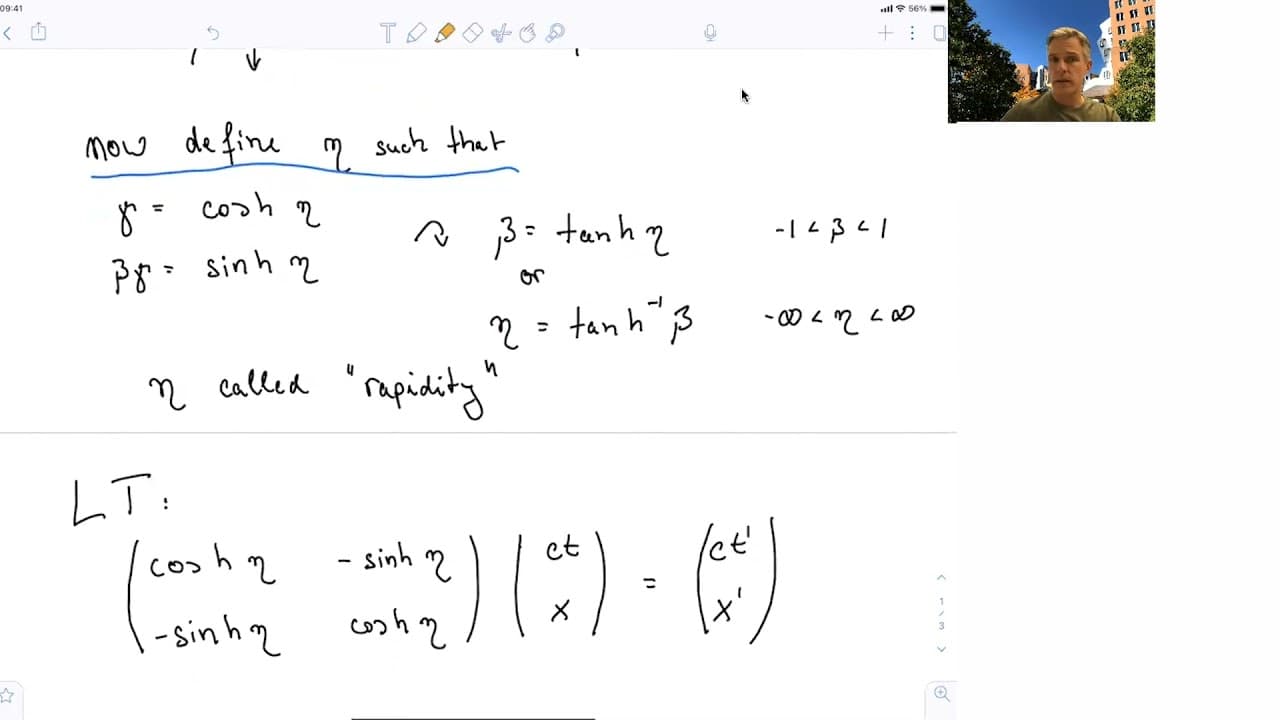
This video introduces the algebra of Lorentz transformations in special relativity, discussing the gamma factor and hyperbolic functions.
Transcript
[SQUEAKING] [RUSTLING] [CLICKING] MARKUS KLUTE: Welcome back to 8.20 Special Relativity. So we're starting a new chapter. In this chapter, we talk about some aspects of special relativity, which are not crucially important to understand the concepts, but they help you to go a little bit deeper in your understanding. I hope this is going to be usefu... Read More
Key Insights
- 🧑🏭 The gamma factor is an essential component in Lorentz transformations, accounting for time dilation and length contraction effects.
- 💁 Hyperbolic functions, such as sinh and cosh, have similar forms to the equations involved in Lorentz transformations.
- 💨 Rapidity, measured in terms of hyperbolic angles, provides a convenient way to describe the boost or velocity of a system in special relativity.
- 😑 Using hyperbolic functions and rapidity, the Lorentz transformations can be expressed in a more compact and simplified form.
- 🪜 The addition of velocities becomes much easier when using hyperbolic functions, as velocities can be directly added instead of using complex transformations.
- 👻 Rapidity covers a wide range of relativistic velocities, allowing for a comprehensive description of boosted systems.
- ❓ The algebra of Lorentz transformations combines rotational and hyperbolic aspects, providing a unique framework for understanding the spacetime structure.
Install to Summarize YouTube Videos and Get Transcripts
Explore YouTube Video Summarizer or Get YouTube Transcript Extractor
Questions & Answers
Q: What is the gamma factor in special relativity and how is it related to beta?
The gamma factor, denoted as gamma, is defined as 1/sqrt(1-beta^2), where beta is the relativistic velocity v/c. It is a crucial factor in Lorentz transformations, allowing us to calculate the time dilation and length contraction effects.
Q: How are hyperbolic functions related to special relativity?
Hyperbolic functions, such as sinh and cosh, have a similar form to the equations involved in Lorentz transformations. By using the hyperbolic functions, we can express gamma and beta gamma in terms of rapidity (eta), providing a more convenient way to calculate relativistic effects.
Q: What is the significance of rapidity in special relativity?
Rapidity (eta) is a measure of how much a system is boosted or accelerated. It is directly related to the hyperbolic functions cosh and sinh, allowing us to express gamma and beta gamma in terms of rapidity. Rapidities can vary from minus infinity to infinity, covering a wide range of relativistic velocities.
Q: How does the algebra of Lorentz transformations make calculations easier?
One advantage of using hyperbolic functions and the concept of rapidity is that it simplifies the addition of velocities. Instead of using a complicated transformation equation, we can simply add the velocities. This provides a more straightforward and efficient way to calculate relativistic effects.
Summary & Key Takeaways
-
The video introduces the gamma factor, which is defined as 1/sqrt(1-beta^2) and is used in Lorentz transformations.
-
Hyperbolic functions, sinh and cosh, are defined and their relation to Lorentz transformations is explored.
-
The video explains how the rapidity, eta, can be used to describe the boost or velocity of a system, and its relation to hyperbolic functions and Lorentz transformations.
Read in Other Languages (beta)
Share This Summary 📚
Summarize YouTube Videos and Get Video Transcripts with 1-Click
Try YouTube Summary with ChatGPT & Claude or YouTube Transcript Generator
Explore More Summaries from MIT OpenCourseWare 📚


Summarize YouTube Videos and Get Video Transcripts with 1-Click
Try YouTube Summary with ChatGPT & Claude or YouTube Transcript Generator