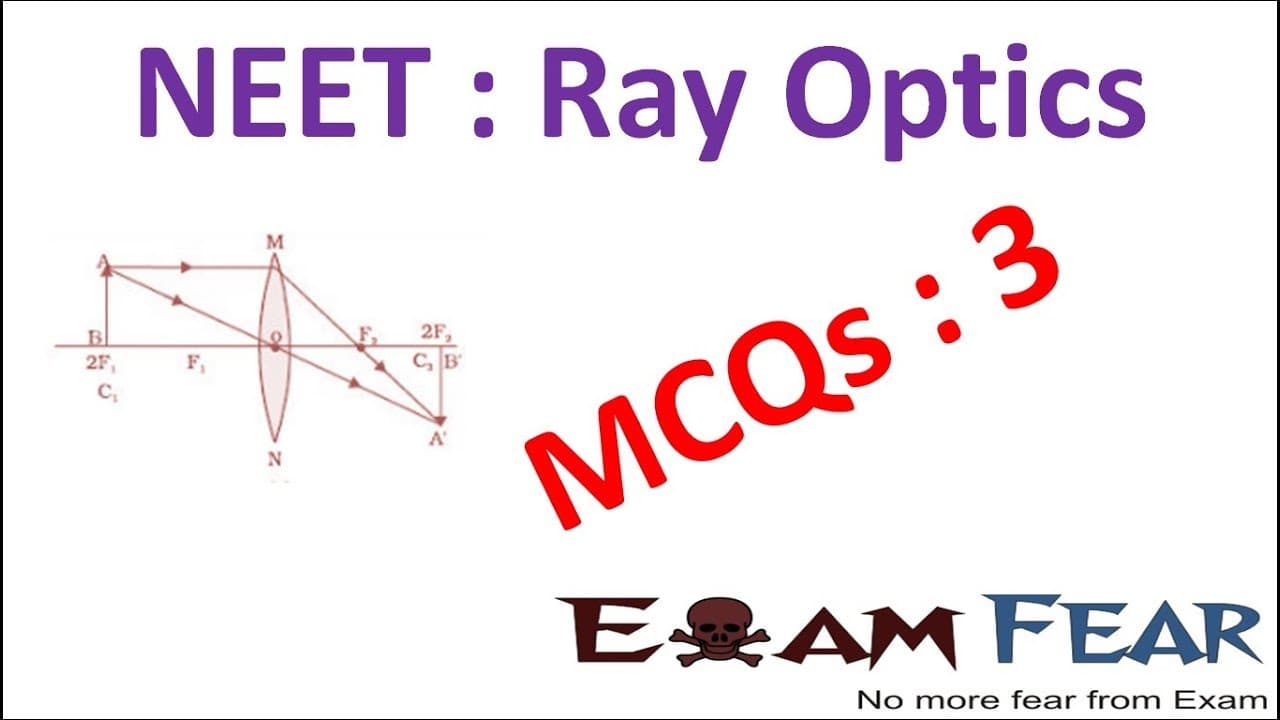
NEET Physics Ray Optics : Multiple Choice Previous Years Questions MCQs 3
TL;DR
The video explains how light is reflected and refracted as it enters and exits a glass sphere at different angles of incidence.
Transcript
hello friends this video on each ray optics is brought to you by example.com no more fear profits question number 8 array enters a glass sphere of refractive index mu is equal to root over 3 at an angle of incidence of 60 degree array is reflected and refracted at the further surface of the sphere the angle between the reflected and refracted rays ... Read More
Key Insights
- 🙂 Light undergoes refraction as it enters and exits a glass sphere, with the angles of refraction determined by Snell's law.
- 😎 The angle between the reflected and refracted rays at the second surface of the glass sphere is found to be 90 degrees.
- ◼️ The critical angle of a medium can be calculated using the formula C = sin^(-1)(1/μ), where μ is the refractive index of the medium.
Install to Summarize YouTube Videos and Get Transcripts
Explore YouTube Video Summarizer or Get YouTube Transcript Extractor
Questions & Answers
Q: How does a ray of light behave when entering a glass sphere at an angle of incidence?
The ray of light undergoes refraction as it enters the glass sphere, bending towards the normal. The angle of refraction is determined by Snell's law.
Q: What happens when the ray of light reaches the other surface of the glass sphere?
At the second surface, the ray of light again undergoes refraction, this time bending away from the normal as it moves from a denser medium (glass) to a rarer medium (air).
Q: How is the angle between the reflected and refracted rays calculated?
By considering the geometry of the problem and the fact that the incident and reflected angles are equal, the angle between the reflected and refracted rays can be found to be 90 degrees.
Q: How can the focal length of a combination of two lenses be calculated?
The focal length of the combination is found using the formula 1/F = 1/F1 + 1/F2, where F1 and F2 are the focal lengths of the individual lenses.
Summary & Key Takeaways
-
The video discusses the reflection and refraction of a ray of light as it enters a glass sphere at an angle of incidence and undergoes refraction twice.
-
The angle of incidence, angle of refraction, and angle between the reflected and refracted rays are calculated using the law of refraction (Snell's law).
-
The critical angle of a medium and the combination of two lenses in contact are also explained, along with the calculations involved.
Read in Other Languages (beta)
Share This Summary 📚
Summarize YouTube Videos and Get Video Transcripts with 1-Click
Try YouTube Summary with ChatGPT & Claude or YouTube Transcript Generator
Explore More Summaries from LearnoHub - Class 11, 12 📚


Summarize YouTube Videos and Get Video Transcripts with 1-Click
Try YouTube Summary with ChatGPT & Claude or YouTube Transcript Generator