Writing a General Formula of an Arithmetic Sequence
TL;DR
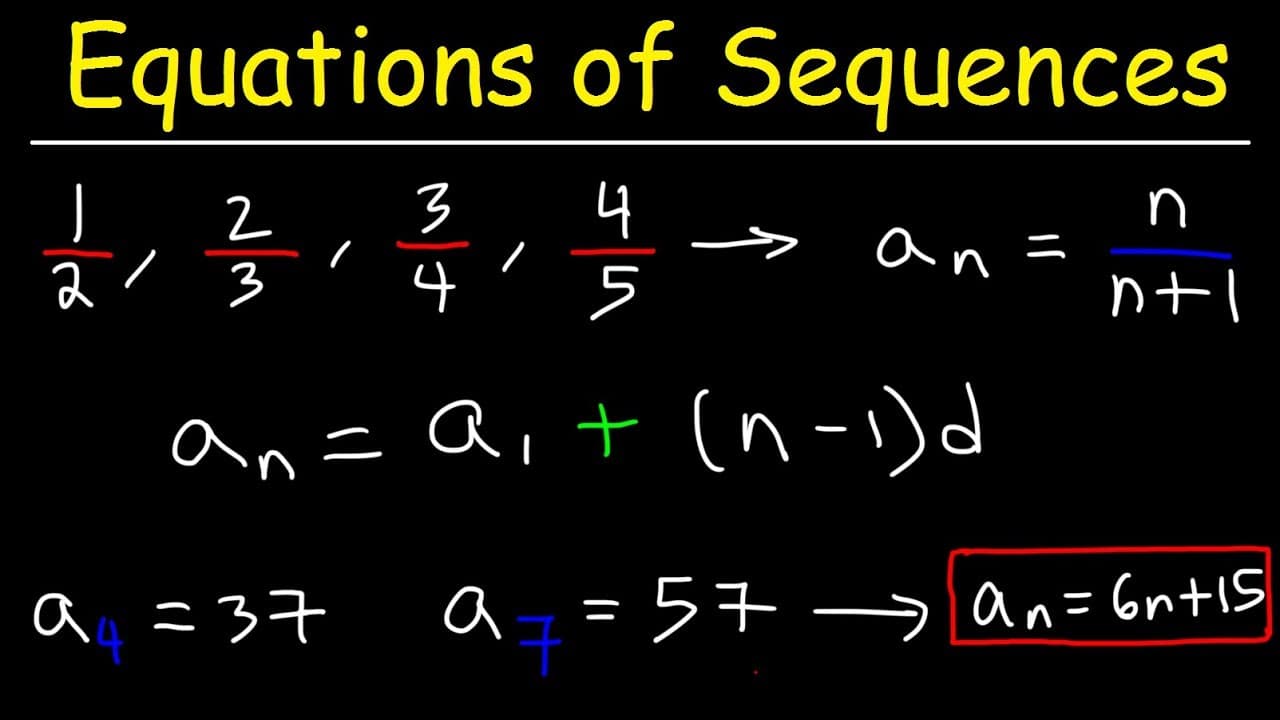
This content provides equations for different types of sequences, including arithmetic, geometric, and alternating sign patterns, as well as sequences based on perfect squares and fractions.
Transcript
now let's say if you're given a sequence of numbers 2 4 6 8 10 and your goal is to write an equation that will help you to find any indicated term so what equation describes this pattern notice that we have an arithmetic sequence that increases by two the common difference is two so the equation is simply two n because it differs by two and you cou... Read More
Key Insights
- 💳 Arithmetic sequences can be represented by the equation a sub n = a sub 1 + (n-1) * d, where a sub n is the nth term, a sub 1 is the first term, n is the position of the term, and d is the common difference.
- 💳 Geometric sequences can be represented by the equation a sub n = a sub 1 * r^(n-1), where a sub n is the nth term, a sub 1 is the first term, r is the common ratio, and n is the position of the term.
- 🧘 Sequences with alternating signs can be represented by the equation (-1)^n, where n is the position of the term. The result is negative for odd positions and positive for even positions.
- 🧘 Sequences of perfect squares can be represented by the equation n^2, where n is the position of the term. Each term is obtained by squaring its corresponding position.
- 😀 Fractional sequences can be represented by separate equations for the numerator and denominator. The equation for the numerator is n, and the equation for the denominator is n+1.
Install to Summarize YouTube Videos and Get Transcripts
Explore YouTube Video Summarizer or Get YouTube Transcript Extractor
Questions & Answers
Q: How can you write an equation for an arithmetic sequence?
For an arithmetic sequence, you need to identify the common difference and the first term. The equation is then written as a sub n = a sub 1 + (n-1) * d, where a sub n is the nth term, a sub 1 is the first term, n is the position of the term, and d is the common difference.
Q: What is the equation for a geometric sequence?
In a geometric sequence, each term is obtained by multiplying the previous term by a constant ratio. The equation is given by a sub n = a sub 1 * r^(n-1), where a sub n is the nth term, a sub 1 is the first term, r is the common ratio, and n is the position of the term.
Q: How do you write an equation for a sequence with alternating signs?
If a sequence has alternating signs, you can use the equation (-1)^n to represent it. When n is odd, the result is negative, and when n is even, the result is positive. This equation works for both the original pattern and the reversed pattern.
Q: What equation represents a sequence of perfect squares?
A sequence of perfect squares can be represented by the equation n^2, where n is the position of the term. Each term in the sequence is obtained by squaring its corresponding position.
Summary & Key Takeaways
-
The content explains how to find equations for arithmetic sequences, where the common difference is added or subtracted to each term.
-
It also shows how to find equations for geometric sequences, where each term is multiplied or divided by a common ratio.
-
The content demonstrates how to write equations for sequences with alternating signs, perfect squares, and fractions by analyzing the patterns in the sequences.
Read in Other Languages (beta)
Share This Summary 📚
Summarize YouTube Videos and Get Video Transcripts with 1-Click
Try YouTube Summary with ChatGPT & Claude or YouTube Transcript Generator
Explore More Summaries from The Organic Chemistry Tutor 📚




Summarize YouTube Videos and Get Video Transcripts with 1-Click
Try YouTube Summary with ChatGPT & Claude or YouTube Transcript Generator