Products
Features
YouTube Video Summarizer
Summarize YouTube videos
Web & PDF Highlighter
Highlight web pages & PDFs
Chat with PDF
Ask any PDF questions with AI
Ask AI Clone
Chat with your highlights & memories
Audio Transcriber
Transcribe audio files to text
Glasp Reader
Read and highlight articles
Kindle Highlight Export
Export your Kindle highlights
Idea Hatch
Hatch ideas from your highlights
Integrations
Obsidian Plugin
Notion Integration
Pocket Integration
Instapaper Integration
Medium Integration
Readwise Integration
Snipd Integration
Hypothesis Integration
Apps & Extensions
Chrome Extension
Safari Extension
Edge Add-ons
Firefox Add-ons
iOS App
Android App
Discover
Discover
Ideas
Discover new ideas and insights
Articles
Curated articles and insights
Books
Book recommendations by great minds
Posts
Essays and notes from readers
Quotes
Inspiring quotes collection
Videos
Curated videos and summaries
Explore Glasp
Glasp Newsletter
Weekly insights and updates
Glasp Talk
Interview series with great minds
Glasp Blog
Latest news and articles
Glasp Use Cases
Learn how others use Glasp
Build & Support
Glasp API
Access Glasp's API for developers
MCP Connector
Connect Glasp to Claude & ChatGPT
Community
Glasp Reddit Community
Students
Student discount and benefits
FAQs
Frequently Asked Questions
AboutPricing
DashboardLog inSign up

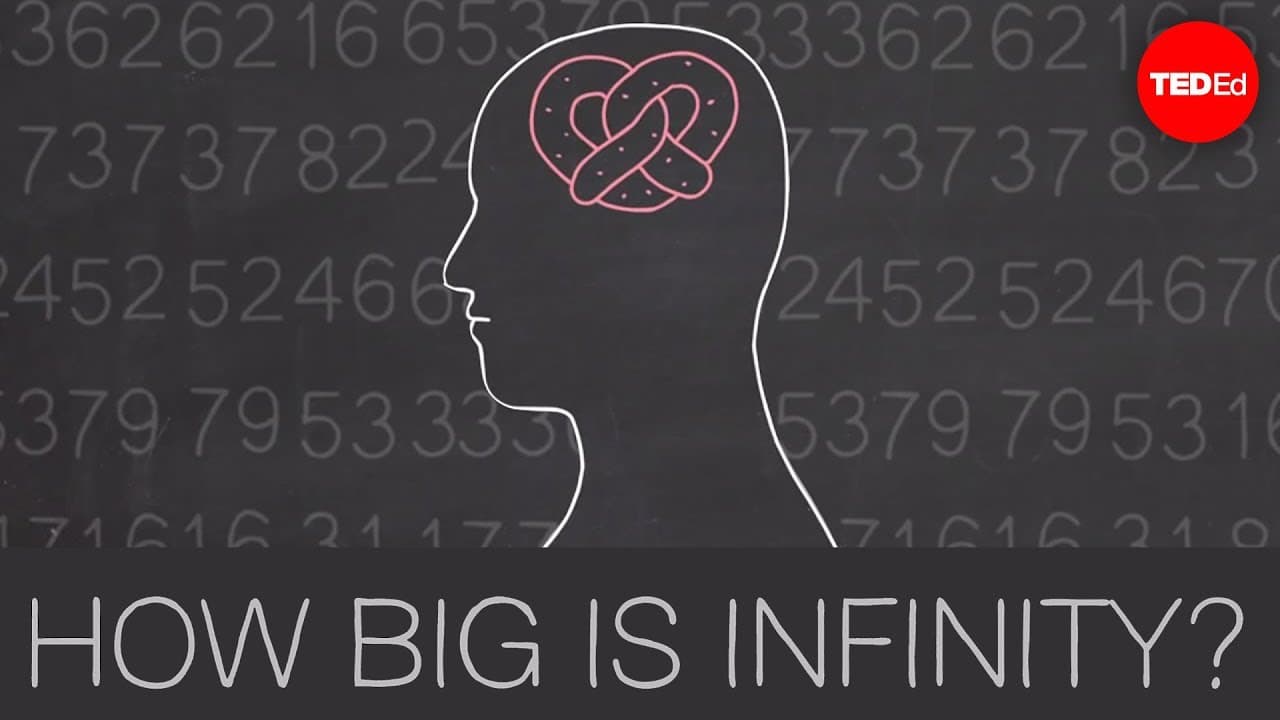
How big is infinity? - Dennis Wildfogel
3.5M views
•
August 6, 2012
by
TED-Ed
YouTube video player
How big is infinity? - Dennis Wildfogel

TL;DR

Different types of infinity exist; rational vs. irrational numbers, subsets, and unanswerable questions.

Transcript

When I was in fourth grade, my teacher said to us one day: "There are as many even numbers as there are numbers." "Really?", I thought. Well, yeah, there are infinitely many of both, so I suppose there are the same number of them. But even numbers are only part of the whole numbers, all the odd numbers are left over, so there's got to be more whole... Read More

Key Insights

  • ♾️ The concept of infinity in mathematics entails different sizes of infinities, such as rational and irrational numbers.
  • 😫 Georg Cantor's work revolutionized the understanding of infinity, showcasing the uncountable nature of certain sets.
  • 💦 The continuum hypothesis, a fundamental mathematical problem, remained unsolved until Gödel and Cohen's groundbreaking work.

Install to Summarize YouTube Videos and Get Transcripts

Explore YouTube Video Summarizer or Get YouTube Transcript Extractor

Questions & Answers

Q: How do even numbers have the same quantity as all numbers?

Even numbers and whole numbers are shown to have the same quantity as each can be matched up one to one, proving that both sets have the same number of elements.

Q: How did Georg Cantor create a list of all fractions?

Cantor arranged fractions in a grid and created a list by sweeping diagonally, skipping repeated fractions, demonstrating a one-to-one correspondence between fractions and whole numbers.

Q: Why can't all real numbers be put on a list?

Cantor's diagonal argument illustrates that not all decimal numbers can be listed as producing a new number not on any list, proving the existence of an uncountable infinity beyond whole numbers.

Q: What does the continuum hypothesis state?

The continuum hypothesis suggests an infinite set of real numbers between whole and decimal numbers, unresolved until Gödel and Cohen showed its unprovability.

Summary & Key Takeaways

  • The concept of infinity in mathematics is explored, highlighting how even numbers have the same quantity as all numbers due to matching elements.

  • The idea of forming a list of all fractions is discussed through a clever grid method by Georg Cantor.

  • Cantor's groundbreaking work on the continuum hypothesis and the discovery of unanswerable questions in mathematics is presented.


Read in Other Languages (beta)

English

Share This Summary 📚

Summarize YouTube Videos and Get Video Transcripts with 1-Click

Download browser extensions on:

Try YouTube Summary with ChatGPT & Claude or YouTube Transcript Generator

Explore More Summaries from TED-Ed 📚
Einstein's twin paradox explained - Amber Stuver thumbnail
Einstein's twin paradox explained - Amber Stuver
TED-Ed
How we conquered the deadly smallpox virus - Simona Zompi thumbnail
How we conquered the deadly smallpox virus - Simona Zompi
TED-Ed
Can you solve "Einstein’s Riddle"? - Dan Van der Vieren thumbnail
Can you solve "Einstein’s Riddle"? - Dan Van der Vieren
TED-Ed
Four sisters in Ancient Rome - Ray Laurence thumbnail
Four sisters in Ancient Rome - Ray Laurence
TED-Ed
A glimpse of teenage life in ancient Rome - Ray Laurence thumbnail
A glimpse of teenage life in ancient Rome - Ray Laurence
TED-Ed
Questions No One Knows the Answers to (Full Version) thumbnail
Questions No One Knows the Answers to (Full Version)
TED-Ed

Summarize YouTube Videos and Get Video Transcripts with 1-Click

Download browser extensions on:

Try YouTube Summary with ChatGPT & Claude or YouTube Transcript Generator

Apps & Extensions

  • Chrome Extension
  • Safari Extension
  • Edge Add-ons
  • Firefox Add-ons
  • iOS App
  • Android App

Key Features

  • YouTube Video Summarizer
  • Web & PDF Summarizer
  • Web & PDF Highlighter
  • Chat with PDF
  • Ask AI Clone
  • Audio Transcriber
  • Glasp Reader
  • Kindle Highlight Export
  • Idea Hatch

Integrations

  • Obsidian Plugin
  • Notion Integration
  • Pocket Integration
  • Instapaper Integration
  • Medium Integration
  • Readwise Integration
  • Snipd Integration
  • Hypothesis Integration

More Features

  • APIs
  • MCP Connector
  • Blog & Post
  • Embed Links
  • Image Highlight
  • Personality Test
  • Quote Shots

Company

  • About us
  • Blog
  • Community
  • FAQs
  • Job Board
  • Newsletter
  • Pricing
Terms

•

Privacy

•

Guidelines

© 2026 Glasp Inc. All rights reserved.