A number theory proof
TL;DR
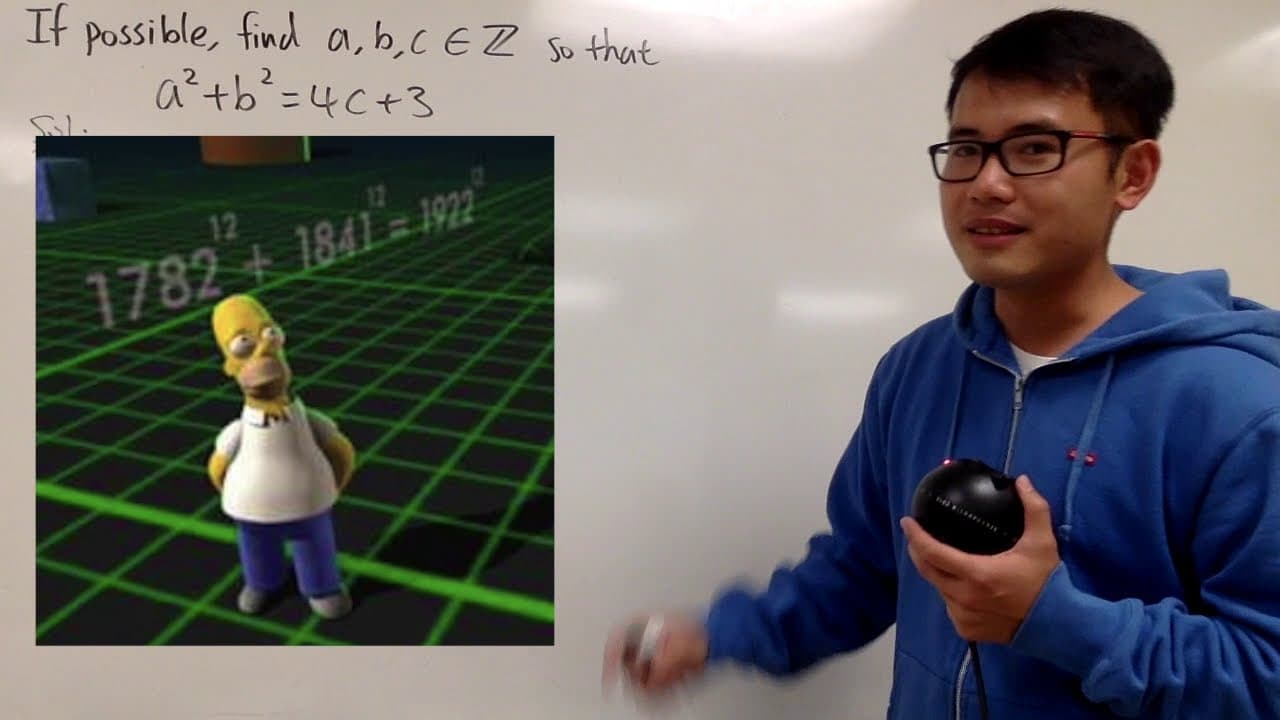
An analysis of the equation a squared plus b squared equals 4c plus 3 reveals that it has no integer solutions.
Transcript
let's do some fo fanna here if possible we are going to fight integers ABC so that a squared plus b squared equal to 4 c plus 3 and as always please pause the video and try this first okay I'll teach you guys to this well well let me show you guys my solution right here and of course you should share your station with us as well just leave a commen... Read More
Key Insights
- ❎ The equation a squared plus b squared equals 4c plus 3 represents a sum of two squares and is always greater than or equal to zero.
- 🚮 The parity of the equation reveals that c must be greater than 0, but the signs of a and b do not matter.
- 😃 By examining the equation's structure, we deduce that either a or b must be even, and the other must be odd.
- 🫲 The equation can be further simplified by factoring out a common factor of 4 on the left-hand side.
- 🥺 The contradiction arises when comparing the factored equation with the original equation, leading to the conclusion that no integer solutions exist.
- 🦕 The phrase "without loss of generality" indicates that the assumption of one variable being even and the other being odd does not affect the proof's validity.
- 👍 An alternate approach using modular arithmetic shows that the equation is not congruent, proving the absence of integer solutions.
Install to Summarize YouTube Videos and Get Transcripts
Explore YouTube Video Summarizer or Get YouTube Transcript Extractor
Questions & Answers
Q: Why does the equation a squared plus b squared equals 4c plus 3 have no integer solutions?
The equation represents a sum of two squares, and it is greater than or equal to zero. However, when examining the parity of the equation, we find that either a or b must be even, and the other must be odd, leading to a contradiction.
Q: Can the equation be simplified further?
We can factor out a common factor of 4 on the left-hand side to obtain (4 times K squared plus L squared plus L) plus 1. However, this still does not change the fact that the equation has no integer solutions.
Q: What is the significance of the phrase "without loss of generality"?
The phrase "without loss of generality" indicates that it does not matter whether we assume a to be even and b to be odd or vice versa. The essential observation is that one of them must be even, and the other must be odd.
Q: Is there any way to prove that the equation has no integer solutions using modular arithmetic?
Yes, by considering the equation modulo 4, we can see that a squared plus b squared is congruent to 1 modulo 4, while 4c plus 3 is congruent to 3 modulo 4. Since these two values are not congruent, the equation has no integer solutions.
Summary & Key Takeaways
-
The equation a squared plus b squared equals 4c plus 3 represents a sum of two squares on the left-hand side, and it is always greater than or equal to zero.
-
The observation that 4 times any integer is always even leads to the conclusion that c must be greater than 0.
-
By considering the parity of the equation, it can be deduced that either a or b must be even, and the other must be odd.
Read in Other Languages (beta)
Share This Summary 📚
Summarize YouTube Videos and Get Video Transcripts with 1-Click
Try YouTube Summary with ChatGPT & Claude or YouTube Transcript Generator
Explore More Summaries from blackpenredpen 📚
Summarize YouTube Videos and Get Video Transcripts with 1-Click
Try YouTube Summary with ChatGPT & Claude or YouTube Transcript Generator