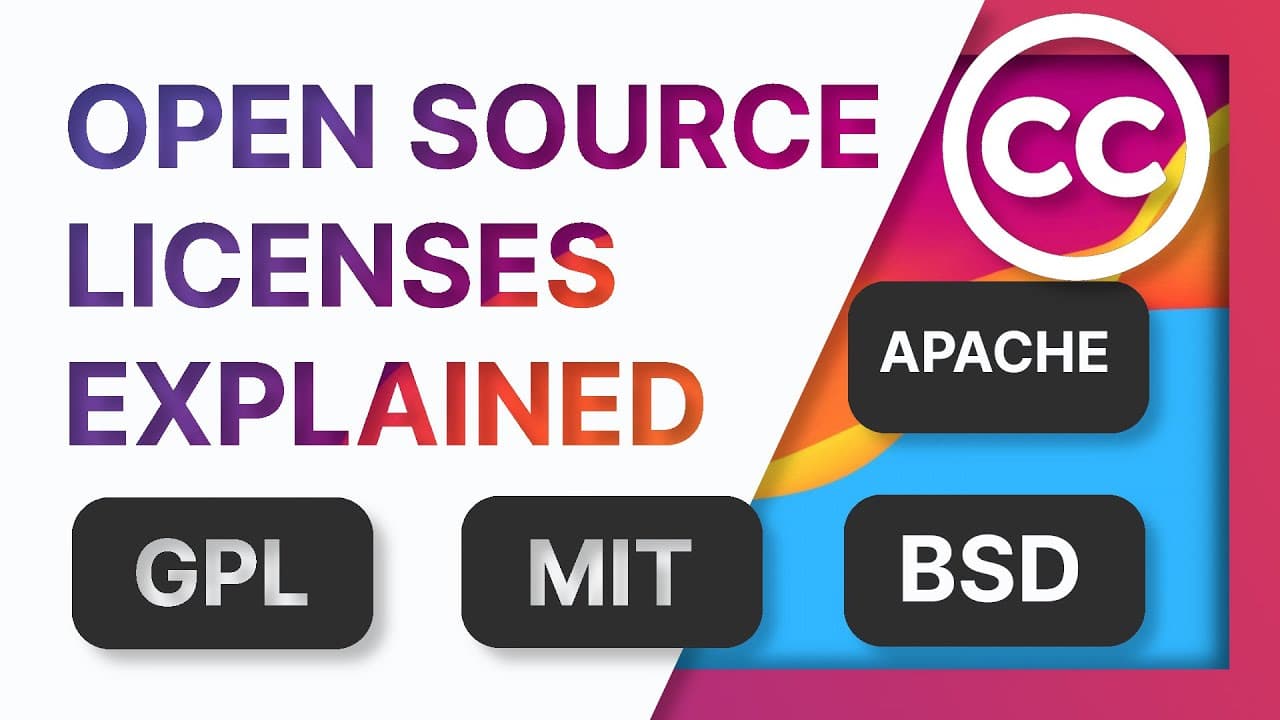
Free and Open Source software licenses explained
TL;DR
Different open source software licenses grant varying rights and restrictions when it comes to using, modifying, and distributing code.
Transcript
man finding b-roll for this one is gonna be a nightmare hey everyone this is nick and not all open source software is created equal the rights you have regarding this software is defined in the license that's attached to the software and while most of them mean that you can get basically any rights you want over the code some are more permissive an... Read More
Key Insights
- 🤗 Open source software licenses determine the rights users have regarding code usage, modification, and redistribution.
- 👨💻 The GPL and its variants are copyleft licenses that prevent code from becoming proprietary and require distribution of modifications.
- 👻 The MIT License is a permissive license that allows code inclusion in proprietary software without redistribution requirements.
- ❓ The Apache License provides similar freedoms as the MIT License but includes patent protection provisions.
- 👻 The BSD License is a low-restriction license, similar to the MIT License, allowing the use, modification, and redistribution of code.
- 💦 Creative Commons licenses apply to creative works other than code, offering various permissions and restrictions.
- 🤗 Selling open source software is allowed under most licenses, including the GPL.
Install to Summarize YouTube Videos and Get Transcripts
Explore YouTube Video Summarizer or Get YouTube Transcript Extractor
Questions & Answers
Q: What is the General Public License (GPL) and how does it differ from its variants?
The GPL is a copyleft license that prevents code from being turned proprietary and requires the redistribution of modifications. Variants like GPL version 3 and LGPL offer additional provisions, such as compatibility clauses and digital rights management clauses.
Q: Can the GPL-licensed code be sold?
Yes, code under the GPL can be sold by the original creator or anyone else. However, the person who buys the software has the right to redistribute the code for free.
Q: What are the main characteristics of the MIT License?
The MIT License is a permissive license that allows users to copy, modify, merge, and distribute code without restrictions. It can be included in proprietary software, making it attractive to companies.
Q: How does the Apache License differ from other licenses?
The Apache License grants similar freedoms as the MIT License but includes patent rights protection. Contributions to the project automatically grant rights to all patents related to the code. It is a less restrictive alternative to the GPL.
Key Insights:
- Open source software licenses determine the rights users have regarding code usage, modification, and redistribution.
- The GPL and its variants are copyleft licenses that prevent code from becoming proprietary and require distribution of modifications.
- The MIT License is a permissive license that allows code inclusion in proprietary software without redistribution requirements.
- The Apache License provides similar freedoms as the MIT License but includes patent protection provisions.
- The BSD License is a low-restriction license, similar to the MIT License, allowing the use, modification, and redistribution of code.
- Creative Commons licenses apply to creative works other than code, offering various permissions and restrictions.
- Selling open source software is allowed under most licenses, including the GPL.
- Understanding the differences between licenses is essential for developers and users in the open source community.
Summary & Key Takeaways
-
Open source software licenses determine the rights and restrictions of using and modifying code.
-
The General Public License (GPL) and its variants, such as GPL version 3 and Lesser GPL (LGPL), prevent code from becoming proprietary and require redistribution of modifications.
-
The MIT License is more permissive, allowing code to be included in proprietary software without redistribution requirements.
-
The Apache License strikes a middle ground, granting similar freedoms as the MIT License but with patent protection provisions.
-
The BSD License is a low-restriction license that grants users the freedom to use, modify, and redistribute code, similar to the MIT License.
Read in Other Languages (beta)
Share This Summary 📚
Summarize YouTube Videos and Get Video Transcripts with 1-Click
Try YouTube Summary with ChatGPT & Claude or YouTube Transcript Generator
Explore More Summaries from The Linux Experiment 📚


Summarize YouTube Videos and Get Video Transcripts with 1-Click
Try YouTube Summary with ChatGPT & Claude or YouTube Transcript Generator