How to Calculate Atomic Mass Practice Problems
TL;DR
Calculate the average atomic mass of elements by multiplying the mass of each isotope by its percent abundance.
Transcript
Gallium has two stable isotopes, and the masses of Gallium 69 which is 60.11 percent abundant and Gallium 71 (39.89 percent abundant) are 68.926 amu and 70.925 amu, respectively. Do you know what respectively means? It means that we've got two masses here and two atoms here. So respectively means the first of these masses goes with the first atom m... Read More
Key Insights
- ✋ Isotopes with higher percent abundances contribute more to the average atomic mass.
- 🫀 The atomic weight/mass reported on the periodic table is the mean of the isotopes based on their abundances.
- 💆 The average atomic mass calculation involves multiplying each isotope's mass by its percent abundance as a decimal.
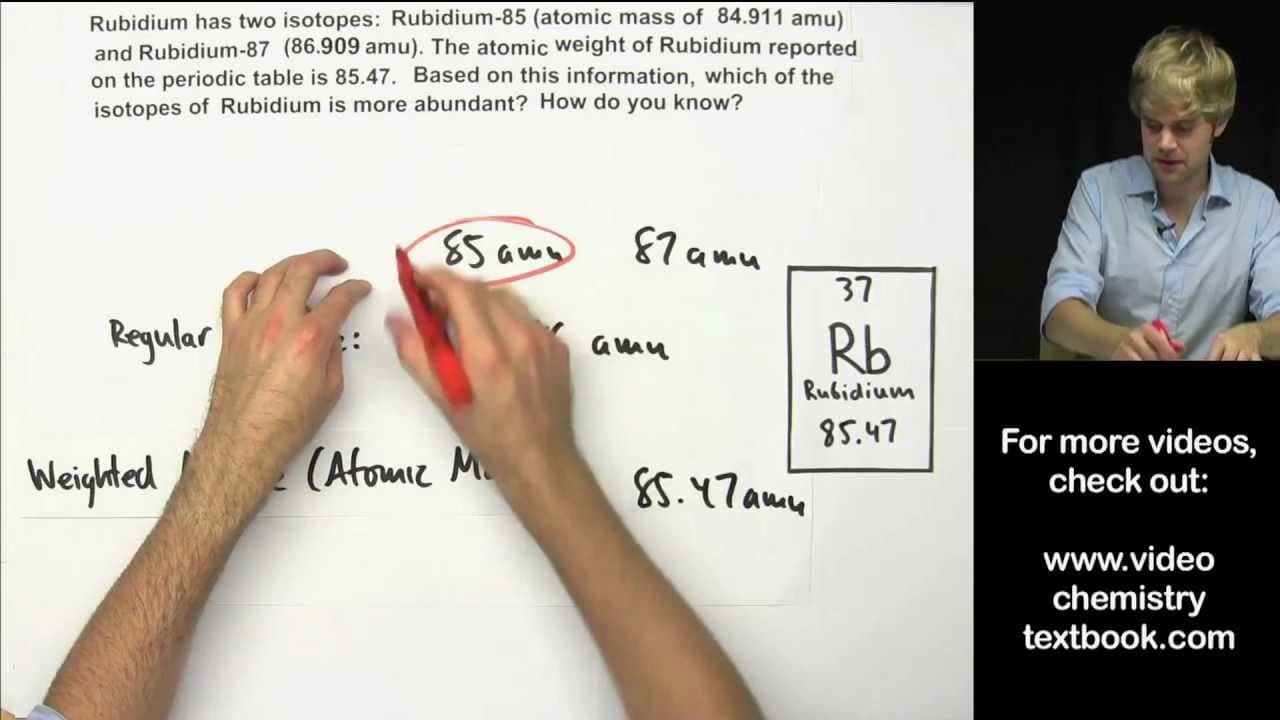
- 😚 Isotopes with masses closer to the reported atomic weight/mass are more abundant.
Install to Summarize YouTube Videos and Get Transcripts
Explore YouTube Video Summarizer or Get YouTube Transcript Extractor
Questions & Answers
Q: What does "respectively" mean in the context of isotopic masses?
In the context of isotopic masses, "respectively" means that each mass corresponds to the specific isotope mentioned earlier. It helps us correctly associate the masses with their respective isotopes.
Q: How is the average atomic mass of an element calculated?
The average atomic mass of an element is calculated by multiplying the mass of each isotope by its percent abundance (expressed as a decimal) and adding the products together. This gives the weighted average based on the relative abundance of each isotope.
Q: How can we determine which isotope of an element is more abundant without calculations?
By comparing the reported atomic weight/mass on the periodic table to the masses of the isotopes, we can determine which isotope is more abundant. The isotope with a mass closer to the reported atomic weight/mass is the more abundant one.
Q: Can the process of calculating average atomic mass be applied to elements with more than two isotopes?
Yes, the process can be applied to elements with any number of isotopes. For each isotope, its mass is multiplied by its percent abundance, and the products are added together, giving the average atomic mass of the element.
Summary & Key Takeaways
-
Gallium has two stable isotopes, Gallium 69 (60.11% abundant) and Gallium 71 (39.89% abundant), with masses of 68.926 amu and 70.925 amu, respectively. The average atomic mass of Gallium is calculated to be 69.72 amu.
-
Rubidium has two isotopes, Rubidium 85 and Rubidium 87, with atomic masses of 84.911 amu and 86.909 amu, respectively. The atomic weight reported for Rubidium is 85.47 amu, indicating that Rubidium 85 is more abundant.
-
Magnesium has three stable isotopes, Magnesium 24, Magnesium 25, and Magnesium 26, with masses of 23.985 amu, 24.9586 amu, and 25.983 amu, respectively. The average atomic mass of Magnesium is calculated to be 24.31 amu.
Read in Other Languages (beta)
Share This Summary 📚
Summarize YouTube Videos and Get Video Transcripts with 1-Click
Try YouTube Summary with ChatGPT & Claude or YouTube Transcript Generator
Explore More Summaries from Tyler DeWitt 📚




Summarize YouTube Videos and Get Video Transcripts with 1-Click
Try YouTube Summary with ChatGPT & Claude or YouTube Transcript Generator