CRO Class: How Do You Optimize Website Conversion Rates?

TL;DR
Optimize website conversion rates with a four-step CRO framework: research, optimization, results and analysis, then repetition. The process identifies where valuable traffic fails to convert, tests targeted improvements, and builds a consistent optimization program. One device-report review uncovered a Samsung Galaxy S10 page with a broken button, showing how basic fixes can unlock substantial revenue. Read on for the framework, testing principles, and landing-page practices.
Transcript
hi everybody i am so excited to have you here for our event on conversion rate optimization where you are going to learn the four step framework to convert traffic for less that is one of the main goals of everybody on the internet right now how can you convert traffic for less that's how you get a competitive advantage online you are going to lear... Read More
Key Insights
- Conversion rate optimization (CRO) is essential for converting traffic efficiently and gaining a competitive advantage online.
- A four-step CRO framework includes research, optimization, analysis, and repetition to consistently improve website conversions.
- Quantitative and qualitative research are crucial for understanding user behavior and identifying conversion opportunities.
- A/B testing is a powerful tool for determining the effectiveness of changes made to a website, ensuring positive impacts on conversions.
- Google Optimize is a recommended tool for running A/B tests due to its seamless integration with Google Analytics.
- Mobile optimization is critical, as a significant portion of traffic comes from mobile devices, requiring a mobile-first approach.
- Regularly reviewing and adjusting website elements based on user feedback and data analysis is vital for continuous improvement.
- Running at least one test per month on key landing pages can significantly enhance conversion rates and overall website performance.
Install to Summarize YouTube Videos and Get Transcripts
Explore YouTube Video Summarizer or Get YouTube Transcript Extractor
Questions & Answers
Q: How do you optimize conversion rates for a website?
Use the four-step CRO system: research, optimization, results and analysis, then repeat the process. This creates a consistent program for finding conversion problems, making targeted changes, evaluating outcomes, and continuing to improve.
Q: What is conversion rate optimization?
Conversion rate optimization, also called conversion optimization, is a process for helping website traffic convert more efficiently. Its goal is to convert traffic for less and create a competitive advantage online.
Q: What are the four steps in the CRO framework?
The framework covers research, optimization, results and analysis, and repeating the earlier steps. Repetition turns individual improvements into a consistent flywheel program rather than a one-time project.
Q: How should CRO research begin?
Start by examining how the entire website converts instead of looking at pages in isolation. Review reports such as device performance data to identify traffic segments or website functions that are failing to convert.
Q: Why should CRO include device-level analysis?
Conversion problems may affect a specific device even when the broader website appears functional. In the example, a devices report showed that the Samsung Galaxy S10 did not convert because a page button did not work, and fixing that basic issue produced substantial additional revenue without more advertising spend.
Q: Who teaches the CRO Class?
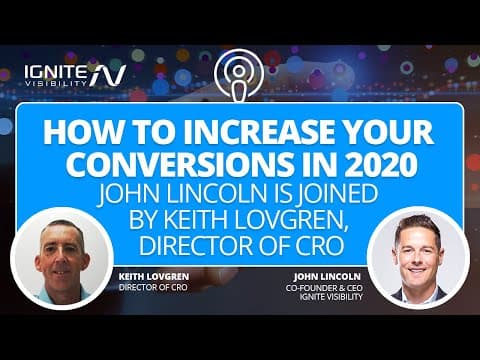
The class features John Lincoln, CEO of Ignite Visibility, Randy Anderson, its director of conversion rate optimization, and Danny Conlon, its director of product management. They cover the CRO process, testing practices, strategic frameworks, and documentation used for websites across different industries.
Q: Who is this CRO framework intended for?
It is intended for websites receiving traffic that is not converting at the required rate. It also serves teams that have experimented with CRO but lack consistent results or a reliable system for repeatedly increasing conversions.
Q: What practical resources does the CRO Class provide?
The presentation includes specific strategies and documentation for applying conversion rate optimization to a business. It also offers landing-page guidance and a CRO checklist that viewers can use on their own websites.
Summary & Key Takeaways
-
Conversion rate optimization (CRO) involves a four-step framework: research, optimization, analysis, and repetition. The process begins with identifying high-traffic, low-conversion areas using data analytics, followed by implementing A/B testing to refine strategies. Consistent review and adjustment of website elements are essential for maintaining a competitive edge.
-
Quantitative and qualitative research are crucial for understanding user behavior and identifying conversion opportunities. A/B testing, facilitated by tools like Google Optimize, helps determine the effectiveness of changes made to a website, ensuring positive impacts on conversions. Regular testing and analysis are key to successful CRO.
-
Mobile optimization is critical due to the high volume of mobile traffic. A mobile-first approach, combined with regular reviews and adjustments based on user feedback and data analysis, ensures continuous improvement. Running at least one test per month on key landing pages can significantly enhance conversion rates and overall website performance.
Read in Other Languages (beta)
Share This Summary 📚
Summarize YouTube Videos and Get Video Transcripts with 1-Click
Try YouTube Summary with ChatGPT & Claude or YouTube Transcript Generator
Explore More Summaries from IgniteVisibility 📚
Summarize YouTube Videos and Get Video Transcripts with 1-Click
Try YouTube Summary with ChatGPT & Claude or YouTube Transcript Generator