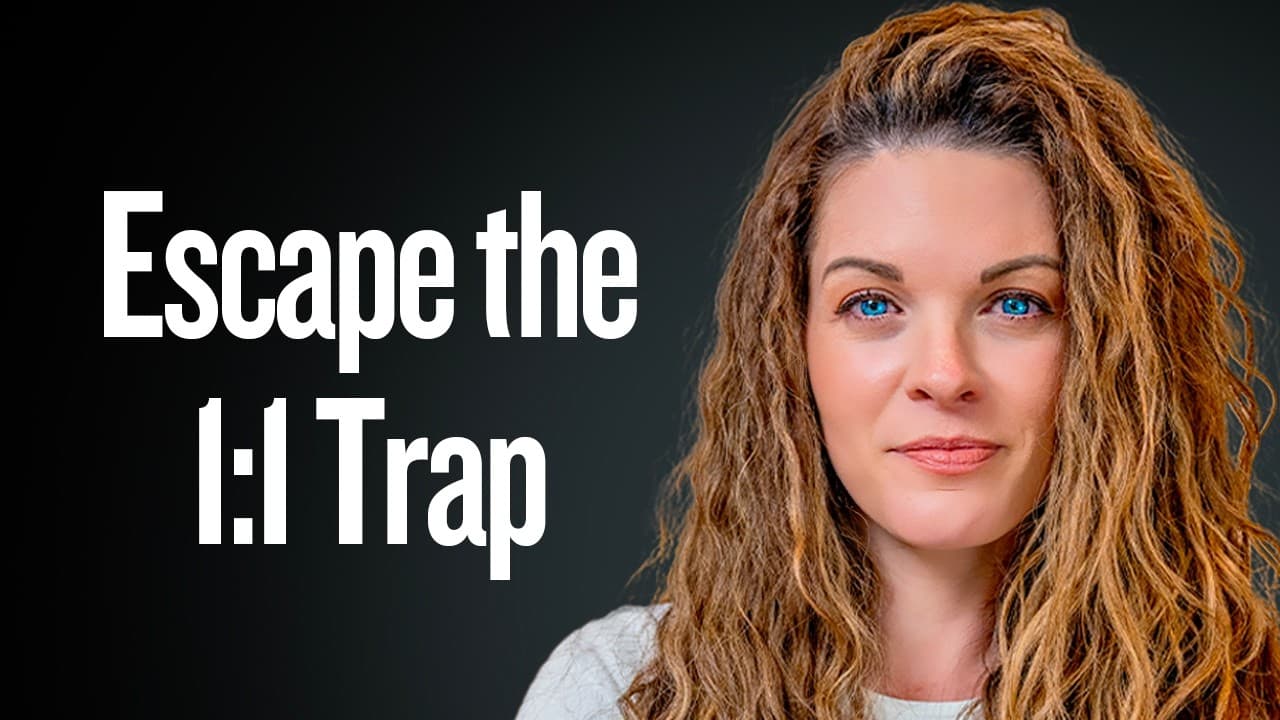
1:1 Coaching Nearly Killed Me But Now I Have 4,000 Clients
TL;DR
Transform coaching from one-on-one to scalable impact.
Transcript
Eight years ago, I made $8,000 a month working with four clients, and it nearly put me in the hospital. Fast forward to today, we've supported over $4,000 clients and generate half a million dollars a month in our business. Same expertise, better results for our clients, but one model almost killed me and the other model gave me my life back. But m... Read More
Key Insights
- Transitioning from one-on-one coaching to a scalable model can dramatically increase impact and revenue while reducing personal burnout.
- The 'Three Cs' model—Curriculum, Coaching, and Community—enables coaches to deliver consistent, high-quality results to more clients simultaneously.
- Traditional one-on-one coaching often leads to burnout and limits the number of clients a coach can serve effectively.
- Successful transition involves validating the offer before building the entire program, ensuring demand and avoiding wasted effort.
- This scalable model allows coaches to support thousands of clients globally without sacrificing quality or personal time.
- Building a business around existing expertise can be done with minimal startup costs and without a large social media following.
- The knowledge monetization model creates a self-sustaining system where client success stories drive new client acquisition.
- Implementing strategic systems allows a business to operate independently, freeing up the coach's time for personal pursuits.
Install to Summarize YouTube Videos and Get Transcripts
Explore YouTube Video Summarizer or Get YouTube Transcript Extractor
Questions & Answers
Q: What is the main challenge with traditional one-on-one coaching?
The main challenge with traditional one-on-one coaching is the limitation it imposes on the coach's time and energy. Coaches often face burnout due to the demanding schedule, which restricts the number of clients they can serve effectively. This model also limits income potential as it is directly tied to the time spent with each client.
Q: How does the 'Three Cs' model improve client outcomes?
The 'Three Cs' model improves client outcomes by allowing coaches to deliver their expertise at scale through a structured curriculum, group coaching sessions, and a supportive community. This approach not only increases the number of clients served but also enhances the quality of service by reducing coach burnout, enabling them to show up as their best selves consistently.
Q: What role does community play in the 'Three Cs' model?
Community plays a crucial role in the 'Three Cs' model by providing a space for clients to support each other. This peer interaction often leads to valuable insights and shared experiences, enhancing the learning process. The community aspect fosters a collaborative environment where clients can learn from each other's journeys, contributing to better overall outcomes.
Q: Why is it important to validate an offer before building a full program?
Validating an offer before building a full program is important because it ensures there is genuine demand for the service. This step prevents coaches from investing time and resources into creating a product that may not resonate with potential clients. By engaging in conversations with prospects, coaches can refine their offerings to meet real client needs, leading to a more successful launch.
Q: How can coaches start building a scalable business with minimal resources?
Coaches can start building a scalable business with minimal resources by leveraging their existing expertise and focusing on creating a profitable offer prototype (POP). This involves conducting market research through client conversations, developing a basic curriculum outline, and inviting early participants to join a prototype program. This approach minimizes upfront costs and allows for iterative development based on real client feedback.
Q: What is the knowledge monetization model?
The knowledge monetization model is a business strategy that focuses on transforming personal expertise into a scalable, profitable business. It emphasizes low startup costs, rapid launch, high revenue retention, and peaceful scaling. By building a business around existing knowledge, coaches can create an authority-based enterprise that grows through client success stories and word-of-mouth referrals.
Q: How does the scalable model affect a coach's work-life balance?
The scalable model positively affects a coach's work-life balance by reducing the need for constant, intensive one-on-one sessions. By implementing systems that run independently, coaches can reclaim their time for personal pursuits, creativity, and strategic thinking. This model allows coaches to maintain high-quality service delivery while enjoying more freedom and flexibility in their daily lives.
Q: What is the significance of authority status in the scalable model?
Authority status in the scalable model signifies that a coach's expertise has become a valuable business asset rather than a time-consuming task. This status is achieved when the coach's reputation and results drive client acquisition and retention, creating a self-sustaining business. Authority status enables coaches to detach income from time, build a legacy, and focus on high-impact activities.
Summary & Key Takeaways
-
The transition from one-on-one coaching to a scalable model using the 'Three Cs'—Curriculum, Coaching, and Community—can significantly enhance impact and revenue while reducing burnout.
-
The 'Three Cs' model provides a framework for delivering consistent, high-quality results to a larger client base, enabling coaches to expand their reach and effectiveness.
-
By validating offers before full development, coaches can ensure demand and avoid unnecessary effort, leading to a sustainable and profitable business model.
Read in Other Languages (beta)
Share This Summary 📚
Summarize YouTube Videos and Get Video Transcripts with 1-Click
Try YouTube Summary with ChatGPT & Claude or YouTube Transcript Generator
Explore More Summaries from Sunny Lenarduzzi 📚



Summarize YouTube Videos and Get Video Transcripts with 1-Click
Try YouTube Summary with ChatGPT & Claude or YouTube Transcript Generator