How Does the Sentencepiece Tokenizer Work for Transformers?
TL;DR
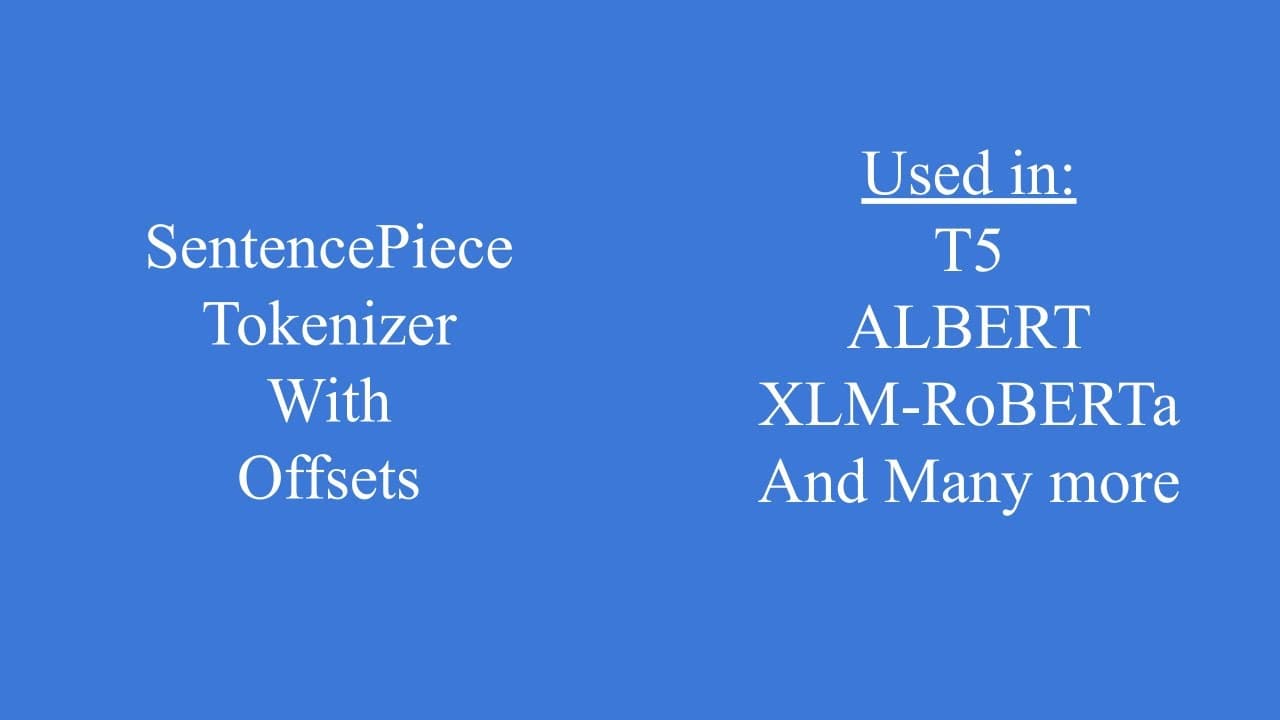
The Sentencepiece tokenizer efficiently tokenizes text for transformer-based models, such as T5 and ALBERT, by providing offsets that are crucial for tasks involving question answering. Unlike the Hugging Face tokenizer, Sentencepiece is language-independent and consists of components for normalization, training, encoding, and decoding. By creating a custom implementation, developers can leverage its capabilities for better data processing.
Transcript
hello everyone and welcome to yet another video about data processing for cushion answering system and this time we are going to deal with Albert so we have created this processed data function for Roberta and word previously so we're just going to do some magic there no sir no we are not going to do any magic but we're we don't have to change a lo... Read More
Key Insights
- 📽️ The talk show is an opportunity for project presentation and learning from experienced guests like Andre from Kaggle.
- 🕰️ Sentence piece tokenizer is preferred for transformer-based models because it is language-independent and provides Unicode character compatibility.
- 🤗 Hugging face tokenizer library lacks offsets for sentence piece tokenization, requiring the creation of a custom tokenizer for compatibility.
- 🕰️ The sentence piece tokenizer consists of a normalizer, trainer, encoder, and decoder components for efficient tokenization.
- 👻 Sentence piece tokenization enables the processing of text in various languages and allows for easy retrieval of offsets for accurate results.
- 👨💻 The code example demonstrates the implementation of a sentence piece tokenizer with offsets, making it compatible with transformer-based models.
- 🙃 The tokenizer can be used to encode text and obtain token IDs and offsets, facilitating data processing and analysis.
Install to Summarize YouTube Videos and Get Transcripts
Explore YouTube Video Summarizer or Get YouTube Transcript Extractor
Questions & Answers
Q: What is the purpose of the new talk show mentioned in the video?
The talk show aims to provide a platform for guests to present their projects, with the first guest being Andre from Kaggle. Viewers can ask questions during the live event.
Q: Why is using offsets important in transformer-based question answering systems?
Offsets help determine the starting and ending position of answers and enable the mapping of tokenized sentences back to the original text, ensuring accurate results.
Q: What is the main limitation of the hugging face tokenizer library for sentence piece tokenization?
The hugging face tokenizer library does not provide offsets for sentence piece tokenization, making it incompatible with transformer-based question answering systems that rely on offset information.
Q: How can the sentence piece tokenizer be implemented in a code example?
By importing the necessary libraries, loading the sentence piece model, and using the encode function, the sentence piece tokenizer can be used to tokenize text with offsets.
Summary & Key Takeaways
-
The video introduces a new talk show where guests can present their projects, with the first guest being Andre from Kaggle, and invites viewers to join the show.
-
The content explains the limitations of the hugging face tokenizer library for sentence piece tokenization and the importance of using offsets for transformer-based question answering systems.
-
The video demonstrates the usage of the sentence piece tokenizer and provides a code example for implementing it, along with the necessary imports and adjustments in code.
Read in Other Languages (beta)
Share This Summary 📚
Summarize YouTube Videos and Get Video Transcripts with 1-Click
Try YouTube Summary with ChatGPT & Claude or YouTube Transcript Generator
Explore More Summaries from Abhishek Thakur 📚
Summarize YouTube Videos and Get Video Transcripts with 1-Click
Try YouTube Summary with ChatGPT & Claude or YouTube Transcript Generator