Miller sweep Circuit | PDC | Lec-82
TL;DR
The video explains the Miller sweep circuit's mechanics and its components like amplifiers and capacitors.
Transcript
hi everyone in this video I am going to explain about the Miller sweep circuit in the previous video we have seen Miller and bootstrap time based generators how the basic circuit diagram like resistance and capacitance can be converted into a Miller Circuit by including some amplifier or a generator so we have seen in the case of Miller circuit an ... Read More
Key Insights
- ⚾ The Miller sweep circuit leverages an amplifier to enhance the performance of capacitor-based charging systems, addressing non-linearity issues.
- 🎨 By integrating Thevenin's equivalent circuits, design efficiency and accuracy in predicting circuit behavior are improved.
- 👻 The circuit allows for a broader range of input signals, thus providing flexibility in various electronic applications.
- 🉐 Understanding gain dynamics is crucial, as changes in amplifier gains significantly affect circuit output and linearity.
- 📡 The analysis of output signals reveals the relationship between input conditions and resultant waveform shapes, illustrating overall circuit stability.
- 🌍 The inclusion of resistive elements significantly influences the transient response of the circuit, reflecting real-world operational challenges.
- 🍵 Negative gain effects are handled by careful design strategies, ensuring the output signal behaves predictably and align with desired specifications.
Install to Summarize YouTube Videos and Get Transcripts
Explore YouTube Video Summarizer or Get YouTube Transcript Extractor
Questions & Answers
Q: What is the primary function of the Miller sweep circuit?
The Miller sweep circuit's primary function is to maintain a linear response when a capacitor is charged over time. By integrating an amplifier with a theoretical infinite gain into the circuit, the design helps mitigate issues associated with current decrease during capacitor charging, thus maintaining desired output characteristics.
Q: How does the inclusion of an amplifier affect the performance of the Miller circuit?
The inclusion of an amplifier with a gain of minus infinity alters the performance by providing active control over the waveform characteristics. This enables the circuit to produce more stable output signals and minimizes deviations from linearity, effectively countering the errors typically seen in capacitive charging.
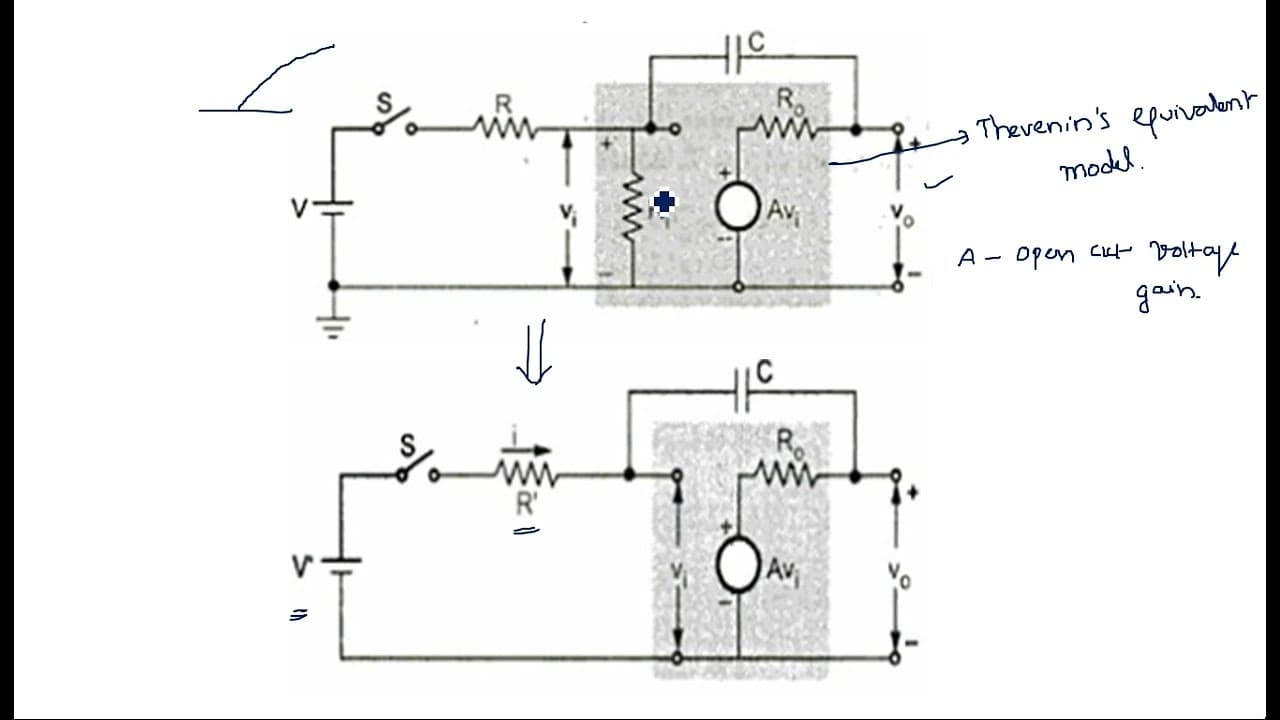
Q: What are Thevenin's equivalent models used for in the context of the Miller sweep circuit?
Thevenin's equivalent models simplify complex circuits by representing them as a single voltage source and a single resistance. In the Miller sweep circuit, these models help analyze input and output impedances, aiding in the design process by predicting how different component values can affect overall circuit performance.
Q: Can the current through the capacitor decrease during operation, and how is this managed?
Yes, the current through the capacitor is expected to decrease as it charges. This is managed by incorporating an amplifier to maintain constant output during charging, effectively compensating for the diminishing current to ensure that the output remains stable and exhibits the desired linear response.
Q: What is the significance of the "slope error" discussed in the video?
The "slope error" refers to the deviation from the expected linear response during capacitor charging, which affects the output signals. Minimizing this error is crucial for ensuring the circuit operates accurately, especially under varied loads or input conditions, which the Miller sweep circuit design aims to address.
Q: How does the voltage across the capacitor change over time when using the Miller sweep circuit?
Initially, when the capacitor is uncharged, its voltage is zero. As time progresses and the switch is closed, the capacitor starts charging, and its voltage increases until it acts as an open circuit at T equals infinity. This charge behavior is essential for understanding signal transitions within the circuit.
Summary & Key Takeaways
-
The content presents the Miller sweep circuit, explaining how it integrates amplifiers with resistance and capacitance to create linear response characteristics.
-
It details the mechanism by which the capacitor charges and how deviations from linearity can be minimized in practical applications using this circuit.
-
The video discusses the circuit's modifications through Thevenin’s equivalent model, emphasizing the importance of gain-adjusted amplifier configurations to optimize output signals.
Read in Other Languages (beta)
Share This Summary 📚
Summarize YouTube Videos and Get Video Transcripts with 1-Click
Try YouTube Summary with ChatGPT & Claude or YouTube Transcript Generator