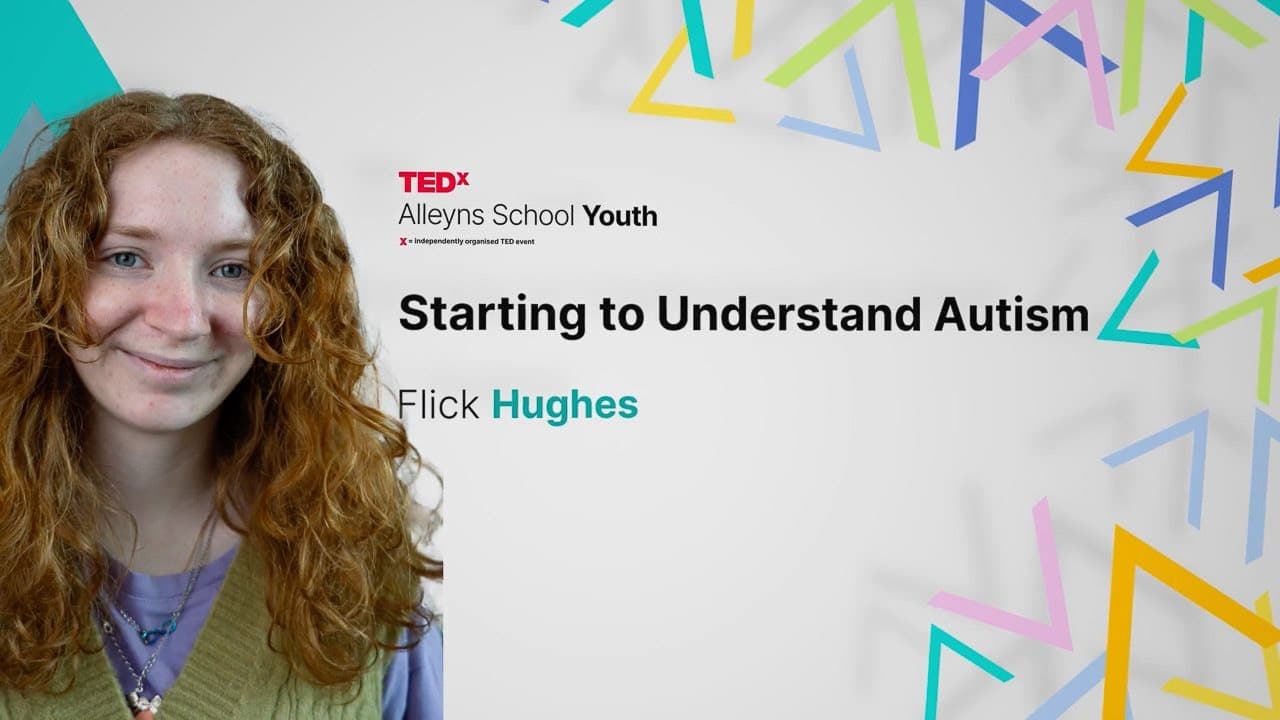
Starting to Understand Autism | Flick Hughes | TEDxAlleyns School Youth
TL;DR
Autism complexities go beyond academic descriptions, affecting daily struggles uniquely for each individual.
Transcript
Transcriber: EMILY JIA HUEI Lim Reviewer: Jiwoo Park Autism was first described as a separate condition in 1926 by Grunya Efimova Zakharova. Her descriptions were so vivid and stuck in the minds of other academics so well that they were able to recognize children displaying autistic traits in passing on the street. Later, Hans Asperger described au... Read More
Key Insights
- 🖐️ Autism history shaped by Zakharova's and Asperger's observations, laying the foundation for future understanding.
- 🛟 Autism's spectrum includes varying communication styles, social struggles, and unique behaviors affecting daily life.
- 🙂 Autistic experiences like inertia and masking shed light on personal challenges beyond diagnostic criteria.
- ❓ Environment, personality, and intellect contribute to diverse autistic realities, emphasizing individual nuances.
- #️⃣ Understanding autism requires acknowledging qualitative experiences, as numbers cannot capture the full spectrum.
- 🪡 Advocating for autism awareness and acceptance fosters inclusivity and support for diverse needs.
- 🛟 Empowering individuals with autism through enabling environments and reasonable adjustments promotes thriving in all aspects of life.
Install to Summarize YouTube Videos and Get Transcripts
Explore YouTube Video Summarizer or Get YouTube Transcript Extractor
Questions & Answers
Q: How did Grunya Efimova Zakharova's descriptions impact recognition of autistic traits?
Zakharova's vivid descriptions enabled recognition of autistic traits, leading to the identification of individuals displaying such traits in society.
Q: What is the difference between symptoms and traits in autism?
Traits are inherent characteristics in autism, while symptoms are responses to environmental stimuli based on these traits, influencing individual experiences.
Q: How does autistic inertia affect transitions between activities?
Autistic inertia causes difficulty in transitioning between activities, manifesting as a disconnection between intention and action, particularly challenging in certain contexts.
Q: What is the significance of masking in autism?
Masking involves individuals consciously adjusting their behavior to fit social norms, often leading to heightened self-awareness and communication challenges for autistic individuals.
Summary & Key Takeaways
-
Autism history dates back to vivid descriptions by Zakharova and Asperger, leading to evolving understanding.
-
Autism encompasses communication challenges, social interactions, and repetitive behaviors.
-
Personal experiences like autistic inertia and masking shed light on diverse autistic realities.
Read in Other Languages (beta)
Share This Summary 📚
Summarize YouTube Videos and Get Video Transcripts with 1-Click
Try YouTube Summary with ChatGPT & Claude or YouTube Transcript Generator
Explore More Summaries from TEDx Talks 📚


Summarize YouTube Videos and Get Video Transcripts with 1-Click
Try YouTube Summary with ChatGPT & Claude or YouTube Transcript Generator