How The Flex Company disrupted menstrual care (with founder & CEO Lauren Wang) | Masters of Scale
TL;DR
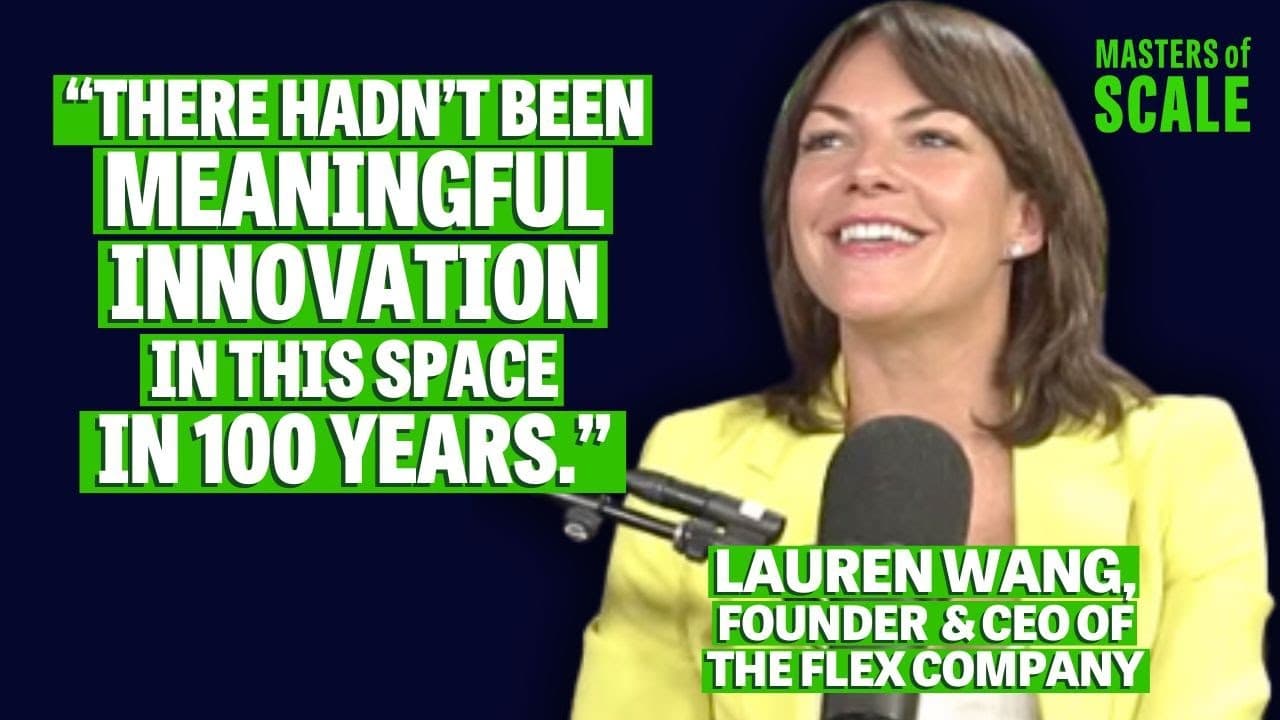
Lauren Wang revolutionizes menstrual care with innovative products and bold marketing.
Transcript
so I was on this journey telling everyone that I met about my idea and asking for help and saying I was looking for a CEO and I would be CMO Lauren Wong knew that her idea for a new kind of menstrual product had massive potential she wanted to create a disposable flexible disc that could be worn instead of a tampon but Lauren wasn't sure she could ... Read More
Key Insights
- Lauren Wang founded The Flex Company to address the lack of innovation in menstrual products, driven by personal health issues with tampons.
- Flex's menstrual disc offers a unique alternative to tampons and pads, allowing for up to 12 hours of wear and self-emptying during urination.
- Lauren's journey to becoming CEO was marked by initial self-doubt and external skepticism, but she overcame these challenges with determination.
- The company faced significant hurdles in funding and scaling, particularly in breaking into retail dominated by legacy brands.
- Lauren leveraged her network and asked for specific help to overcome knowledge gaps in product development and supply chain management.
- Flex's marketing strategy focuses on authenticity and choice, avoiding fearmongering while educating consumers about new options.
- The company achieved rapid growth, becoming the top seller in its category on Amazon and expanding to over 30,000 stores.
- Future plans include launching new products, deepening retail partnerships, and expanding internationally to reach more consumers.
Install to Summarize YouTube Videos and Get Transcripts
Explore YouTube Video Summarizer or Get YouTube Transcript Extractor
Questions & Answers
Q: What inspired Lauren Wang to start The Flex Company?
Lauren Wang was inspired to start The Flex Company due to her personal health issues with tampons, which caused recurring infections. After realizing the lack of innovation in menstrual products, she was driven by a moral imperative to provide better options for women, ultimately leading to the creation of the Flex disc.
Q: How did Lauren Wang overcome her initial self-doubt about being a CEO?
Lauren Wang overcame her initial self-doubt about being a CEO through encouragement from her network, including a pivotal conversation with a friend who believed in her capabilities. Despite skepticism from trusted colleagues, she was motivated by a strong sense of purpose and the desire to address a significant gap in menstrual care.
Q: What challenges did Flex face in entering the retail market?
Flex faced significant challenges in entering the retail market, including breaking into a space dominated by legacy brands like Procter & Gamble. The company had to navigate complex supply chain issues and align cash flows, while also convincing retailers of the demand for their innovative products.
Q: How did Lauren Wang leverage her network to build The Flex Company?
Lauren Wang leveraged her network by creating a detailed list of people she had interacted with professionally and reaching out with specific, time-bound requests for help. This approach allowed her to tap into second and third-degree connections, gaining valuable insights and assistance in areas like supply chain and product development.
Q: What is unique about the Flex disc compared to other menstrual products?
The Flex disc is unique in that it sits around the cervix, unlike tampons and cups that sit in the vaginal canal. It can be worn for up to 12 hours, holds the equivalent of five super tampons, and self-empties when urinating, providing convenience and reducing the need to carry multiple products.
Q: How did Flex's marketing strategy contribute to its growth?
Flex's marketing strategy contributed to its growth by focusing on authenticity and consumer choice, avoiding fearmongering tactics. The brand communicates the benefits of its products without bashing competitors, resonating with consumers seeking innovative and trustworthy menstrual care solutions.
Q: What role did Y Combinator play in Flex's development?
Y Combinator played a crucial role in Flex's development by providing initial funding and mentorship. The program emphasized the importance of doing things that don't scale initially and helped Lauren Wang refine her business model, ultimately leading to a successful pitch at demo day that attracted significant investor interest.
Q: What are Flex's future plans for growth and expansion?
Flex's future plans for growth and expansion include launching new products, deepening strategic partnerships with retail partners, and expanding internationally. The company aims to increase awareness of its products and address the needs of a larger segment of the global population, requiring additional capital to support these initiatives.
Summary & Key Takeaways
-
Lauren Wang founded The Flex Company to innovate menstrual care, driven by personal health challenges and a lack of industry progress. Her flagship product, the Flex disc, offers a unique alternative to traditional products, allowing up to 12 hours of wear and self-emptying capabilities.
-
Despite initial self-doubt and external skepticism, Lauren became CEO and successfully scaled Flex Co. She overcame funding and scaling hurdles, particularly in a retail space dominated by legacy brands, by leveraging her network and asking for specific help.
-
Flex's marketing strategy emphasizes authenticity and consumer choice, steering clear of fearmongering. The company has seen rapid growth, becoming a top seller on Amazon and expanding to over 30,000 stores, with plans for new product launches and international expansion.
Read in Other Languages (beta)
Share This Summary 📚
Summarize YouTube Videos and Get Video Transcripts with 1-Click
Try YouTube Summary with ChatGPT & Claude or YouTube Transcript Generator
Explore More Summaries from Masters of Scale 📚

Summarize YouTube Videos and Get Video Transcripts with 1-Click
Try YouTube Summary with ChatGPT & Claude or YouTube Transcript Generator