Ensembling, Blending & Stacking
TL;DR
Learn about ensembling, blending, and stacking models to improve performance in machine learning competitions and real-world applications.
Transcript
hello everyone and welcome to my channel in this video today i'm going to talk about ensembling blending and stacking and this has been one of the most requested video a lot of people have to ask me to make a tutorial around it and finally i found some time and that's why we are doing it today so when we hear the words ensembling and stacking what ... Read More
Key Insights
- 👻 Ensembling, blending, and stacking allow for the combination of different models to improve prediction accuracy.
- ✊ With advancements in computing power, ensembling is not limited to machine learning competitions but can also be used in production settings.
- 🙏 Creating folds and using stratified k-fold is important when ensembling models to ensure consistency and effectiveness.
- 🏋️ Different methods, such as averaging, weighted averaging, and stacking, can be used to combine models, each with its own advantages and purposes.
- 🏋️ Optimal weight selection can be achieved through optimization functions, such as fmin, to find the best weights for blending or weighted averaging.
- 😜 Rank averaging can be an alternative to traditional averaging, where predictions are converted to ranks and then averaged.
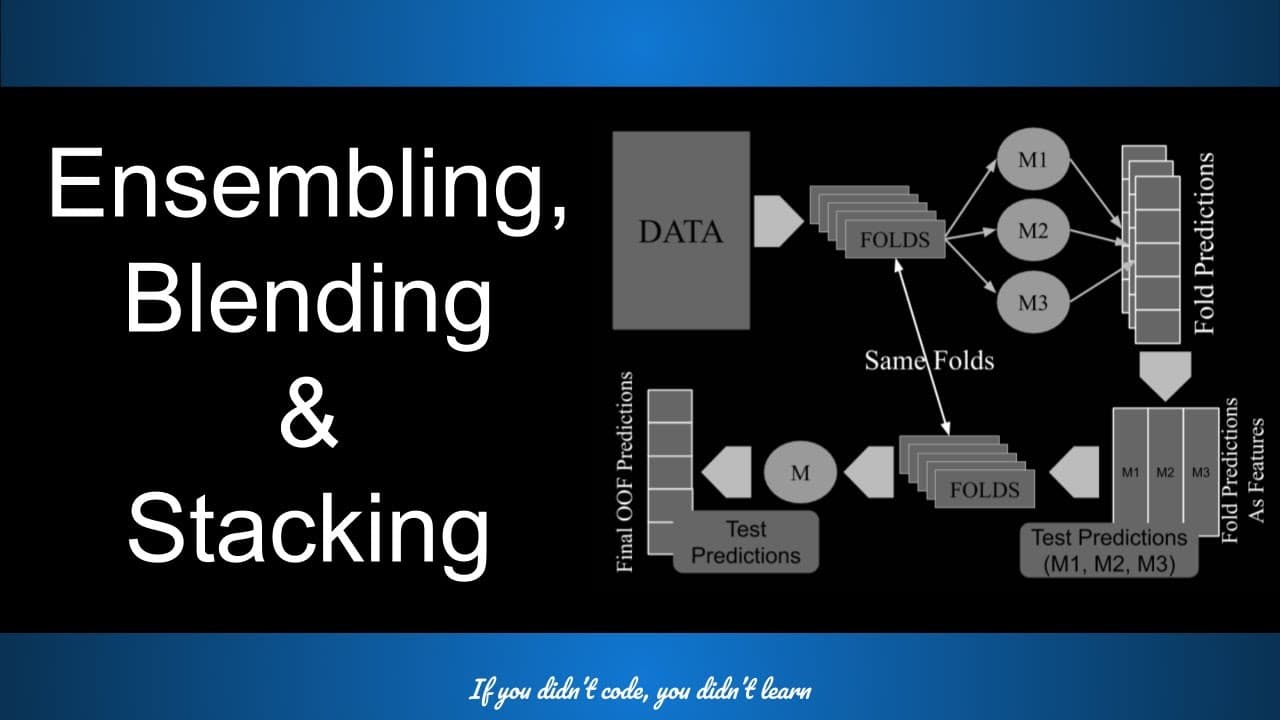
- 🚄 Stacking involves training a new model on the predictions of existing models, allowing for more complex combinations and potentially higher performance.
Install to Summarize YouTube Videos and Get Transcripts
Explore YouTube Video Summarizer or Get YouTube Transcript Extractor
Questions & Answers
Q: What is ensembling and why is it useful?
Ensembling is the combination of different models to improve prediction accuracy. It is useful because it allows us to leverage the strengths of multiple models and reduce the impact of any individual model's weaknesses.
Q: What is the difference between blending and stacking?
Blending involves simple averaging or weighted averaging of predictions from different models. Stacking, on the other hand, involves training a new model on the predictions of existing models.
Q: How can ensembling be used in real-world applications?
Ensembling can be used in various applications, including sentiment analysis, image classification, fraud detection, and recommendation systems. By combining different models, we can improve accuracy and reliability in these tasks.
Q: What is the benefit of using stacking over blending?
Stacking often outperforms blending as it involves training a new model on the predictions of existing models, allowing for more flexible and complex combinations of models. This can potentially lead to better performance in prediction accuracy.
Summary & Key Takeaways
-
Ensembling, blending, and stacking are techniques used to combine different models for improved performance in machine learning competitions and production settings.
-
Ensembling involves combining different models to create a more accurate prediction by leveraging their strengths.
-
Blending and stacking refer to different methods of combining models, with blending focusing on simple averaging or weighted averaging, while stacking involves training a new model on the predictions of existing models.
Read in Other Languages (beta)
Share This Summary 📚
Summarize YouTube Videos and Get Video Transcripts with 1-Click
Try YouTube Summary with ChatGPT & Claude or YouTube Transcript Generator
Explore More Summaries from Abhishek Thakur 📚

Summarize YouTube Videos and Get Video Transcripts with 1-Click
Try YouTube Summary with ChatGPT & Claude or YouTube Transcript Generator