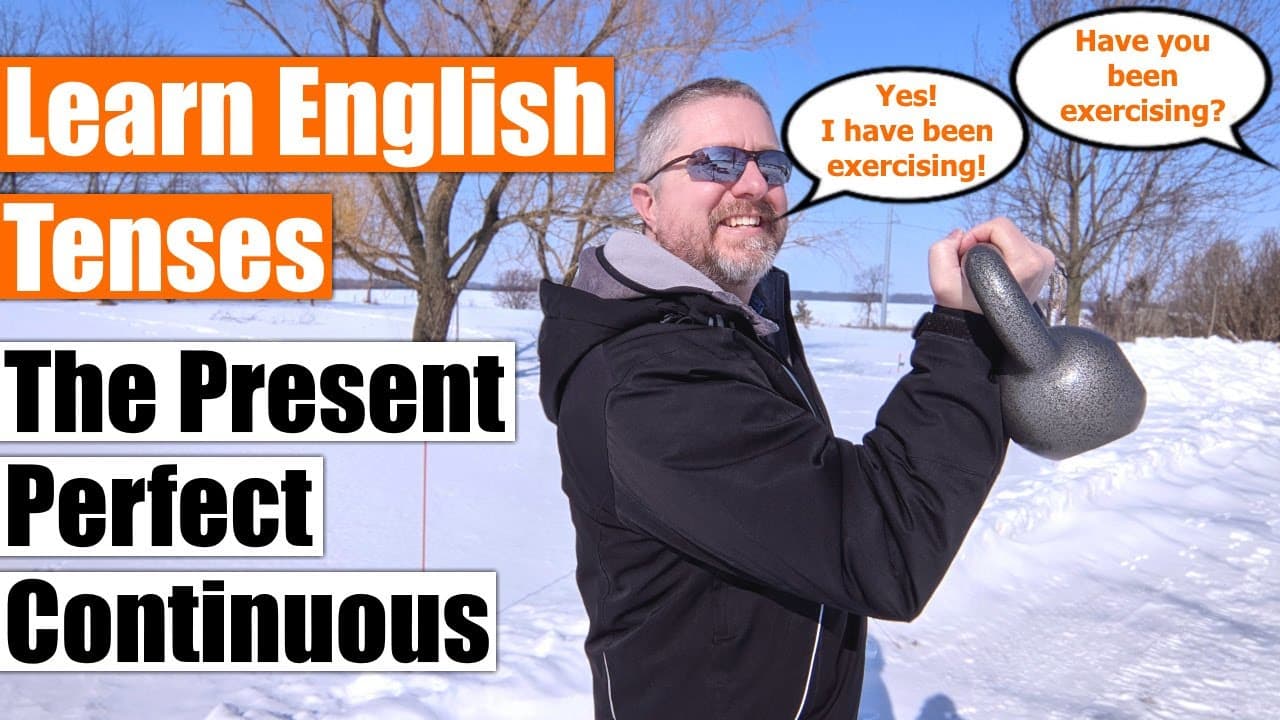
How to Use the Present Perfect Continuous Tense
TL;DR
The present perfect continuous tense describes actions that started in the past and continue to the present. To form it, use the subject, 'have,' 'been,' and the verb ending in 'ing.' This tense is useful for indicating ongoing activities, recent actions, and providing reasons for statements.
Transcript
(boots squeaking) Hello there. I've been running for 10 minutes. Whew. Ha, now I'm out of breath because I've been running. (cheerful instrumental music) Well, hello and welcome to this English lesson where I'm going to help you learn the English verb conjugation that we call the present perfect continuous. This is a verb conjugation that we use wh... Read More
Key Insights
- 💯 Present perfect continuous indicates ongoing past actions.
- ❤️🩹 Conjugation involves the subject, 'have,' 'been,' and verb with 'ing' ending.
- 🍝 It is used for actions that began in the past, ongoing or recent activities, and giving reasons for statements.
- 😯 Pronunciation often contracts 'been' to 'bin' in speech for quick communication.
- 😒 Negative sentences in present perfect continuous use 'not' between 'have' and 'been.'
Install to Summarize YouTube Videos and Get Transcripts
Explore YouTube Video Summarizer or Get YouTube Transcript Extractor
Questions & Answers
Q: How is the present perfect continuous conjugated?
It is formed by using subjects (I, you, he, she, we, they), 'have,' 'been,' and verb with 'ing' ending to denote ongoing actions.
Q: When is the present perfect continuous used?
It is used for actions that began in the past and are continuing, recent activities indicated by 'lately' or 'recently,' and to give reasons for statements.
Q: How do you form negative sentences in the present perfect continuous?
Negative sentences are formed by placing 'not' between the conjugation of 'have' and 'been,' such as "I have not been exercising lately."
Q: How are questions structured in the present perfect continuous?
Questions are formed by inverting the subject and 'have been' to ask if the action has been ongoing, like "Have you been eating healthy food lately?"
Summary & Key Takeaways
-
Present perfect continuous is used to talk about actions that started in the past and are ongoing now.
-
Conjugation involves the subject, 'have,' 'been,' and verb with 'ing' ending.
-
It is used for ongoing actions, recent activities, and to give reasons for statements.
Read in Other Languages (beta)
Share This Summary 📚
Summarize YouTube Videos and Get Video Transcripts with 1-Click
Try YouTube Summary with ChatGPT & Claude or YouTube Transcript Generator
Explore More Summaries from Learn English with Bob the Canadian 📚




Summarize YouTube Videos and Get Video Transcripts with 1-Click
Try YouTube Summary with ChatGPT & Claude or YouTube Transcript Generator